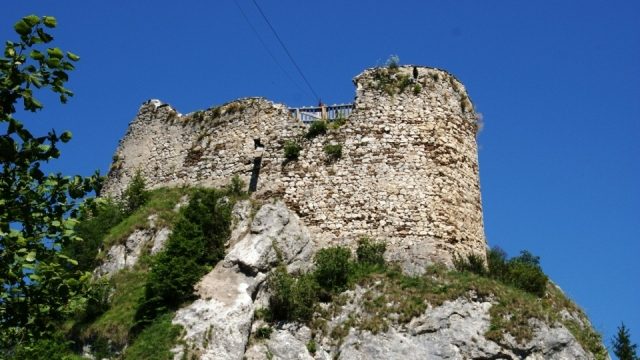
CastleEppenstein

Eppenstein Castle

Eppenstein Castle

The remains of the Castle can be visited

Eppenstein Castle is a medieval castle ruin above the village of Eppenstein in western Upper Styria. The area belongs to the Murtal district.

The former hilltop castle is located directly above the village of Eppenstein on a steep rock spur at an altitude of around 736 meters above sea level. In the Middle Ages, an important north-south trade route over the Obdacher Sattel passed below the castle – in the narrow Granitzental valley.

Eppenstein Castle is first mentioned in a document in 1160 as being in the possession of the noble family of the Traungauer. However, it probably dates back to a wooden castle built in the 10th century. The Margraves of Eppenstein named themselves after this castle (cf. Eppensteiner). However, the family died out as early as 1122 and the castle came into the possession of the Wildonier family. When they participated in a conspiracy against the Bohemian King Ottokar, the castle was expropriated and occupied by followers of the king, who ruled parts of Austria during the Interregnum.

After Ottokar's defeat against the Habsburgs in the Battle of Marchfeld in 1278, the Wildonier managed to reoccupy the castle. Ottokar's followers who remained in the castle were all slaughtered, but the castle soon fell into other hands: the Carinthian dukes, the families Colledo, Nádasdy, Pranckh, Sessler, Graben and others followed as lords of the castle. In 1478, the castle was extensively rebuilt in the Gothic style, but changed owners more frequently again. Among other things, it was conquered by a Hungarian army. The castle was actually considered impregnable and only fell through betrayal. After a devastating fire and an earthquake, the castle was rebuilt, but became obsolete with the construction of Neu-Eppenstein Castle. It fell into the state it is in today. Currently, the Eppenstein Castle Association is trying to renovate and restore the ruin.

Layout+

The castle is designed as a hilltop and ring castle. The keep stood centrally on the highest point of the rock. Since it was a hilltop castle, the construction of an additional motte was not necessary. The keep was surrounded by a pentagonal curtain wall. The massive gatehouse was secured by a moat that could be crossed by means of a drawbridge. The gatehouse and the palas with the keep represented the most massive defensive structures of the castle. The curtain wall primarily protected the economic buildings existing within the castle. In Gothic times, two bastions were also built to accommodate artillery. Access to the castle is only possible via a narrow path. Hence the assumption at the time that the castle was impregnable.

Take Mobile History with you

You are reading this text for free. Premium adds what matters on the road: descriptions read aloud, sites found through your camera, whole regions taken offline.

  • Every description, including the ~17,700 Premium sites
  • Audio guide: have descriptions read to you on location
  • AR finder: see sites through your camera, with distance and bearing
  • Unlimited saved sites

14 days free, then from €2.99 a month. Cancel anytime.

Source: Wikipedia · Licence: CC BY-SA 4.0 · Image: http://www.wehrbauten.at

This description draws on the facts documented in the linked Wikipedia article; Wikipedia content is licensed under CC BY-SA 4.0. Wording and editing: Mobile History.

Location: 47.1308, 14.7361