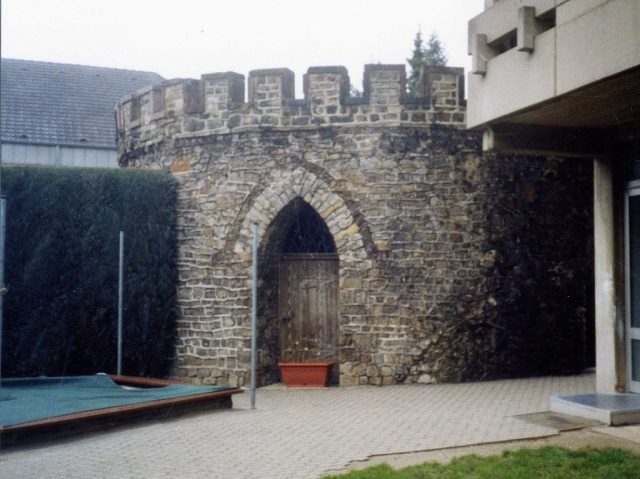
RuinEschweiler

Eschweiler Castle

Eschweiler Castle

The remains of the Castle can be visited

Eschweiler Castle is a former moated castle in the city center of Eschweiler in the Rhineland, on what is now Dechant-Deckers-Straße. Only three of its round towers, which have been listed as historical monuments since 1992, remain, as the castle grounds were built over in 1967 with modern hospital buildings of the St. Antonius Hospital.

Residents and Owners+

Before the construction of Eschweiler Castle, there was already a building on the site that served as the official residence for the bailiff appointed by the Cologne Cathedral Chapter. The first bailiff mentioned in documents was Wilhelm von Eschweiler in 1145.

In 1429, Eschweiler Castle was owned by the Jülich hereditary marshal Frambach von Birgel. In 1572, the feudal relationship of Eschweiler Castle to the Duchy of Jülich expired, and the knight's seat and the cathedral court were subsequently subject to the Mannkammer zu Aldenhoven.

In the first half of the 17th century, the von Hetzingen family owned Eschweiler Castle. From 1654, the complex came into the possession of the von Hompesch family, an old Rhenish noble family, for almost 180 years. In 1898, Hompeschstraße, formerly Hompeschgärten, was named after them in Eschweiler-Mitte. The first lord of the castle was Karl Kaspar Hompesch.

When Wilhelm Graf von Hompesch-Bollheim died in 1830, the castle came into the possession of the Palatinate captain Carl Englerth, who was the first mayor of Eschweiler. His son Friedrich Englerth built a new, cube-shaped residential house on the foundations of the old castle complex, which was popularly known as "Kaffeemöll". The new building was occupied in 1845, although it was not yet completed.

In August 1858, the Catholic parish of St. Peter and Paul acquired the area for 16,000 thalers to establish a hospital in the buildings.

Construction History+

Although neither a precise date of origin nor a builder is known, historians assume, based on the former architectural style, that the first Eschweiler castle complex dates from the 13th or 14th century. A ring wall with six round towers, which had a wall thickness of two meters, enclosed an area of 197 by 93 meters. The manor house had a square floor plan of 21 by 21 meters and was surrounded by a moat fed by a side arm of the Inde river.

During the Thirty Years' War, after the Battle of Kempen Heath, Eschweiler and its castle were conquered in 1642 by troops from Hesse, Weimar, and France. Although the owners were able to retain possession, they lacked the financial means to repair damage or even to have new buildings erected.

Around 1800, a large part of the complex was demolished due to dilapidation, during which the old castle dungeon under the southeastern tower was discovered. Only the round towers with their surrounding wall and the outbuildings were spared from demolition. In 1840, the south tower housed a pump house.

Around 1845, Friedrich Englerth had a new residential building designed according to the romantic ideas of the time. He hired Friedrich Heinrich Exner as the architect, who equipped the towers of the house with battlements and loopholes.

After acquiring the castle, the parish of St. Peter and Paul had several new buildings erected on the site, such as a chapel in 1892 and a large extension wing in 1926.

In mid-1967, the castle buildings had to make way for a new building of the St. Antonius Hospital. With the exception of three round corner towers, the surrounding wall, and an outbuilding, the old building fabric was demolished. This outbuilding, used for many years as an isolation ward, was replaced in August 2005 by the new radiology building. During the demolition, a part of the original castle wall was uncovered. Until the 1980s, the mortuary of the hospital was located in the southeast tower.

Legend+

There is a legend about a ghost in Eschweiler Castle that roamed there for a long time. This ghost always tapped the residents on the shoulder when they fetched water from the well and haunted the castle at night, starting from a certain room. The residents then sold the castle.

The new owner was a brave nobleman and began to investigate the mystery of the ghost. One night, he sat in the room from which the haunting always originated. At midnight precisely, a white-clad, ghostly figure appeared to him and beckoned the lord of the castle to follow her. The ghost led him through all the rooms to the cellar, where the nobleman found a large key. Then the white figure led him further through the cellar vaults to a locked trapdoor. The lord of the castle opened it with the key he had found and followed the ghost into a room below, in the middle of which stood three vessels. Upon closer inspection, the nobleman noticed that they were filled with gold and all sorts of precious jewels. At the same moment, he heard a deep, relieved sigh, and when he turned around, the mysterious figure had disappeared.

From that moment on, the ghost no longer appeared, for it had found a person who had been bold enough to follow it and thus discover the treasure. This treasure had once been hidden there by three sisters who had since died, without ever entrusting their secret to anyone during their lifetime. The last to die, however, found no rest in her grave and went every night in search of a man who was bold enough to follow her, so that she could hand over the treasure to him. Her spirit was now redeemed, and the gifted lord of the castle used the money for the benefit of the poor in the village.

Take Mobile History with you

You are reading this text for free. Premium adds what matters on the road: descriptions read aloud, sites found through your camera, whole regions taken offline.

  • Every description, including the ~17,700 Premium sites
  • Audio guide: have descriptions read to you on location
  • AR finder: see sites through your camera, with distance and bearing
  • Unlimited saved sites

14 days free, then from €2.99 a month. Cancel anytime.

Source: Wikipedia · Licence: CC BY-SA 4.0 · Image: http://de.wikipedia.org/wiki/Datei:Ewburgsoturm.jpg

This description draws on the facts documented in the linked Wikipedia article; Wikipedia content is licensed under CC BY-SA 4.0. Wording and editing: Mobile History.

Location: 50.8180, 6.2646