CastleBad Wildbad-Aichelberg

Fautsburg Castle
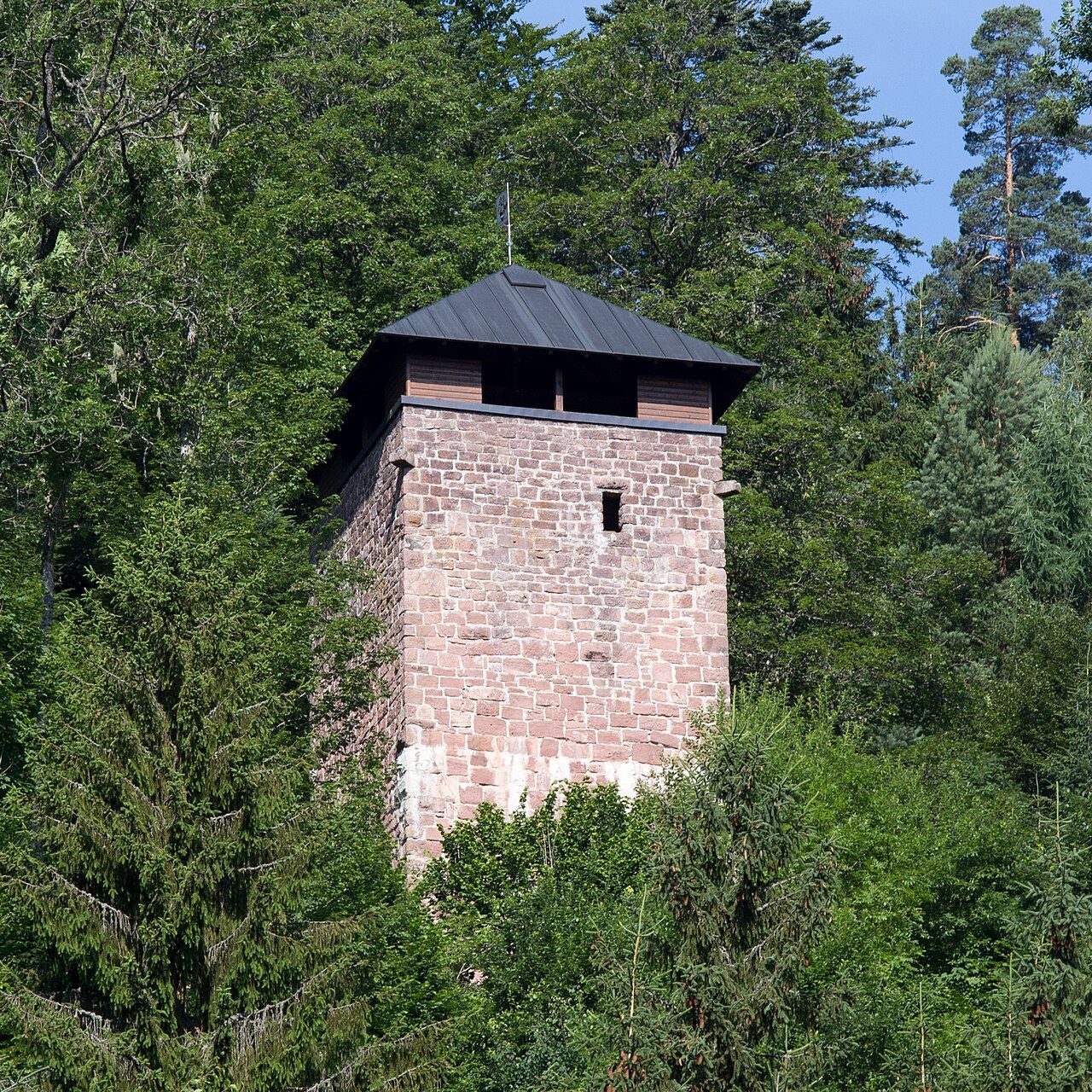
Fautsburg Castle

The remains of the Castle can be visited

The Fautsburg is a castle ruin above the Rehmühle in the Aichelberg district of the city of Bad Wildbad in the Calw district of Baden-Württemberg. Of the hilltop castle, no visible traces remain except for the keep and some wall remnants.

It is presumed that the castle was built by the Counts of Calw, as the castle is mentioned as being in their possession in 1276. The castle may have been built by the Counts of Hohenberg at the end of the 12th or beginning of the 13th century. Several documents from this period indicate a ministerial seat of the Knights of Vogtesberg. Their heirs, the Lords of Hornberg, sold half of the castle in 1323 for 300 pounds Heller to Count Eberhard of Württemberg. The other half later came into the possession of the House of Württemberg via Count Palatine Rudolf IV of Tübingen. The administration of the castle was entrusted to the lower nobility of the region. In 1476, Count Eberhard of Württemberg granted Dean Count Johann of Helfenstein refuge in the castle from the Bishop of Strasbourg, Rupprecht, whom he had previously criticized. In 1561, the reformer Johannes Brenz received the Fautsburg as a fief. In 1570, Brenz returned the fief to the Württembergers. In the same year, Duke Ludwig of Württemberg enfeoffed Hirsau Monastery with the property. In 1594, the forester Eberhard Zangmeister was enfeoffed with the estate by Duke Friedrich of Württemberg, which fell back to Württemberg in 1603. In 1604, a forest worker was mentioned as an inhabitant of the already dilapidated Fautsberg. Later, it came into the possession of the Rehmüller family, who used the walls as a quarry. In the mid-19th century, the forest use rights were bought by the state and redistributed. The property with the Fautsburg was assigned to Johann Georg Rentschler. In 1910 and 1939, initial preservation work was carried out on the ruin, and in 1967, it was made accessible to the public, although shortly thereafter the walls became overgrown again and fell into oblivion. In 2000, the castle was uncovered again, and in 2004, the first castle festival was held.

Layout+

Today, the keep, used as a lookout tower, and some wall remnants are preserved. A superficial examination of the castle complex took place in 1930. West of the tower, there was likely a shield wall with a wall thickness of three meters. Since no interlocking with the tower could be determined in 1930, the wall is likely younger than the tower. The palas was probably connected to the shield wall, and the economic buildings were opposite. A gate zwinger was found in the northeast.

Take Mobile History with you

You are reading this text for free. Premium adds what matters on the road: descriptions read aloud, sites found through your camera, whole regions taken offline.

  • Every description, including the ~17,700 Premium sites
  • Audio guide: have descriptions read to you on location
  • AR finder: see sites through your camera, with distance and bearing
  • Unlimited saved sites

14 days free, then from €2.99 a month. Cancel anytime.

Source: Wikipedia · Licence: CC BY-SA 4.0 · Image: Stefan Karl / CC BY-SA 4.0 via Wikimedia Commons

This description draws on the facts documented in the linked Wikipedia article; Wikipedia content is licensed under CC BY-SA 4.0. Wording and editing: Mobile History.

Location: 48.6662, 8.5459