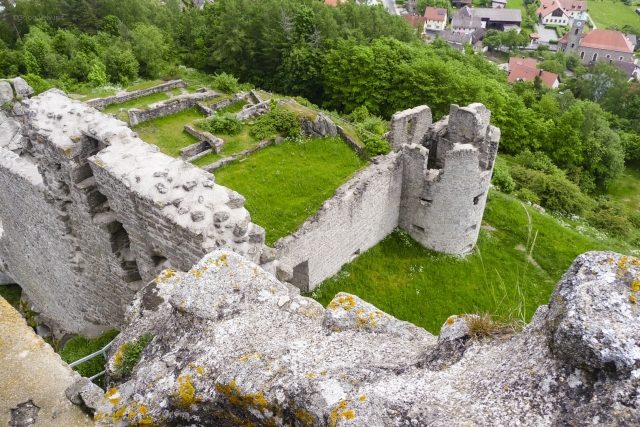
The remains of the Castle can be visited
Flossenbürg Castle

Flossenbürg Castle is a former high medieval noble castle, which rises high above the Upper Palatinate municipality of Flossenbürg in the district of Neustadt an der Waldnaab in Bavaria on a bare granite rock.
The castle ruins of the summit castle are freely accessible at all times.
The castle ruins are located immediately northwest of the village of Flossenbürg on the highest point of the 732-meter-high Flossenbürg Schlossberg, about 13 kilometers east of Neustadt an der Waldnaab in the Upper Palatinate Forest. It is divided into a main castle on the rocky summit, and a large outer bailey, which is located southeast below the summit.
The ruins are located within the "Schlossberg Flossenbürg" nature reserve (identifier NSG-00010.01). Nearby are the ruins of Schellenberg Castle to the east, the Haselstein motte to the northwest, and the Leuchtenberg castle ruins to the south.
The castle was founded around 1100 by Count Berengar of Sulzbach and initially consisted only of a residential tower with a high curtain wall, the so-called "Hoher Mantel". In the 13th century, the out-lying keep was added, while the gate systems only date from the 16th century.
Over the centuries, the castle changed owners several times. The most famous owners were Emperor Frederick Barbarossa, the Dukes of Bavaria, the Bohemian Kings, and the Leuchtenbergers.
During the Thirty Years' War, in 1634, the castle complex was set on fire by the soldiers of Bernhard of Saxe-Weimar during their withdrawal. From then on, the castle increasingly lost its importance and served the surrounding area as a welcome source of building material. Thus, the castle complex continued to decay over the years.
Today, only ruins of the castle remain. In the 1980s, systematic conservation of the remains began. During the restoration and excavation work, scientifically interesting finds, such as the remains of an oven and a cellar vault, were made.
The castle ruins are a well-known and popular excursion destination, especially because of the excellent view from the tower. To protect the surrounding beech forests with noble deciduous trees on the rock and block soils, the 21.2-hectare Schlosshänge natural forest reserve was designated in 1992. Below the castle, quarries were operated until the 1960s to extract the granite found there.
From 1938 to 1945, the Flossenbürg concentration camp existed east of the castle, where Flossenbürg granite was mined under inhumane working and living conditions at Wurmstein. It is now a memorial site.
Geotope+
Due to its dome-like shape and the striking segregation of the rock, the Schlossberg Flossenbürg is one of the most famous granite rocks in the Upper Palatinate. Especially in the summit area and on the west side of the mountain, the striking, onion-skin-like bedding is visible, which was probably caused by pressure relief. The Schlossberg has been designated as Geotope 374A009 by the Bavarian State Office for the Environment and awarded the official seal of quality "Bavaria's most beautiful geotopes". See also List of geotopes in the district of Neustadt an der Waldnaab.
Take Mobile History with you
You are reading this text for free. Premium adds what matters on the road: descriptions read aloud, sites found through your camera, whole regions taken offline.
- Every description, including the ~17,700 Premium sites
- Audio guide: have descriptions read to you on location
- AR finder: see sites through your camera, with distance and bearing
- Unlimited saved sites
14 days free, then from €2.99 a month. Cancel anytime.
Source: Wikipedia · Licence: CC BY-SA 4.0 · Image: Google Hupf
This description draws on the facts documented in the linked Wikipedia article; Wikipedia content is licensed under CC BY-SA 4.0. Wording and editing: Mobile History.
Location: 49.7344, 12.3456