The remains of the Castle can be visited
CastleForchtenberg
Forchtenberg Castle
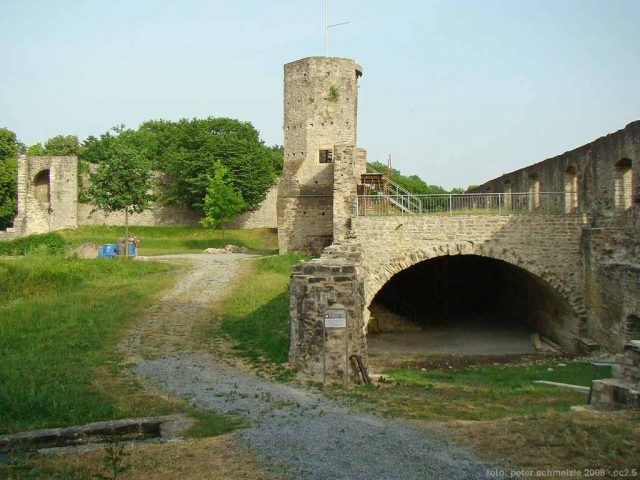
The castle ruin of Forchtenberg, a medieval complex, is located in Forchtenberg in the Hohenlohe district on a mountain spur above the Kocher river.
History+
The origins of Forchtenberg Castle date back to the early 13th century. Konrad von Dürn, who had acquired land on the Kocher through marriage, had the castle built to secure his possessions. Construction was completed by 1234. The town of Forchtenberg, located below the castle, was founded in the course of its construction, while the older Wülfingen was abandoned. After Konrad's childless grandson Ruprecht, the castle passed to Kraft II von Hohenlohe in 1323. The Hohenlohe family used the complex temporarily as a residence and dower house, later as an administrative seat and storage facility for tithes. During the Renaissance, the castle was expanded in a palatial style. However, it was largely destroyed by Swedish troops during the Thirty Years' War. The administrative seat was then moved to the town. Only the large vaulted cellar was extended after 1680 and continued to be used for storing wine tithes. The tower visible today dates from this period and was built with stones from the former castle walls.
Source: Wikipedia · Licence: CC BY-SA 4.0 · Image: https://commons.wikimedia.org/wiki/File:Forchtenberg-burg1.jpg
This description draws on the facts documented in the linked Wikipedia article; Wikipedia content is licensed under CC BY-SA 4.0. Wording and editing: Mobile History.
Location: 49.2879, 9.5651