CastleStuttgart-Feuerbach

Frauenberg Castle
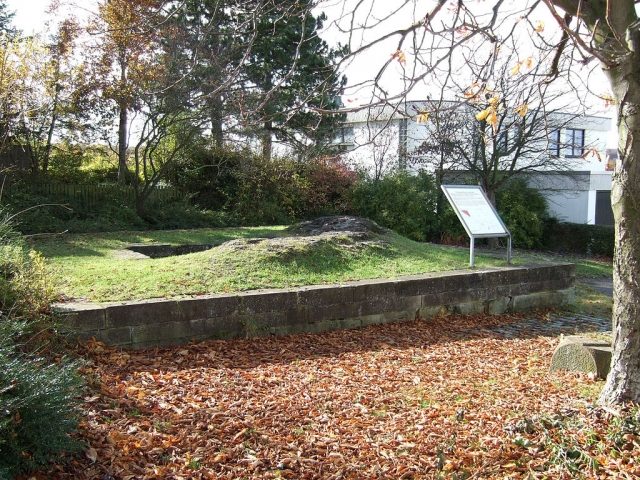
Frauenberg Castle

The remains of the Castle can be visited

Frauenberg Castle is a ruin in the Feuerbach district of Stuttgart. The hilltop castle was built in the early 13th century. The central tower was about 20 m high. The small interior - still visible today - served as a prison around 1390. The walls measured between 3 and 3.8 m thick. From the end of the 14th century, seven families became co-owners. However, the castle was demolished as early as the beginning of the 16th century, and it was not until 1971 that wall remains were discovered, which were secured and surrounded by an enclosure in 1973.

Location+

The castle was situated on a hill above the village of Fürbach (Feuerbach) in the valley of the same name, thus controlling the heavily trafficked trade route between Hohenneuffen and Asperg that ran through the Feuerbach Valley.

Frauenberg Castle was first mentioned in a document on July 1, 1251. Stonemason marks on the ashlar stones indicate that the castle was already built in the Romanesque Staufer period between 1220 and 1250. The first known lord of the castle was Wolfram von Frauenberg.

The simple red and silver coat of arms of the Lords of Frauenberg was also the shield of the coat of arms of the city of Feuerbach (until 1933).

In addition to Feuerbach, the castle lords' possessions also included Botnang, Zazenhausen, and estates in Ditzingen and other places. In the late Middle Ages, the property was divided among several female collateral lines: the Lords of Helmstatt, the Schenken von Winterstetten, and other noble families. The castle became a Ganerbenburg (a castle owned jointly by several families).

In 1390 or 1391, the two robber knights Wilhelm and Peter von Helmstatt, who lived in the castle, ambushed some Cologne merchants traveling through the Feuerbach Valley and locked them in the tower dungeon to extort ransom. When the sovereign, Count Eberhard II of Württemberg, learned of this, he confiscated the castle, but later returned it as a fief to the castle residents. This secured the Count considerable influence over the previously independent Frauenberg Castle, which further increased through the sale of individual co-heirs' shares. In 1481, Count Eberhard im Bart also bought the halves of the castle, the village of Feuerbach, and the hamlet of Botnang that were still in the joint possession of the Frauenberg heirs, thus bringing the entire lordship under Württemberg. The brothers Conrad and Bernhard Schenk von Winterstetten are named as the selling co-heir owners of that half, as well as Martin and Eberhardt von Heusenstamm together with their uncle Eucharius von Venningen, to whom the latter's father or grandfather Johann von Venningen, Palatine Vitztum in Neustadt an der Weinstraße, had bequeathed this partial possession from the inheritance of his wife Adelheid von Frauenberg.

Frauenberg Castle fell into disrepair and was exploited as a quarry, primarily for the construction of the Stuttgart city wall. By the beginning of the 16th century, no visible remains of the complex were left.

Despite warnings from the State Office for Monument Preservation and the City Archives, the Stuttgart city council drew up a development plan in the late 1960s. When the first excavator arrived in 1971, Staufer ashlar stones were discovered. In a clandestine operation, plots of land were exchanged to preserve at least the foundations of the castle tower. These are now the only remains of the castle and can be viewed at the turning circle of the street "An der Burg".

Take Mobile History with you

You are reading this text for free. Premium adds what matters on the road: descriptions read aloud, sites found through your camera, whole regions taken offline.

  • Every description, including the ~17,700 Premium sites
  • Audio guide: have descriptions read to you on location
  • AR finder: see sites through your camera, with distance and bearing
  • Unlimited saved sites

14 days free, then from €2.99 a month. Cancel anytime.

Source: Wikipedia · Licence: CC BY-SA 4.0 · Image: http://de.wikipedia.org/w/index.php?title=Datei:Reste_der_Burg_Frauenberg.JPG&filetimestamp=20100205105348&

This description draws on the facts documented in the linked Wikipedia article; Wikipedia content is licensed under CC BY-SA 4.0. Wording and editing: Mobile History.

Location: 48.8012, 9.1593