CastleOberdiebach

Fürstenberg Castle

Fürstenberg Castle

The remains of the Castle can be visited


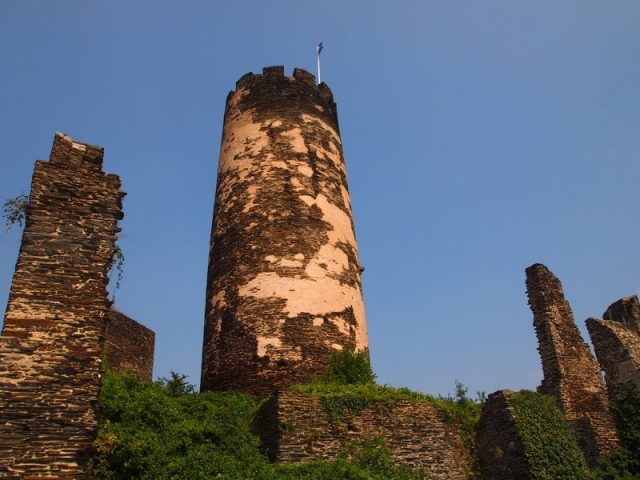
Fürstenberg Castle is a medieval castle ruin near Rheindiebach, a district of Oberdiebach in the Mainz-Bingen district in Rhineland-Palatinate, Germany. Since 2002, the hilltop castle Fürstenberg has been part of the UNESCO World Heritage Upper Middle Rhine Valley.

The hillside castle is located at 152 m above sea level above Rheindiebach in the Upper Middle Rhine Valley on the Middle Rhine near Bingen. On the mountain side, it was secured by a neck ditch and a up to ten meter high shield wall with a keep behind it. Access was via a bridge (now renewed) with a gatehouse.

From the viewing terrace, a wide view opens over the Rhine to the north on the left bank up to Bacharach, and on the right bank to the southeast to the Nollig castle ruin, to Lorch, and to the vineyards of the Rheingau, which begin south of Lorch.

Fürstenberg was built in 1219 on behalf of Archbishop Engelbert von Berg to secure the Cologne electoral possessions around Bacharach. As early as 1243, it became a fief of the Electors Palatine, who finally acquired it by purchase in 1410. In the 15th century, a tower was added to the bend side of the curtain wall, allowing the wall to be flanked by firearms. During the Thirty Years' War, the castle was conquered by the Spanish in 1620 and by the Swedes in 1632. In the War of the Palatine Succession, the French finally destroyed Fürstenberg in 1689, like many other castle complexes in the region, which has been a ruin ever since. In contrast to most castles in the Upper Middle Rhine Valley, no reconstruction took place here in the 19th century, so that original medieval masonry with plaster and paint residues was preserved in the ruin.

Initially, in 1844, the widow of King Friedrich Wilhelm III of Prussia, Princess Auguste von Liegnitz, had tried in vain to acquire the castle. This was achieved in 1845 by her son-in-law, Prince Friedrich of the Netherlands. Auguste's daughter Luise was the sister of the reigning King Friedrich Wilhelm IV. Prince Friedrich of the Netherlands gifted the castle complex to his wife on February 1, 1846. Luise planned to expand the ruin into a magnificent castle in neo-Gothic forms, which would have stood up to comparison with the castles and palaces of Stolzenfels, Rheinstein, Sooneck, and Sayn in terms of art and cultural history. The architect C. de Jong drew the plans in 1849, which are now in the archive of the Prince zu Wied family (Neuwied). For unknown reasons, the execution did not take place, which, although it would have paid little regard to the existing medieval castle stock, would otherwise have resulted in one of the most elegant castle expansions on the Rhine.

After the death of the couple, the ruin came into the possession of their only surviving daughter, Princess Marie zu Wied. In 1910, the ruin was sold to the Wasum family from Bacharach. In 1993, Gernot Stelter from Rheindiebach bought it and, in cooperation with the State Office for Monument Preservation Rhineland-Palatinate, began extensive measures to preserve the masonry.

Today+

The castle is closed for visits during the renovation work. Unofficially, it can be entered through an opening on the side above the access road through the Riesling slopes of the Oberdiebacher Fürstenberg site (closed to vehicles), which, however, requires some climbing over unsecured terrain. The area is completely overgrown and nature has taken its course.

Take Mobile History with you

You are reading this text for free. Premium adds what matters on the road: descriptions read aloud, sites found through your camera, whole regions taken offline.

  • Every description, including the ~17,700 Premium sites
  • Audio guide: have descriptions read to you on location
  • AR finder: see sites through your camera, with distance and bearing
  • Unlimited saved sites

14 days free, then from €2.99 a month. Cancel anytime.

Source: Wikipedia · Licence: CC BY-SA 4.0 · Image: http://www.wehrbauten.de/thread.php?threadid=899&sid=246e8c9fdbfa80ccf9a3497b2adfd6ed

This description draws on the facts documented in the linked Wikipedia article; Wikipedia content is licensed under CC BY-SA 4.0. Wording and editing: Mobile History.

Location: 50.0417, 7.7874