Castle ruins can be visited
CastleBlaubeuren - Beiningen
Gleißenburg Castle
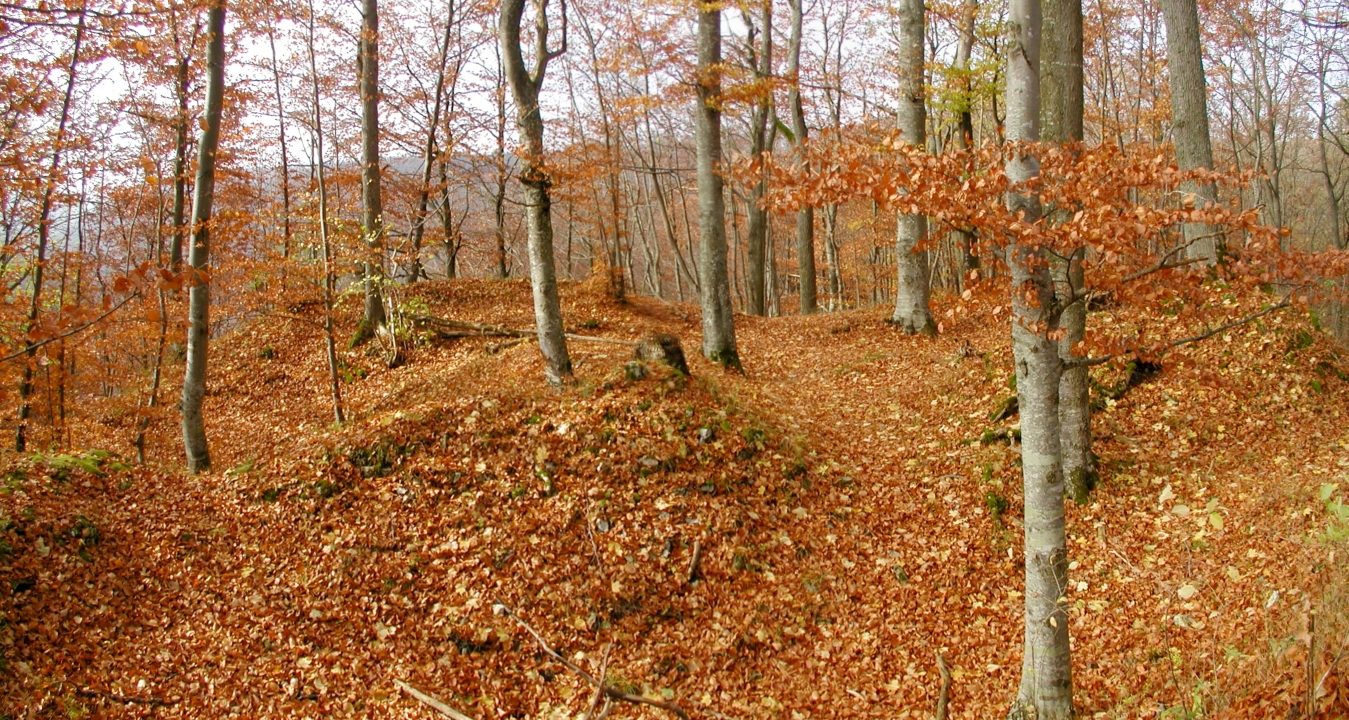
The Gleißenburg ruin is the ruin of a hilltop castle on a 640 m above sea level high rock spur above the Höllental west of Beiningen, a district of Blaubeuren in the Alb-Donau-Kreis in Baden-Württemberg.
Geographical Location+
The Höllental begins as a narrow dry valley with beautiful rock formations in the east in the vicinity of the ruin, flows into the Riedental and later opens into a wide, cultivated plain into the Achtal opposite the Sirgenstein. From the Sirgenstein (Sirgenstein Castle), which also bore a castle, all movements through the Achtal and from the Höllental could be monitored.
History+
In written tradition, the lower nobleman Ruland von Überkingen is first mentioned in 1376 as "seated at Gleißenburg". Ruland von Überkingen sold the castle before 1380 for 500 pounds Heller. In 1380, the widow Nesa von Gundelfingen sold the castle with an associated building and accessories to Hans von Westerstetten. As early as 1408, Eitel Hans von Wernau is mentioned as a witness to a document after Gleißenburg. The lower nobility of Wernau may have owned the castle as their own. At least in 1424, "Eitel von Werdenow gave Duke Friedrich of Austria his half of Veste Gleyssenburg" including accessories as a fief. The second half of the legal complex must also have been enfeoffed to the Habsburgs, who later owned the entire castle. The Habsburgs reserved the right of opening, i.e. the use of the complex for their own troops, when further enfeoffing the castle. In the middle of the 15th century, Gleißenburg was captured and damaged by the imperial city of Ulm in the so-called Städtekrieg (City War). In the subsequent legal dispute, Wolf von Wernau received the castle back in 1458 and was awarded damages. Further owners were the Lords of Altmannshofen, von Villenbach, the sub-bailiff of Blaubeuren Albrecht Heinrichmann, and finally Hans Späth von Schülzburg. The latter sold the castle in 1506 to the Blaubeuren Hospital, where it remained until its end. As late as 1662, the tenant farmer on the neighboring Gleißenburg estate was supposed to cover the construction costs of the castle. In the course of the following 100 years, however, the castle seems to have been abandoned, because in 1772 there is no longer any mention of it.
Source: Wikipedia · Licence: CC BY-SA 4.0 · Image: Karle3 · Wikimedia Commons · CC BY-SA 3.0 de
This description is a machine translation of an excerpt from the linked Wikipedia article. The source text was written by its authors, the translation is by Mobile History; like the original it is licensed under CC BY-SA 4.0.
Location: 48.3772, 9.7912