CastleHofkirchen im Mühlkreis

Haichenbach Castle
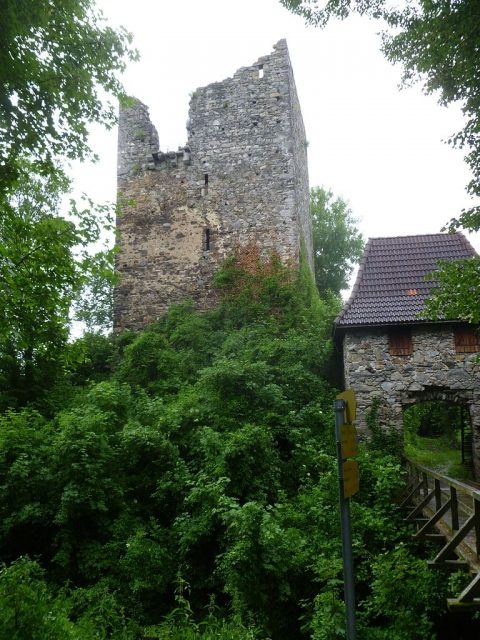
Haichenbach Castle

The remains of the Castle can be visited


Haichenbach Castle Ruin, also known as Kerschbaumerschlössl, is located in the municipality of Hofkirchen im Mühlkreis in the Rohrbach district in Upper Austria's Mühlviertel region.

The former hilltop castle is situated at an altitude of 450 m above sea level on the mountain ridge that forms the so-called Schlögener Schlinge (Schlögen Loop) on the Danube. The linear distance from the center of the market town of Hofkirchen is approximately 6.3 km in a south-westerly direction. The village opposite the castle ruin on the Danube is Schlögen. It can be reached from Freizell.

Description+

The former castle was an elongated complex on the narrow plateau of the mountain ridge in a north-south direction, with a total built-up area of 1,450 square meters. Behind the castle gate in the north stretched the very spacious outer bailey with servants' quarters. On its northeast side, the slightly higher main castle adjoined, which was dominated in the north by a residential tower, from which the castle gate located to the west below could also be defended. The fortified tower once had ten embrasures. Today, the re-roofed castle gate, parts of the curtain wall, and the restored and freely accessible residential tower are preserved, offering a unique view of the Danube valley.

The first documented mention of Haichenbach Castle (at that time: Eichenbach) dates back to 1160. Otto and Wernher de Eichenbach are mentioned at this time as representatives of the ministerial noble family that derived its name from the castle. Otto II was already calling himself von Haichenbach in 1220. In 1258, Rudin von Haichenbach sold the fortress to Wok von Rosenberg. In 1268, the castle belonged to Ulrich von Haichenbach. In 1273, the castle must have burned down for an unknown reason, because in 1274, Rueger von Haichenbach documented in Schlägl that, in return for his accommodation in the monastery hospital - during the time "haihenpach in paw" - he allowed the use of his forests. In 1303, Rueger von Haichenbach sold most of his property to the Diocese of Passau, and his son Rudel von Haichenbach also sold the remainder to Bishop Albert of Passau in 1337.

From this year on, the Diocese of Passau initially had the castle administered by caretakers, had to temporarily pledge the castle (in 1381 to the Schaunberger family), and then granted the castle as a fief: in 1429 to Knight Heinrich Nothaft as a life annuity, followed by his son († 1486), who did not leave Haichenbach until his death due to a dispute over the repayment of renovation costs. From 1491-1496, Haichenbach went to Simon Oberheimer for life. According to tradition, the Oberheimer family is said to have unlawfully enriched themselves in the following years through excessive tolls imposed on Danube boatmen. In 1516, the fief was revoked by Passau Bishop Wiguleus after complaints from the Passau boatmen.

In 1529, the diocesan administration decided to manage all episcopal property north of the Danube from Marsbach Castle. Haichenbach Castle was abandoned. Consequently, the name of the castle also fell into oblivion: in popular parlance, the castle ruin, surrounded by many legends, was called Kerschbaumerschlössl after the nearby Kerschbaumer farm. Since 1984, the Working Committee for Local Heritage Hofkirchen has undertaken renovation measures; the castle ruin can now be visited safely. The current owner is Georg Stradiot.

Take Mobile History with you

You are reading this text for free. Premium adds what matters on the road: descriptions read aloud, sites found through your camera, whole regions taken offline.

  • Every description, including the ~17,700 Premium sites
  • Audio guide: have descriptions read to you on location
  • AR finder: see sites through your camera, with distance and bearing
  • Unlimited saved sites

14 days free, then from €2.99 a month. Cancel anytime.

Source: Wikipedia · Licence: CC BY-SA 4.0 · Image: http://commons.wikimedia.org/wiki/File:Burgruine_Haichenbach-1.jpg

This description draws on the facts documented in the linked Wikipedia article; Wikipedia content is licensed under CC BY-SA 4.0. Wording and editing: Mobile History.

Location: 48.4347, 13.8550