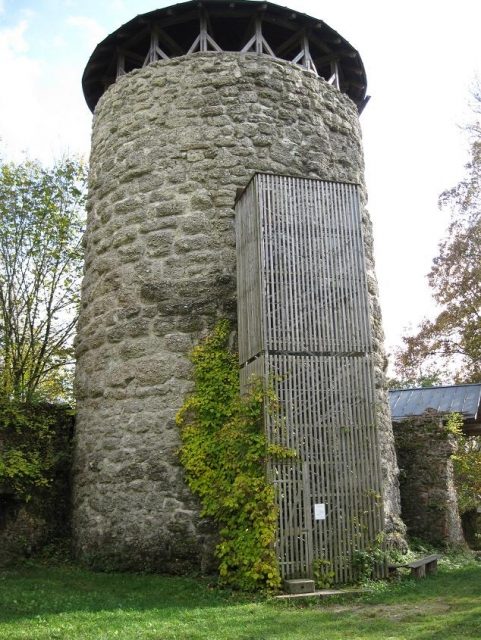
The remains of the Castle can be visited
Haltenberg Castle

Haltenberg Castle is the ruin of a hilltop castle on the steep bank of the Lech river between Scheuring and Kaufering in the district of Landsberg am Lech in Upper Bavaria. The complex is today the only castle ruin on the entire Lechrain between Donauwörth and Füssen.
A Konrad von Haltenberg first appears in a document in 1260 as a vassal of the last Staufer, Konradin. Later, members of this family also served the Dukes of Bavaria.
At the beginning of the 15th century, the Duke acquired half of the castle, which he resold in 1425 to the Augsburg patrician Peter Rehlinger.
The Rehlingers subsequently acquired the entire castle, which remained in the family's possession until the early 17th century.
In 1612, the later Elector Maximilian I finally bought the complex, which was then converted into a hunting lodge. The nearby Lech floodplains were particularly suitable for "heron hawking," i.e., falconry for herons. The nearby "Westerholz" also offered rich hunting grounds for the Munich court society, who arrived here via the Elector's Path.
However, the era of grand court hunts ended with the 18th century. The now superfluous hunting lodge was largely demolished. However, the former farmstead in the outer bailey has been preserved and is still in operation today. The castle grounds had been owned by the Lords of Thyssen since the 19th century.
In 1982, the district of Landsberg am Lech was able to acquire the main castle from the owners and began with the renovation of the complex. The remaining substance was secured and the keep was made accessible as an observation tower. The top of the tower was also bricked up and roofed. Until the renovation, the ruin was in a completely dilapidated state. A leaky water reservoir had been installed in the large keep, whose leaking contents caused considerable frost damage in winter.
Construction Description+
The castle is located above the Lech at the edge of the plateau. The rectangular main castle is protected to the north and east by an impressive, double ditch system. To the south, a simple neck ditch separates the main and outer bailey. The outer bailey is separated from the surrounding area by another outer ditch.
Today, one enters the castle ruin on the north side via an embankment, which offers good views of the ditch system. The plateau of the main castle is surrounded by the outer walls of the former palace. Above the conglomerate stone base, an upper floor of brick has been preserved. The inner courtyard is paved with Lech pebbles, which are largely hidden under a thin, grass-covered layer of earth. To the east, steps lead to the former cellar rooms, which, however, had to be filled in for conservation reasons.
In the southeast corner rises the mighty Romanesque keep. The round tower made of large conglomerate stone blocks has been cleared of rubble and partially supplemented in recent decades. The round-arched entrance opening at a height of about 8 meters is now accessible via a steel scaffolding. On weekends and public holidays, the tower can be climbed. However, the view of the Lech plain and the Alps is largely obstructed by tall trees.
The original main gate of the medieval castle was certainly on this side and was secured by the large outer bailey and the keep. For use as a hunting lodge, the entrance was moved to the other side. In place of today's embankment, a wooden bridge apparently led over the ditch at that time (Wening).
The manor house stood in the west directly above the steep drop. In the east, the servants' quarters were built directly onto the keep (gable approach recognizable). Between the main and outer bailey lie the ruins of the Romanesque-Gothic castle chapel, which was only destroyed after the Second World War.
The 18th-century hunting lodge is well documented by a view by Michael Wening (1726). The copper engraving shows the castle from the northeast in a bird's-eye view. A narrow Zwinger with some rectangular towers surrounded the main castle. The elongated buildings had simple gable roofs, the keep a high spire. The double ditch system and the choir of the chapel are clearly recognizable.
This chapel was well preserved until after the war. The originally Romanesque building, dedicated to Saint Erasmus, was raised and extended in Gothic times. Later, the small church was baroqueized and stuccoed (Wessobrunn masters).
Around 1960, a conglomerate stone block detached from the masonry of the adjacent keep and broke through the roof of the chapel. However, rumors persist among the population to this day that some local lads had helped a little here for money. The owner was said to have found the building maintenance bothersome. Later, the vault completely collapsed. During the restoration of the castle, the ruin was protected by an emergency roof and the remains of the stucco work were salvaged from the rubble.
The ruin is now owned by the district of Landsberg am Lech and is freely accessible. The outer bailey is privately owned and serves as an agricultural estate.
About two kilometers south of the castle, on the Lechhofufer, the earthworks of two pre- to high-medieval fortifications are recognizable (redoubts in the Westerholz). Another castle site north of Haltenberg was largely built over with the Lichtenberg estate.
Take Mobile History with you
You are reading this text for free. Premium adds what matters on the road: descriptions read aloud, sites found through your camera, whole regions taken offline.
- Every description, including the ~17,700 Premium sites
- Audio guide: have descriptions read to you on location
- AR finder: see sites through your camera, with distance and bearing
- Unlimited saved sites
14 days free, then from €2.99 a month. Cancel anytime.
Source: Wikipedia · Licence: CC BY-SA 4.0 · Image: hubi1802
This description draws on the facts documented in the linked Wikipedia article; Wikipedia content is licensed under CC BY-SA 4.0. Wording and editing: Mobile History.
Location: 48.1390, 10.8676