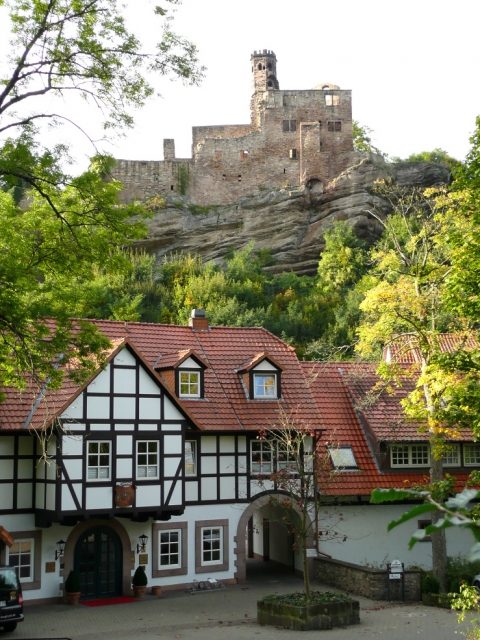
The remains of the Castle can be visited
Hardenberg Castle

Hardenberg Castle is the ruin of a rock castle near Nörten-Hardenberg. The castle was built on a rocky outcrop with steeply sloping rock faces. Today, its remains give the impression of a romantic castle ruin.
It is a double castle, named Vorderhaus and Hinterhaus Hardenberg. One line inhabited the older part of the castle complex, the so-called Hinterhaus. The other line inhabited the northern part, the Vorderhaus. To maintain peace and comply with obligations, both parties concluded a castle peace agreement. Both castle areas were separated by a moat, over which a wooden bridge led. Neither part of the castle has the usual keep, as this was not customary for castles in ecclesiastical possession. Access is only possible via the north side over the moat. Today, the castle ruin may not be entered without supervision due to dilapidation and other dangers. Visits and climbing the observation tower are possible as part of guided tours.
Middle Ages
The castle was founded by the Archdiocese of Mainz to monitor two trade routes. Around 1101, the fortified complex was first documented as "Vestes Haus". In 1098, Archbishop Ruthard of Mainz sought protection from Salian Henry IV at the castle. In the mid-13th century, the Lords of Rosdorf were ministerials of Mainz. In 1287, the castle was besieged by Dukes Henry, Albrecht, and Wilhelm of Brunswick. In the same year, it was pledged for a high sum. The possession did not coincidentally fall to the Counts of Hardenberg, who had often been in the favor of the Archbishops of Mainz before. From them, the Hardenbergs acquired considerable estates, including the castle and the village of Nörten in 1287.
The Lords of Hardenberg now appeared as owners of the castle. They had previously called themselves de Novalis. Bernhard de Novalis had sons Günther and Hermann. The unchallenged position that the Lords of Hardenberg held in the following years also resulted from Archbishop Henry III of Mainz confirming the pledging of the castle and the village of Nörten to them in 1345. His successor Gerlach did the same in 1357. Over time, the Hardenbergs developed complete freedom of action and probably inhabited the castle alone. In 1375, Duke Albrecht of Brunswick-Grubenhagen pledged to protect the Hardenbergs for life, in return for which he received free access to the castle. In the meantime, two lines of the Hardenbergs had formed, which sometimes led to disputes regarding the castle. A division of family property took place in 1409 by Dietrich von Hardenberg, which led to the formation of the Vorderhaus and Hinterhaus branches. The division also affected the castle; in 1430, a dispute arose between Hildebrand von Hardenberg and his cousin Dietrich, also concerning "the grave to Hardinberghe twyschen syner borgh vnde myner, dar ek meine, dat der graven myn were." According to a legend, a feud led to the coat of arms of the Hardenberg family, the boar's head. During a siege of the castle by the Lords of Plesse Castle, a nocturnal attack occurred. A boar is said to have woken the castle inhabitants with loud grunting. The Hardenberg family had already split into two factions around 1403 due to an inheritance contract. This also had an impact on their noble seat, which became a double castle.
Modern Era
The count's private tutor described how in March 1698, during a great thunderstorm, the Vorderhaus gave way and collapsed. The "Vorderhaus" line moved to nearby Göttingen and around 1710 moved into the newly built Hardenberg Castle at the foot of the mountain. The "Hinterhaus" line left the castle in 1720.
In 1840, the castle was renovated, but a drawbridge, an entrance gate, and a new tower in the Neo-Gothic style were also built. From 1962, the castle was again renovated and excavations were also carried out.
Today
Hardenberg Castle was a popular excursion destination for Göttingen students until the 20th century. On May 13, 1848, the Burschenschaft Hannovera student fraternity, which still exists in Göttingen today, was founded in an inn in Nörten-Hardenberg. Accordingly, depictions of the castle ruin can be found in a variety of illustrations.
The Hardenberg family still owns the castle ruin today and operates a distillery in the village, which they founded in 1700. According to their own statements, Hardenberg-Wilthen AG is Germany's second-largest spirits producer. Under the name Gräflicher Landsitz Hardenberg, hotels and restaurants have been added, as well as the organization of numerous events, such as equestrian tournaments or an ice rink event in winter.
Take Mobile History with you
You are reading this text for free. Premium adds what matters on the road: descriptions read aloud, sites found through your camera, whole regions taken offline.
- Every description, including the ~17,700 Premium sites
- Audio guide: have descriptions read to you on location
- AR finder: see sites through your camera, with distance and bearing
- Unlimited saved sites
14 days free, then from €2.99 a month. Cancel anytime.
Source: Wikipedia · Licence: CC BY-SA 4.0 · Image: https://commons.wikimedia.org/wiki/File:Burg_Hardenberg_und_Gut.jpg
This description draws on the facts documented in the linked Wikipedia article; Wikipedia content is licensed under CC BY-SA 4.0. Wording and editing: Mobile History.
Location: 51.6298, 9.9490