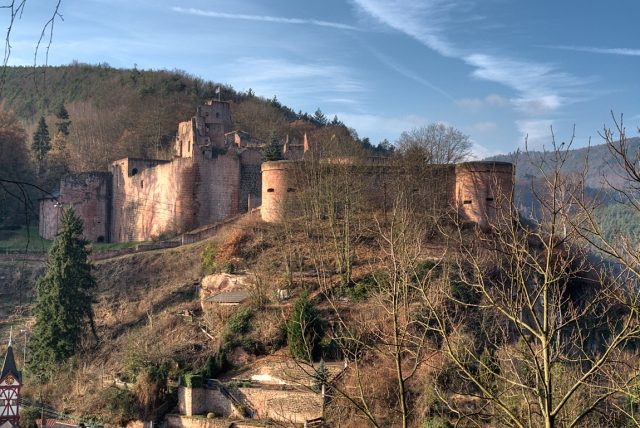
The remains of the Castle can be visited
Hardenburg Castle

Hardenburg Castle, on the eastern edge of the Palatinate Forest near the Rhineland-Palatinate district town of Bad Dürkheim, is still one of the most powerful castles in the Palatinate, even as a ruin.
The hilltop castle is located above the eponymous western district of Bad Dürkheim-Hardenburg on a 200 m long spur to the right above the Isenach valley, whose opening to the Rhine plain it formerly controlled. Access is via federal highway 37 (Bad Dürkheim–Kaiserslautern) and is signposted.
Hardenburg Castle shares many sections of its history with Limburg Monastery, located almost 2 kilometers to the east, from its construction onwards. Opposite, above the left bank of the Isenach, lie much older testimonies to the region's past, e.g., the Celtic ring fort Heidenmauer or the Roman quarry Kriemhildenstuhl.
At the latest between 1205 and 1214, Hardenburg Castle was built by the Counts of Leiningen, who had their ancestral castle Altleiningen ten kilometers further north. For this, they unlawfully appropriated land belonging to Limburg Monastery. Count Friedrich II of Leiningen is considered the founder. In 1237, the castle passed to his son Count Friedrich III in a first Leiningen inheritance division. In 1317, another inheritance division led to the creation of the Leiningen-Hardenburg line under Count Jofried. In the inheritance dispute after his death, the Leiningen-Rixingen line split off in 1345.
After the imperial ban was imposed on Count Emich IX in 1512, Hardenburg Castle was besieged by the Elector Palatine, Ludwig V. The Leiningen family surrendered the castle before it was damaged and received it back in 1519. At the end of the 15th and beginning of the 16th century, they expanded the castle and fortified it even more strongly against enemy artillery fire. Thus, it also offered refuge to the population of the surrounding villages during the Thirty Years' War.
From 1560 to 1725, Hardenburg was the main residence of the Leiningen family and was expanded into a residential palace during this era. It survived the Palatinate War of Succession (1688–1697), in which troops of the French "Sun King" Louis XIV under General Mélac devastated the Palatinate west of the Rhine, but at Hardenburg, they only destroyed the fortifications in 1692. In 1725, the Counts of Leiningen-Dagsburg-Hardenburg moved their residence to the nearby Dürkheim Castle. In 1794, the residential buildings of Hardenburg were set on fire by French revolutionary troops, destroying the valuable interior. Gradually, the castle fell into ruin. Dürkheim Castle also went up in flames. In 1801, all German territories west of the Rhine fell to France, which is why Prince Carl zu Leiningen was compensated in 1803 by the Reichsdeputationshauptschluss with former Mainz and Würzburg possessions in the Odenwald and briefly ruled the new Principality of Leiningen with its seat in the former Amorbach Abbey, which is still owned by the princely house today. In the Palatinate Forest, besides Hardenburg (and the medieval possession Landeck Castle further south), the remains of the former hunting lodges Kehrdichannichts, Murrmirnichtviel, and Schaudichnichtum still commemorate the former rule.
Layout+
The castle complex has a footprint of 180 by 90 m. Massive artillery towers, especially the imposing keep with its 7 m thick walls, which protected the complex from the slope, prevented military conquest and destruction for centuries. After the devastation of 1794, however, only remnants of the once splendidly furnished living quarters – stair towers, windows, elegant portals – remain. In contrast, the huge cellars with their widely spanned rib vaults, built in 1509, have survived to this day.
Current Use+
Hardenburg Castle has been in public ownership since 1820, initially of the Kingdom of Bavaria, today of the state of Rhineland-Palatinate. It is used culturally and can be visited daily – except in December and on every 1st working day of the month – but without a guided tour. Every late summer, a medieval market opens its gates in the ruin. The occasional music events in the old walls are also praised as very atmospheric, such as the alternative rock festival Rock die Burg, which has taken place there annually on the first weekend of September since 2004 and is currently held on a sports field behind Hardenburg.
From 2008 to 2012, renovation work amounting to 6.5 million euros was carried out. This was financed by the state of Rhineland-Palatinate and from the European Regional Development Fund. The Torrondell was provided with an intermediate ceiling and a 200-ton final ceiling. It now houses a visitor center with archaeological finds, a film presentation, and a multimedia tour. Further rooms are used by the administration of the State Enterprise Castles, Palaces, Antiquities and as a sanitary wing.
Take Mobile History with you
You are reading this text for free. Premium adds what matters on the road: descriptions read aloud, sites found through your camera, whole regions taken offline.
- Every description, including the ~17,700 Premium sites
- Audio guide: have descriptions read to you on location
- AR finder: see sites through your camera, with distance and bearing
- Unlimited saved sites
14 days free, then from €2.99 a month. Cancel anytime.
Source: Wikipedia · Licence: CC BY-SA 4.0 · Image: Dr. Gebhard Gaukler
This description draws on the facts documented in the linked Wikipedia article; Wikipedia content is licensed under CC BY-SA 4.0. Wording and editing: Mobile History.
Location: 49.4622, 8.1217