CastleHirschbach

Hauseck Castle

Hauseck Castle

To be privately owned

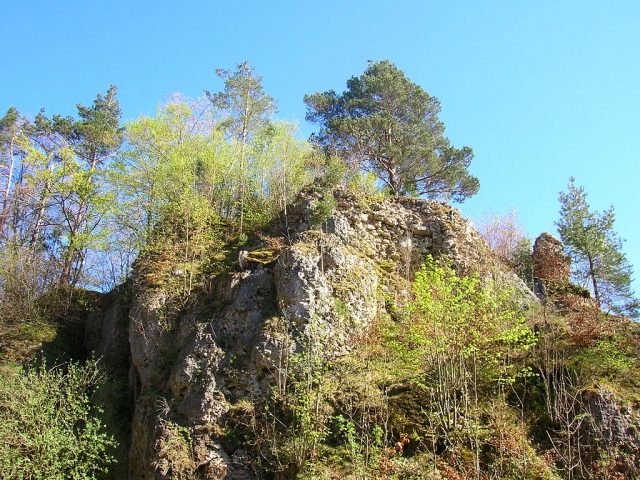
The castle ruin Hauseck is a former late medieval noble castle above the village of Hauseck, east of Hirschbach in the Upper Palatinate district of Amberg-Sulzbach in Bavaria. The upper castle of the ruin is freely accessible; a large part of the lower castle is privately owned and cannot be entered.

The castle ruin, a hilltop castle, is located in the Franconian Switzerland-Veldenstein Forest Nature Park immediately northeast of the village of Hauseck on the Hausecker Schlossberg, about 1.4 kilometers east-southeast of the church in Hirschbach, in the municipality of Etzelwang. It is divided into an upper castle on a rock reef at an altitude of 505 meters, and a lower castle, which stood at the western foot of the reef.

The former castle is best reached from the village of Hauseck by following the road that runs through Hauseck to its end. There, the private property in the lower castle begins. To reach the rock reef of the upper castle, follow a footpath steeply upwards on the western side of the reef.

To the southeast, nearby, are the castle ruin Rupprechtstein with the castle site Werdenstein and another castle site called "Trutziger Kaiser" in their immediate vicinity. To the northeast near Eschenfelden are the castle site Altenburg on the Wachtberg and to the north the castle ruin Hartenstein.

Hauseck Castle is first attested in 1338 in a partition treaty concerning the Palatinate between the sons of Duke Rudolph I and their nephew Ruprecht II. However, Hauseck was not yet mentioned in the House Treaty of Pavia of August 4, 1329, in which the territorial Duchy of Bavaria was divided, which suggests a relatively late construction between 1329 and 1338. The castle was probably also built by Duke Rudolph I to secure his claims to power against the Schenken von Reicheneck. However, a substantiated archaeological investigation into the origin of the castle is still pending (as of 2009).

The Palatine Counts could not hold their castle Hauseck for long. They had to pledge the complex and large parts of the Upper Palatinate in 1353 due to financial obligations to the then Roman-German and Bohemian King Charles IV.

King Charles IV granted the castle in 1354 as a Bohemian fief to the Queen's Chamberlain,

Konrad von Kemnath, who also granted him the right of access. Shortly thereafter, his presumed sons Johann, Conrad, and Heinrich Kemnather inherited the fief and renewed the right of access in 1358. Heinrich XI von Wildenstein and his wife Elsbeth von Henfenfeld acquired the fief shortly thereafter and passed it on to their relative Ulrich von Henfenfeld on February 6, 1372. He then finally sold Hauseck on May 26, 1380, to Stephan von Wolfstein.

Although Hauseck Castle remained a Bohemian fief, after the Treaty of Fürstenwalde, in which the former Elector of Brandenburg, Otto V, renounced his sovereign rights over Brandenburg in favor of the Luxembourgers in exchange for compensation of 500,000 guilders and some castles and towns in the Upper Palatinate, the right of access fell to the Bavarian dukes from 1373.

Before 1489, the Laufer hammer lord Jörg Petz acquired the castle from the Wildensteiners, but sold it in 1492 to Sebold Peringsdorfer

and his son-in-law Jobst II Haller. Around 1500, he ceded the use of the castle to the Nuremberg Council.

During the Landshut War of Succession, which concerned the succession of the Bavarian dukes, Hauseck Castle was captured by the Palatinate forces in 1504 but was recaptured by Nuremberg troops.

In 1507, the castle was then sold by Jobst III Haller to the Imperial City of Nuremberg. Subsequently, presumably repaired by the Nuremberg master stonemason Michael Behaeim, it became a Nuremberg administrative castle.

The end of Hauseck Castle came during the Second Margrave War, in which Albrecht Alcibiades, Margrave of Brandenburg-Kulmbach and Bayreuth, undertook numerous raids and plunderings that led to the destruction of many places and castles in the Empire, especially in Franconia. His troops marched before the castle on May 27, 1552, and set it on fire.

The Imperial City then left it in ruins. In 1774, there is only mention of a castle consisting of a dilapidated pile of stones.

Today, in the area of the lower castle, of which almost nothing remains, there is a private property; the upper castle on a rock reef is threatened with complete disappearance.

Take Mobile History with you

You are reading this text for free. Premium adds what matters on the road: descriptions read aloud, sites found through your camera, whole regions taken offline.

  • Every description, including the ~17,700 Premium sites
  • Audio guide: have descriptions read to you on location
  • AR finder: see sites through your camera, with distance and bearing
  • Unlimited saved sites

14 days free, then from €2.99 a month. Cancel anytime.

Source: Wikipedia · Licence: CC BY-SA 4.0 · Image: http://commons.wikimedia.org/wiki/File:Burgruine_Hauseck,Oberburg_von_Nordwesten.JPG

This description draws on the facts documented in the linked Wikipedia article; Wikipedia content is licensed under CC BY-SA 4.0. Wording and editing: Mobile History.

Location: 49.5526, 11.5577