CastleSalzderhelden

Heldenburg Castle

Heldenburg Castle

The remains of the Castle can be visited

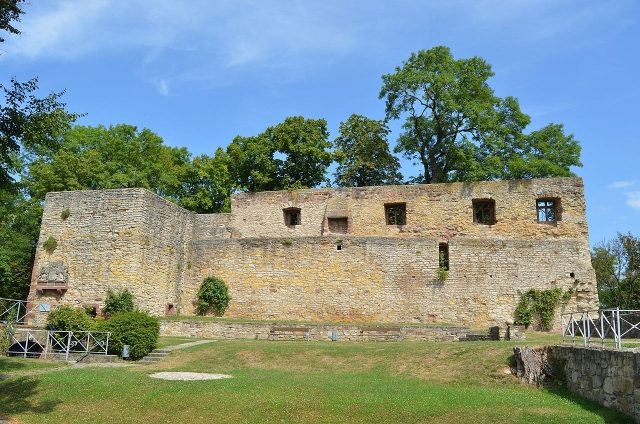
The Heldenburg, also known as Salzderhelden Castle, is a present-day castle ruin located above the village of Salzderhelden. It served to protect the salt well at the foot of the castle ascent.

Construction Description+

Remaining from the hilltop castle are wall remnants of the buildings around a square castle courtyard with parts of the palas, remnants of the castle chapel on the first floor, a spiral staircase tower with 49 steps, a castle tower, and two of formerly three beer cellars. The well in the middle of the castle courtyard has been located and is to be excavated. Impressive are the ramparts and the large wall of the palas with a latrine and fireplace. Visits are made possible by the tourist information in Einbeck and the Heldenburg Castle Association. Worthwhile modern frescoes depicting the history of the castle are located in the castle tavern at the castle entrance.

The Heldenburg was first mentioned in 1320 as castrum solth. The castle was built at the latest in the 13th century by the Counts of Dassel or by the Welf dukes. In 1291, the castle came into the possession of Duke Heinrich Mirabilis, who died at the castle in 1322. A lavish tournament took place in 1305. Due to its strategically favorable location near the salt spring, Grubenhagen Castle, and the beer city of Einbeck, it soon became the residence of the Dukes of Grubenhagen. Many ducal tombs are located in the Minster Church of this city. The dukes were soon referred to by the epithet "von Salzderhelden". For a long time, Salzderhelden Castle was the only extra-urban mint of the Principality of Grubenhagen. The three sons of Heinrich Mirabilis initially administered the land together, but Heinrich the Greek squandered the southern part of the country in the Eichsfeld around the city of Duderstadt on his travels to the Orient, which was then pledged to Mainz and remained there. His sister was married to the Emperor of Constantinople.

In 1365, the castle was besieged by Landgrave Friedrich of Thuringia with about 18,000 men. The castle was defended with a cannon, and the besiegers suffered such heavy losses that they soon withdrew. This is said to have been the first case of a castle being defended with artillery in German lands. In 1448, there was another siege by Landgrave Ludwig the Peaceful of Hesse. According to tradition, the sister of the castellan (Duke Heinrich III of Grubenhagen), Elisabeth (Abbess of Gandersheim), was staying at the castle. She is said to have outwitted the besiegers by hanging women's clothes from the castle windows. The besiegers did not want to fight "women" and withdrew. At the end of the 15th century, representative half-timbered alterations were made. At that time, the castle was a widow's residence. The cities of Einbeck and Osterode long resisted a tax for the renovation, because the duke was impoverished; indeed, it was said that one could ransom oneself from him with a shock of wooden bowls in case of captivity.

With the Welf inheritance treaty of 1481, there was a shift of the dominion to the east to the main residence of Herzberg. After the extinction of the Grubenhagen line, the castle passed into the possession of the Celle line of the Welfs. A Merian engraving from 1654 shows the castle buildings, which were still very representative at the time, but which fell into disrepair because they were only sporadically used in the 17th century. The last known inhabitant of the castle was the Chief Master of the Hunt von Moltke. He was one of the conspirators against a throne and succession law of 1683 and was beheaded in Hanover in 1692 for high treason.

Since the 18th century, the castle has fallen into disrepair. In the 1950s, well-attended castle festivals took place, and there was also a museum with knight's armor in the castle tavern. The part of the castle with the restaurant was then sold by the state of Lower Saxony. The castle ruin was fundamentally renovated in the years 1983–88. The Heldenburg Castle Support Association has been looking after the castle and organizing excavations, castle church services, and events such as castle festivals since 1984. In 2006, an excavation was carried out inside the castle, which uncovered cellar areas.

In 2015, it was announced that due to damage, a new renovation is necessary, for which the state of Lower Saxony is providing 175,000 euros.

Origin of Name+

The origin of the name is probably the same as that of the village Salzderhelden, stemming from the word "Halde" (slope) and referring to the castle "on the slope".

Saxon Steed+

On the occasion of his accession to power in 1361 in Salzderhelden, Duke Albrecht I of Brunswick-Grubenhagen used a horse striding to the (heraldic) right in his seal, which later became the state coat of arms of Lower Saxony (the Saxon Steed).

Take Mobile History with you

You are reading this text for free. Premium adds what matters on the road: descriptions read aloud, sites found through your camera, whole regions taken offline.

  • Every description, including the ~17,700 Premium sites
  • Audio guide: have descriptions read to you on location
  • AR finder: see sites through your camera, with distance and bearing
  • Unlimited saved sites

14 days free, then from €2.99 a month. Cancel anytime.

Source: Wikipedia · Licence: CC BY-SA 4.0 · Image: https://commons.wikimedia.org/wiki/File:Einbeck,_Salzderhelden,_Heldenburg,_2013-08_CN-03.jpg

This description draws on the facts documented in the linked Wikipedia article; Wikipedia content is licensed under CC BY-SA 4.0. Wording and editing: Mobile History.

Location: 51.7996, 9.9124