To be privately owned
Heyden Castle

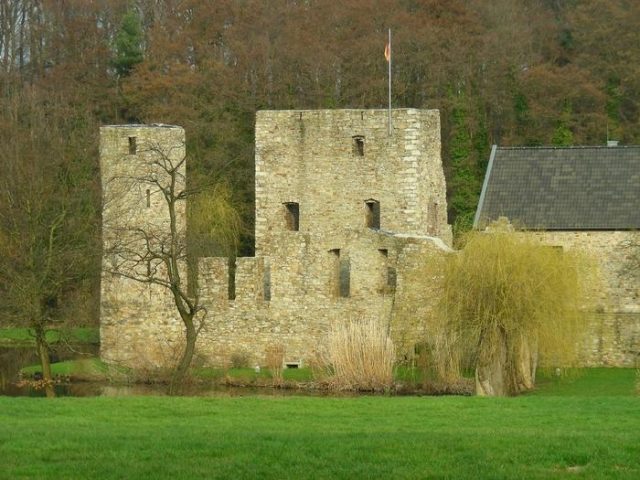
Haus Heyden is the ruin of a moated castle in Horbach, a northwestern district of Aachen. According to historians, it was probably the most imposing complex of its kind in the Aachen region during the Middle Ages.
Knight Arnold von dem Bongart, son of Gottfried von dem Bongart at Haus Bongart near Weisweiler, had Haus Heyden built at the beginning of the 14th century and made it available to the Count of Jülich as an open house on January 21, 1304. It was the seat of the feudal lords who gave the region north of Aachen around Richterich and Horbach the name Heydener Ländchen in 1361. In 1370, the Bongart family was enfeoffed with the sub-lordship for life. From 1375, it was first owned by the von Gronsfeld family and changed hands in 1406 to the von Merode-Rimburg. The complex remained in their possession until 1452. In that year, Haus Heyden came to the von Schönrade family, whose hereditary property it became in 1500.
From 1547, the von dem Bongart family was again the owner and remained so – at times together with the von Leerode and Hochsteden families – until the 20th century. In 1926, they sold it to General Director Westermann, who leased the buildings from 1929.
The French Revolution ended the feudal lordship in Heydener Ländchen in 1786, but between 1815 and 1848, the old name reappeared when the later municipality of Richterich was referred to as "Gemeinde" or "Bürgermeisterei Heyden".
The two outer baileys of the moated castle were used by an agricultural enterprise until 2001 and have not changed in their layout since the mid-17th century. Of the once wide moats, only a remnant remains today in the north of the complex. The core castle has been left to decay since the end of the Thirty Years' War and has therefore remained almost original as a ruin.
The entire complex was extensively restored by its owner between 2001 and 2003, in compliance with monument protection requirements, and is now used as a private residential complex.
Description+
The complex was probably completed in 1303 and consisted of the core castle and initially only one outer bailey. Both were surrounded by wide moats. The castle complex had an extent of approximately 94 meters in north-south and approximately 40 meters in east-west direction. It received the name Zer Heiden, after the heath landscape in which it was built at that time.
The core castle initially consisted of a residential tower, typical for Rhenish moated castles at that time, and had a base area of 11.50 by 10 meters with a wall thickness of two meters in the lower part and a height of about 20 meters to the top of the roof. The residential tower was made of quarry stone and had four floors. The elevated entrance was on the south side of the first floor and could only be reached via a narrow ladder. From the south side, a drawbridge led to the outer bailey.
The first outer bailey was fortified on its east, south, and west sides by strong building walls with a battlement. To the north, it remained open towards the core castle. On the west side, a drawbridge led over the approximately 20-meter-wide moat into the countryside.
About a hundred years after completion, the core castle received a fortification in the form of curtain walls with a battlement and projecting wall towers at the four corners in the early to mid-15th century.
The introduction of gunpowder weapons around the mid-16th century brought an end to castle-like fortifications. Like many other castles, Haus Heyden was also subjected to several destructions. The last damages at the beginning of the Thirty Years' War were so severe that the ruin was not rebuilt. However, the first outer bailey was rebuilt again and again. In 1656, another one was even added. This increased the dimensions of the castle grounds to 78 meters in west-east and 107 meters in north-south direction. It is not known whether the expansion also involved a relocation of the moat around the new outer bailey.
Take Mobile History with you
You are reading this text for free. Premium adds what matters on the road: descriptions read aloud, sites found through your camera, whole regions taken offline.
- Every description, including the ~17,700 Premium sites
- Audio guide: have descriptions read to you on location
- AR finder: see sites through your camera, with distance and bearing
- Unlimited saved sites
14 days free, then from €2.99 a month. Cancel anytime.
Source: Wikipedia · Licence: CC BY-SA 4.0 · Image: http://www.wehrbauten.de/thread.php?threadid=845
This description draws on the facts documented in the linked Wikipedia article; Wikipedia content is licensed under CC BY-SA 4.0. Wording and editing: Mobile History.
Location: 50.8446, 6.0579