The remains of the Castle can be visited
CastleNeckarsteinach
Hinterburg Castle
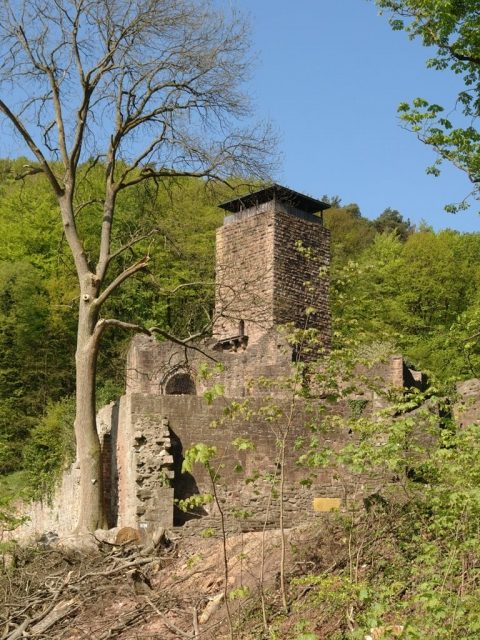
The Hinterburg castle ruin, also known as Alt-Schadeck, is a structure in Neckarsteinach. As the oldest of the four castles in the region, it is the ancestral seat of the noble free lords of Steinach.
History+
Construction of the Hinterburg began around 1100, likely as a fief of the bishoprics of Worms or Speyer. Between 1142 and 1165, Bligger von Steinach is documented as the lord of the castle. His son, the minnesinger Bligger II. von Steinach, expanded the complex into a Staufer castle. After the extinction of the elder line of the Lords of Steinach around 1270, the castle was pledged to creditors by Bishop Heinrich von Speyer in 1272. By 1344, the castle was reportedly abandoned or in disrepair, leading Bishop Gerhard von Speyer to conclude a reconstruction agreement with Peter von Mur. In 1366, Charles IV confirmed the ownership of the Bishop of Speyer. In 1375, Contz Münch von Rosenberg received the castle as a fief. Later, in 1418, Bishop Raban von Speyer granted the castle to his cousin Wilhelm von Helmstatt for life. After his death in 1426, the fief passed to Weiprecht III. von Helmstatt, who had to renovate the by then again dilapidated castle. Following disputes, a castle peace was agreed upon in 1427 between the Helmstatt and the Landschad von Steinach. Weiprecht von Helmstatt was responsible for alterations. After his death in 1490, the fief passed to his nephew Martin von Helmstatt and later to his daughters Mia and Gertrud, thus dividing the castle. Heinrich VII. von Handschuhsheim acquired the Landschad's half in 1497. His son Philipp carried out further construction work in 1529.
Source: Wikipedia · Licence: CC BY-SA 4.0 · Image: Dr. Gebhard Gaukler
This description draws on the facts documented in the linked Wikipedia article; Wikipedia content is licensed under CC BY-SA 4.0. Wording and editing: Mobile History.
Location: 49.4096, 8.8274