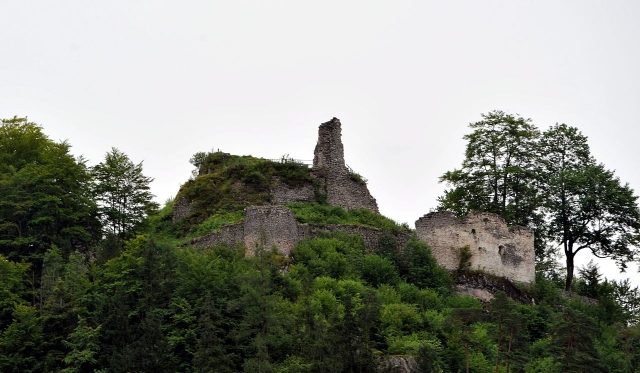
CastleHohenberg

Hohenberg Castle

Hohenberg Castle

The remains of the Castle can be visited

The Hohenberg ruin is the ruin of a hilltop castle in the market town of Hohenberg in southern Lower Austria.

The castle was first mentioned in a document from Lilienfeld Abbey in 1100, with the names Otto, Gottfried, and Herand von Hohenberg, but it is now suspected that these were not the original owners of the castle. Since the Hohenbergs owned many settlements of the same name in the Traisental, an exact attribution is no longer possible. Today, the actual builders of the castle are believed to be Heinrich and Dietrich, the two sons of Leutold von Hohenstaff, who lived in the 13th century. Otto, Gottfried, and Herand presumably lived in Styria, which makes it unlikely that they erected fortifications in Lower Austria.

A dispute over the guardianship of the minor Albrecht V eventually led to a fratricidal war. Hans I sided with Duke Ernst. This allowed him to force the nearby Lilienfeld Abbey to take his side. Duke Leopold, the builder of the abbey, then sent the Moravian knight Sokol to carry out the declared punitive expedition. However, Sokol limited himself to confiscating all of the Hohenbergs' horses. Hans I, offended by the lack of support from the abbey, subsequently plundered it, as Sokol was hiding there at the time.

In 1482, when the battles between Emperor Frederick III and Matthias Corvinus raged, Hans III made his castles Merkenstein, Hohenberg, and Kreisbach available to the Hungarians. A military deployment in front of the castles had no consequences.

In 1529, the family finally died out with Erasmus von Hohenberg. The dominion then passed to Wilhelm von Roggendorf, who was married to Erasmus' daughter Anna.

From this point on, the castle changed owners at short intervals. In 1535, it came into the possession of Sebald Pögl d.J., Baron of Reiffenstein and Arenberg. In 1589, Baron Bernhard V von Jörger acquired the dominion. In 1619, Emperor Ferdinand II confiscated his possessions. The main reason for this was that the Jörger family had already acquired numerous settlements in the Traisental and were now pressuring Lilienfeld Abbey. However, the expropriation was only possible if the castle could first be conquered by imperial order. During the attack under Hans Balthasar von Hoyos, the complex was set on fire and largely destroyed. Hoyos was finally promised the castle as a fief, before it completely passed into his possession in 1627. However, since the Hoyos family was not resident in the Traisental, the castle increasingly fell into disrepair due to lack of maintenance. About 40 years later, Hohenberg is already depicted as a semi-ruin in Vischer's engraving from 1672. However, the outbuildings, the round towers, and the defensive wall were still intact at that time.

In 1892, the square arrow and hunger tower standing on the right bank of the Traisen river were demolished for the construction of the railway. It was part of a dam between the Schlossberg and the Rierkogel. In 1933, the Wittgenstein family bought the forest property including the ruin. Both are now part of the Wittgenstein Forest Administration. The ruin was renovated between 1956 and 1964. Since no one felt responsible for the castle anymore, it increasingly fell into disrepair. At the end of the 1980s, under the tourism association chairman Paul Kropik, the castle hill was cleared of vegetation and a documentation center with the "Spielbichler - Pictures" was set up in the area of the outer castle gate, showing the castle in earlier times. Castle festivals and events tried to maintain the population's interest in the castle, but the rapid decay could no longer be stopped. In 2005, volunteers and a scout association took on the ruin, with the aim of making Hohenberg accessible to tourism again. Railings were installed, hiking trails were renovated, and overgrown green plants were removed. Two years later, the work was completed. Since then, the ruin has been regularly visited by residents and hikers.

Architecture+

The castle was once surrounded by a double wall and a moat and had a gate tower, a zwinger, an outer bailey, and a triangular courtyard. Of this, only the outer defensive wall and a remnant of the chimney flue remain.

Take Mobile History with you

You are reading this text for free. Premium adds what matters on the road: descriptions read aloud, sites found through your camera, whole regions taken offline.

  • Every description, including the ~17,700 Premium sites
  • Audio guide: have descriptions read to you on location
  • AR finder: see sites through your camera, with distance and bearing
  • Unlimited saved sites

14 days free, then from €2.99 a month. Cancel anytime.

Source: Wikipedia · Licence: CC BY-SA 4.0 · Image: https://commons.wikimedia.org/wiki/File:Hohenberg_Burgruine_01.jpg

This description draws on the facts documented in the linked Wikipedia article; Wikipedia content is licensed under CC BY-SA 4.0. Wording and editing: Mobile History.

Location: 47.9040, 15.6233