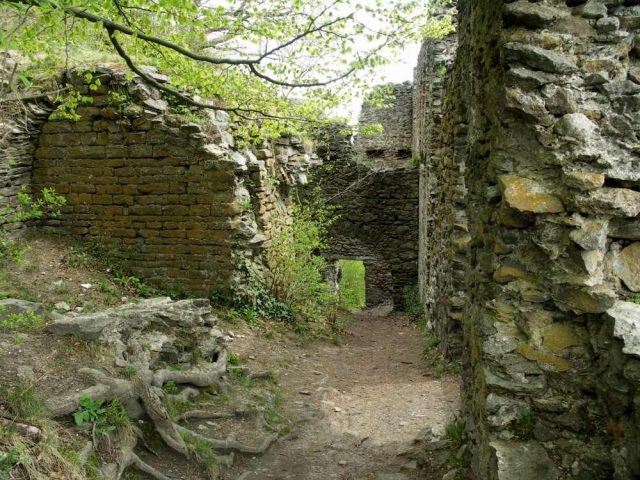
The remains of the Castle can be visited
Hohenkrähen Castle

Hohenkrähen Castle is a high medieval hilltop castle near Mühlhausen-Ehingen, close to Singen in the Konstanz district of Baden-Württemberg, Germany. The present-day ruin of the summit castle is located on the 644 m high Hohenkrähen ("Krayen"), a mountain of volcanic origin north of Singen in the Hegau region, situated between the villages of Duchtlingen, Schlatt unter Krähen, and Mühlhausen, within the Duchtlingen municipal area.
From the ruin, there is a good view of Hohentwiel Fortress, Mägdeberg Castle, and the western Lake Constance area.
The mountain is overgrown, with shrubs and trees covering the terrain. The summit can be reached via a narrow path. The partly very old lime tree stands on the mountain flanks are considered to be currently the largest lime forest in Western Germany. (The largest contiguous lime forest in Central Europe is the Colbitz Heath.) One of the largest dormouse populations in Germany lives in the forests on the mountain.
Archaeological finds suggest an initial settlement around Hohenkrähen as early as prehistoric and protohistoric times, thanks to its striking and strategically secure location. Some finds document settlement activity during the Late Neolithic and Bronze Ages. Individual finds prove settlement on Hohenkrähen since the Neolithic period. Romans and Alemanni used the mountain as a cult site. Traces of Roman settlement are dated to the 2nd century AD.
The castle's construction period is dated to 1180 to 1190 – it was built by the Lords of Friedingen, who were also referred to as "de Craien" from 1191 onwards.
After an inheritance dispute and the War of the Confederates, Hans Wilhelm von Friedingen hired about 20 former Swiss mercenaries around 1446. From Hohenkrähen, raids were carried out into Swiss territory over the following six months, leading to a settlement between the lord of the castle and the Confederates. In the subsequent years, the Friedingens exploited the turmoil between Austria, the Confederates, and the Swabian League to increase their possessions through highway robbery and looting. The actual trigger for the siege was the spurned courtship of a Swabian nobleman, Stefan Hausner, towards a beautiful burgher's daughter from Kaufbeuren. He therefore attacked merchants and retreated to his ally Friedinger at Hohenkrähen. For this reason, Emperor Maximilian ordered an army of the Swabian League under the command of Paul von Lichtenstein and Georg von Frundsberg, 8000 men, equipped among other things with 10 pieces (heavy artillery), which were brought from Innsbruck, including the Scharfmetz and Singerin, the Turntraxel, the Herzog Sigismund and the Ketterlin. The cannonballs often rolled back due to the steep height of the mountain, were collected and fired again. Frundsberg had shots fired from a middle elevation at the bakery, so that flour and feathers flew out at the top (November 9). On November 12, 1512, after a three-day siege, Hohenkrähen was captured, but the nobles had fled during the night, the castle was burned and razed, it was later rebuilt.
Around 1560, Hohenkrähen was acquired by Hans Jakob Fugger from Wolf von Homburg for 20,300 guilders, but the castle remained an Austrian fief. The building was structurally expanded for the last time after the purchase – Fugger had the palas built on the east side of the complex. As early as 1571, the Fuggers sold the castle again. Hans Ludwig von Bodman became the new owner. He was probably followed by Count Ernst Georg von Hohenzollern. He, in turn, sold the castle and lordship to his brother-in-law Caspar Ernst II von Rechberg-Illereichen on January 3, 1620. In the following years, the castle fell into disrepair.
During the Thirty Years' War, Hohenkrähen and Mägdeberg castles were burned down in 1634 by Konrad Widerholt, the fortress commander of Hohentwiel. From this point on, Hohenkrähen Castle was a ruin and was no longer used.
After many changes of ownership, the Grauer Reiter scout association leased the ruin in 1956 from Count Douglas Freiherr von Reischach. In return, they are obliged to maintain the buildings and facilities in the outer bailey.
In August 2007, a rockfall, triggered by heavy rainfall, destroyed the ascent to the ruin. Since May 1, 2010, access to the castle has been possible again.
Complex+
Youth Castle
Hohenkrähen gained new significance as a youth castle through the Grauer Reiter scout association, serving as a meeting and educational center for young people. The sponsors of youth castles usually come from the Wandervogel and scout movements or are at least closely associated with the youth movement.
In 1956, the year of the lease, the construction of one of the houses in the outer bailey began. Later, another house was built on the ruins of the former stables as accommodation, also for guest groups. A campsite is also available. Recent years have been marked by major construction measures, including the installation of a bio-sewage treatment plant, a new power supply, and escape ladders – all done by the voluntary work of the Grauer Reiter scout association. Since 1956, the castle ruin has served as the federal center of the Grauer Reiter scout association.
In 1957, the first inter-association meeting (ÜT) of the youth movement took place at the foot of the youth castle and on the surrounding meadows, to which the Grauer Reiter scout association and Nerother Wandervogel had jointly invited.
The Legend of Poppele+
Many local traditions tell of a castle bailiff and robber knight Popolius Maier, who lived in the castle around the beginning of the 15th century and, according to legend, as punishment for his misdeeds, must restlessly roam the area as the "castle ghost Poppele". A field cross at the foot of the mountain is said to protect against the spirit. The figure appears in numerous legends and plays an important role in the Singen Carnival. In a successful children's book, Elisabeth Walter describes the story of the mischievous boy Schmiedledick, a life of hardship and difficulty. Schmiedledick ultimately voluntarily stays with the travelers to redeem the Poppele ghost.
Take Mobile History with you
You are reading this text for free. Premium adds what matters on the road: descriptions read aloud, sites found through your camera, whole regions taken offline.
- Every description, including the ~17,700 Premium sites
- Audio guide: have descriptions read to you on location
- AR finder: see sites through your camera, with distance and bearing
- Unlimited saved sites
14 days free, then from €2.99 a month. Cancel anytime.
Source: Wikipedia · Licence: CC BY-SA 4.0 · Image: https://de.wikipedia.org/w/index.php?title=Datei:Hohenkraehen_Eingang1.jpg&filetimestamp=20060501162934&
This description draws on the facts documented in the linked Wikipedia article; Wikipedia content is licensed under CC BY-SA 4.0. Wording and editing: Mobile History.
Location: 47.7989, 8.8206