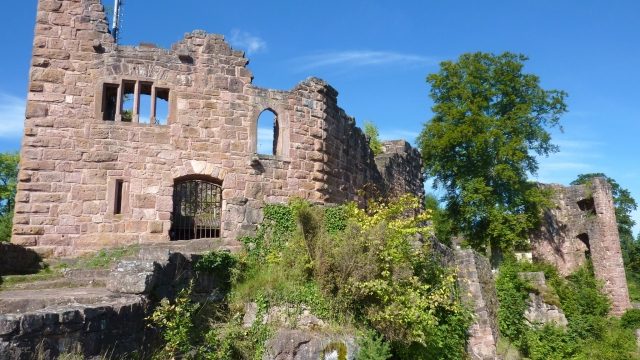
The remains of the Castle can be visited
Hohenschramberg Castle

Hohenschramberg, also known as Nippenburg, is the ruin of a spur castle on the Schlossberg in Schramberg in the Baden-Württemberg district of Rottweil. The castle ruin Hohenschramberg is located on the 636.2 m above sea level southeast spur of the Schlossberg (683.1 m), which rises steeply in the Black Forest and northwest above the confluence of the Lauterbach into the Schiltach in Schramberg.
Hans von Rechberg, who had acquired the castles of Falkenstein, Schilteck and Ramstein and thus founded the Lordship of Schramberg, began construction of the castle in 1457. He expanded the castle into a fortress. Hohenschramberg is thus one of the last castles to be built in Germany. In 1464, Count Eberhard im Bart unsuccessfully besieged the castle.
In 1526, the Lordship and thus the castle passed to the Lords of Landenberg from Thurgau in Switzerland.
In 1547, the Lordship and the castle came into the possession of the Austrian Chancellor in Alsace, Rochus Merz von Staffelfelden. Rochus Merz further expanded the castle and received market rights from Emperor Charles V in 1547.
From 1583 to 1805, the castle, along with the Lordship of Schramberg, remained with Austria (Further Austria).
In 1633, during the Thirty Years' War, the castle was besieged by the Duke of Württemberg, or Konrad Widerholt, who subsequently also captured the castle.
In 1648, the castle and the Lordship were pledged to the Counts of Bissingen and Nippenburg. They first lived in Hohenschramberg Castle and built a first palace in the valley in 1772/73.
During the Palatinate War of Succession in 1689, the castle was set on fire by troops of King Louis XIV of France.
Between 1957 and 1983, numerous excavation works and preservation measures were carried out by the Burgpioniere, a group of citizens who dedicated themselves to the preservation of the castle ruin, supported by the city of Schramberg and the state of Baden-Württemberg.
Description+
The entire ruin as such is very worth seeing, as it is well preserved and very large.
Parts of the western outer bastion with the upper courtyard, the chapel tower, the middle and rear castle, the horse stable, as well as the foundations of the bathhouse and bakery and other buildings on the east and north sides are preserved.
Take Mobile History with you
You are reading this text for free. Premium adds what matters on the road: descriptions read aloud, sites found through your camera, whole regions taken offline.
- Every description, including the ~17,700 Premium sites
- Audio guide: have descriptions read to you on location
- AR finder: see sites through your camera, with distance and bearing
- Unlimited saved sites
14 days free, then from €2.99 a month. Cancel anytime.
Source: Wikipedia · Licence: CC BY-SA 4.0 · Image: Joachim Schneeleopard
This description draws on the facts documented in the linked Wikipedia article; Wikipedia content is licensed under CC BY-SA 4.0. Wording and editing: Mobile History.
Location: 48.2257, 8.3785