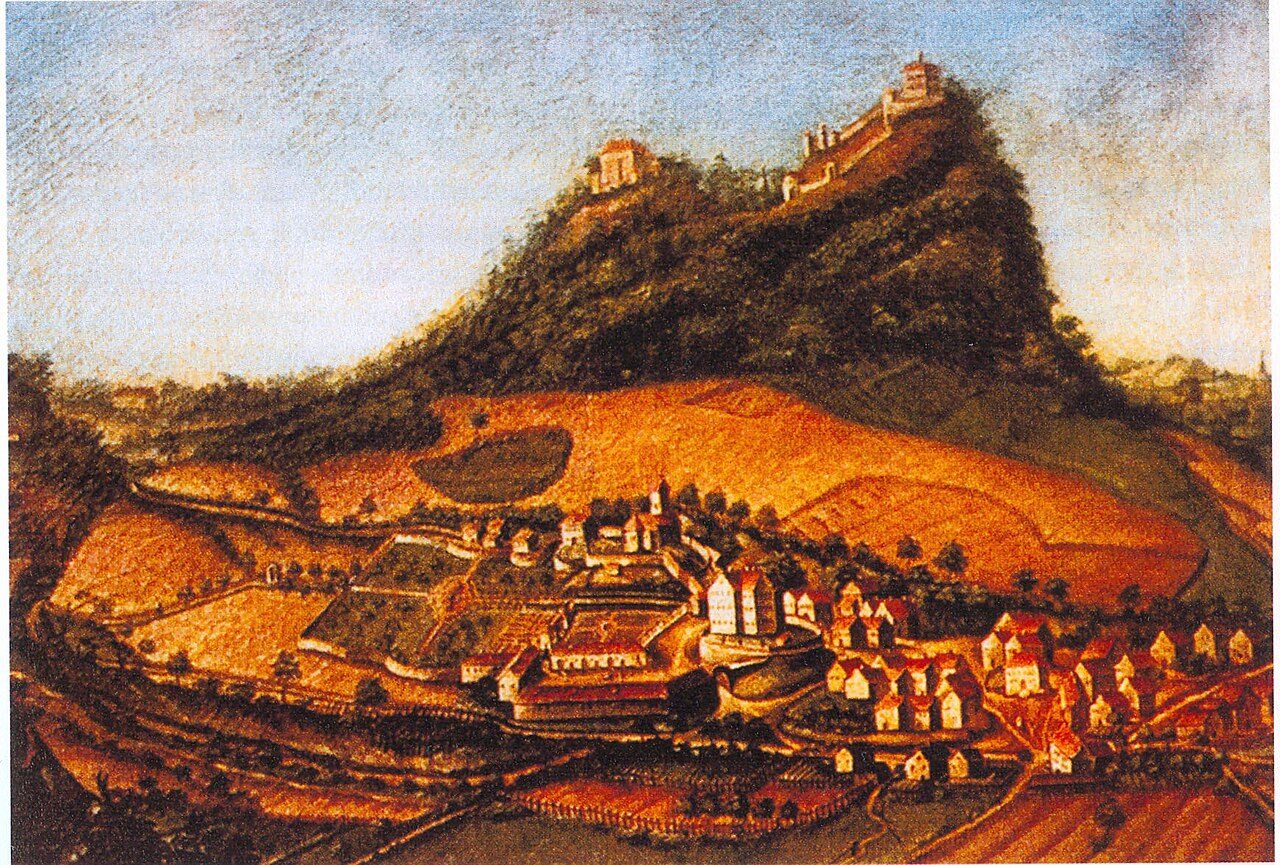
The remains of the Castle can be visited
Hohenstoffeln Castle

The Hohenstoffeln ruin refers to the ruins of the hilltop castles of Vorderhohenstoffeln, Mittelhohenstoffeln, and Hinterhohenstoffeln near the municipality of Hilzingen in the district of Konstanz in Baden-Württemberg. The castles are located on the Hohenstoffeln at 841.8 meters above sea level, 1800 meters east of the Binningen district of the municipality of Hilzingen.
Burg Hinterstoffeln was located on the northern peak and Burg Vorderstoffeln on the southern peak. Burg Mittelstoffeln was located in the saddle of the mountain.
A first mention of Hohenstoffeln Castle dates back to 1034. In 1056, Bishop Gebhard of Regensburg, brother of Emperor Conrad II, was imprisoned at Hohenstoffeln Castle for secret alliances against Emperor Henry III.
The castles Vorderstoffeln and Mittelstoffeln were built later; the first mention of all castles occurred in 1299.
Former owners mentioned are Ludwig von Pfullendorf-Ramsberg zu Stoffeln, Staufer in 1067, the Lords of Stoffeln from 1236 to around 1400, and the Lords of Hornstein in 1623.
The castles and Mount Hohenstoffeln were part of the Landgraviate of Nellenburg.
The castles of Hohenstoffeln were destroyed during the Thirty Years' War by Rheingraf Otto Ludwig von Salm-Kyrburg-Mörchingen. After he had captured Rheinfelden, Laufenburg, and Waldshut, he marched on July 14, 1633, with 8000 Swedes and Württembergers and heavy artillery to and onto the Hohenstoffeln and shelled the castles. Afterwards, the surrounding farmers had to demolish the remaining walls. The north side of the former volcanic vent served as a basalt quarry until 1939; the writer Ludwig Finckh campaigned for the preservation of the mountain.
Contemporary Diary Report on the Destruction+
After the only son of Count Maximilian von Pappenheim, Heinrich Ludwig von Pappenheim, was killed by a headshot on June 27, 1633, during an attempted attack (together with Swiss mercenaries, i.e., the Protestant party, and on the instructions of Gustav Adolf, against the Imperial forces) on the castles of Vorder- and Mittelstoffeln, which were under the administration of Balthasar Ferdinand von Hornstein (Hinterstoffeln Castle was owned by Bilgeri von Reischach; however, the three castles were imperial fiefs, and Ferdinand was a son-in-law of Conrad von Stoffeln), and the council clerk and rentier, Georg Michael Wepfer (1591–1659), born in Diessenhofen, father of the Schaffhausen physician Johann Jakob Wepfer, was also present in the trench, he further reports in his diary: "On July 20, His Excellency Lord Rheingraf shot so heavily at Stofflen Castle that the wall in the old castle towards Wyterdingen half collapsed; as those in the castle then feared they could no longer hold the old castle, they set the old castle on fire (others claim it was caused by them, others that it was set on fire by a firebomb) which burned down completely that night, whereupon the besieged retreated into the new castle and gave strong fire; the next day Lord Rheingraf had three large pieces brought through the old castle towards the new one and shot heavily at the new castle, immediately piercing the round tower and shooting through the rooms into the new castle, so that they agreed that evening and surrendered the castle, receiving quarter, withdrawing with sticks, pardoning the commandant Lorenz Eckart von Bretten from the Palatinate, capturing about 12 from Engen, some of whom were later hanged, and giving the castle over to the soldiers for plunder. On July 21, I rode with Captain Hans Wilhelm im Thurn, Mr. Alexander Hurtern, and others early in the morning to the camp, then came to both castles, where a terrible plundering, smashing, breaking open began, a great deal of goods were found therein, especially what had been brought there for refuge by the neighbors, about 200 wagons with all kinds of fruits, herbs and lot, household goods and other things were carried out, I got about 24 books therein, which were given to me by soldiers for a trifle and a small tip. On July 24, the beautiful and strong new castle was also set on fire and completely burned down by order of Lord Rheingraf and the Duke of Württemberg, making von Hornstein a beggar. Thus Stofflen received its deserved reward."
Two citizens of Engen were hanged in revenge for the death of the count's son, others were put in irons. The subjects of the surrounding villages were forced by order of the Duke of Württemberg to finally destroy the remaining wall fragments.
Layout+
Only a few remnants of the castle complex, which was heavily damaged by demolition and quarrying, can be found today. Hinterstoffeln Castle was the largest of the castles. The three castles were connected by a curtain wall, in which there was a common entrance, stables, and barns. The meager remains of Vorderstoffeln indicate a palas with a side length of 18.5 meters on a platform of 52 x 52 meters.
Lords of Stoffeln+
- Kuno von Stoffeln (1365–1411), Prince-Abbot of St. Gallen Abbey.
- Konrad von Stoffeln (13th century), Minnesinger
Take Mobile History with you
You are reading this text for free. Premium adds what matters on the road: descriptions read aloud, sites found through your camera, whole regions taken offline.
- Every description, including the ~17,700 Premium sites
- Audio guide: have descriptions read to you on location
- AR finder: see sites through your camera, with distance and bearing
- Unlimited saved sites
14 days free, then from €2.99 a month. Cancel anytime.
Source: Wikipedia · Licence: CC BY-SA 4.0 · Image: Unknown authorUnknown author / Public domain via Wikimedia Commons
This description draws on the facts documented in the linked Wikipedia article; Wikipedia content is licensed under CC BY-SA 4.0. Wording and editing: Mobile History.
Location: 47.7960, 8.7502