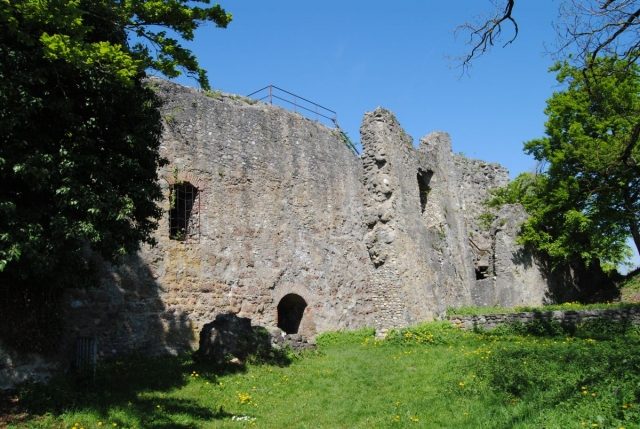
The remains of the Castle can be visited
Homburg Castle

Homburg Castle is a high medieval ruin near Stahringen, a district of Radolfzell am Bodensee, and thus stands not far from the western shore of Lake Constance in Hegau, Konstanz district, Baden-Württemberg.
Located at an altitude of 635.3 m, above Stahringen, Homburg served as the seat of the Lords of Homburg for a long time. The castle complex itself is situated on a mountain spur that slopes steeply towards the village. Over the centuries, the massive castle complex, like many other Hegau castles, fell into disrepair and was eventually abandoned.
The origins of Homburg date back to the 11th century, when the Lords of Homburg, former ministerials of the Bishop of Constance, had the ring wall built on the ice-age gravel remnants high above Stahringen. Stahringen was then mentioned for a long time as a knightly village in documentary writings.
During the Swiss War in 1499, the castle was plundered, its inhabitants robbed of their possessions, and burned down. In 1502, it was rebuilt and even enlarged.
In 1565, Wolf von Homburg sold his lordship to his son-in-law Hans Konrad von Bodman. He himself died a year later without legitimate heirs in Radolfzell, where a bronze epitaph still commemorates him in the Minster. The Lords of Bodman were local lords in Stahringen for barely 50 years. In 1614, the village and Homburg came into the possession of the Benedictine monastery of St. Gallen.
During the Thirty Years' War, there were multiple changes of ownership. The castle was occupied by both Protestant and Catholic troops. In 1642, the castle - once again it was the fortress commander from Hohentwiel, Konrad Widerholt - was attacked, but this time burned down. After the war, it served as a quarry, and remnants can still be found today in the courtyards below the ruin.
In 1749, the castle - or what remained of the former complex - passed to the Bishop of Constance. Between 1803 and 1808, Habsburg and Württemberg on one side, and Baden on the other, disputed ownership of the lordship of Stahringen-Homburg. After two years of belonging to the Kingdom of Württemberg, the area belonging to the former Landgraviate of Nellenburg was finally assigned to the Grand Duchy of Baden in 1810 and incorporated into the Baden Lake District.
Complex+
The castle was strategically well located merely for observation, but due to the flat ascent from the west, it was easy to capture.
Over the centuries, the shield wall was clad with large bossed ashlar blocks of Nagelfluh up to almost 3 meters thick. Homburg was thus expanded into a fortified residential complex.
Repeatedly destroyed, only a wall system over 11 meters high and a mighty shield wall still hint at its size and structural form.
There are no conclusive reconstructions of the castle. A round tower of the castle can be seen in an 18th-century painting.
Take Mobile History with you
You are reading this text for free. Premium adds what matters on the road: descriptions read aloud, sites found through your camera, whole regions taken offline.
- Every description, including the ~17,700 Premium sites
- Audio guide: have descriptions read to you on location
- AR finder: see sites through your camera, with distance and bearing
- Unlimited saved sites
14 days free, then from €2.99 a month. Cancel anytime.
Source: Wikipedia · Licence: CC BY-SA 4.0 · Image: http://schloesserrundschau.de/bawue/schloesser/konstanz23.html
This description draws on the facts documented in the linked Wikipedia article; Wikipedia content is licensed under CC BY-SA 4.0. Wording and editing: Mobile History.
Location: 47.7921, 8.9663