CastleKrefeld-Hüls

Hüls Castle

Hüls Castle

Cultural Events

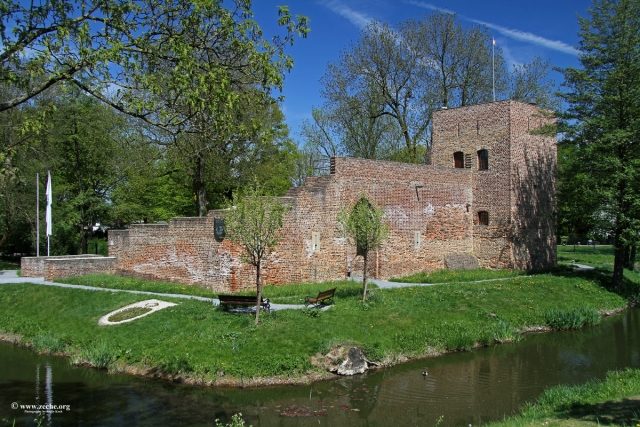
Hüls Castle is a moated castle in the Krefeld district of Hüls (North Rhine-Westphalia). It was built starting in 1455, when Archbishop Dietrich II of Moers allowed the knight Friedrich von Hüls to build a castle in the marsh east of Hüls. Brick was used as building material at that time.

The name Hüls is derived from the Low German word "Hulis" for the holly bush, also known as Ilex. Hüls was first mentioned in a document in 1112. The knightly family of the Lords of Hüls ruled the town from Hüls Castle until the 16th century, when in 1565 the last Lady of Hüls, Katharina, died without direct heirs.

From the 14th century onwards, documents from the Lordship of Hüls exist in a language that is now referred to across borders as Rheinmaasländisch. Rheinmaasländisch was a written and chancery language of the upper classes in the Rhine-Meuse triangle, which, however, differed significantly from the "spoken language" of the common people, the local Hölsch Plott (Hülser Platt). Here is an example of an excerpt from an inheritance division in 1363 between the knights Matthias von Hüls and his brothers Geldolf and Johann:

  • I, Mathys van Hulß, son of Lord Walraven... make known and declare to all people under my seal... that I, with the full counsel and will of my relatives and peers, with Geldolp and Johan, my brothers... as true and as whatever rights may be situated, which have fallen to me from my father and may hereafter fall to me from my mother, Lady Stynen van Hulß, after her death... (followed by further references and listed inheritances, including the "Hof aan dem Eynde", which refers to the Papenburg, then located at the northern end of the town, which later, with its associated land, came into the possession of the Counts of Moers).

In 1492, the castle was the scene of a witch trial against Nesgen tho Range from Inrath.

In numerous armed conflicts of the 16th and 17th centuries, including the Truchsessian War in the vicinity of the Battle of Hüls in 1583 and the Thirty Years' War after the Battle of Hülser Heide in 1642, the castle was destroyed several times. On Pentecost night 1686, according to eyewitnesses, the manor house of the castle finally collapsed. Since then, the castle has been a ruin that was not rebuilt.

After the Hüls noble families lost their sovereign rights in Hüls at the beginning of the 19th century and sold their land, they donated the castle to the children of the last Hüls bailiff, Anno Laurenz Rosen. The last bailiff's daughter, Franziska Rosen, bequeathed the castle to the Catholic parish of St. Cyriakus after her death in 1843. Shortly after 1950, the then independent municipality of Hüls acquired the castle ruin and surrounding land. From 1954 to 1958, extensive clearing and excavation work was carried out on the remains of the castle ruin. It was led by the renowned local historian and archaeologist Professor Albert Steeger and mainly carried out by Hüls schoolchildren. The construction of the current primary school "An der Burg" was a decisive factor.

Lack of structural maintenance, severe weather, uncontrolled and damaging vegetation, but also willful destruction led to the castle ruin being in an extremely poor condition by the end of the 20th century. The city of Krefeld, which had become the owner of the ruin through the incorporation of Hüls, had no money for the castle's renovation. Therefore, the Hüls local history association and the Hüls sports club decided to renovate this important monument for Hüls with volunteer efforts. Planning began in 1998, and the first construction phase started in 2000. The area was cleared of vegetation, and parts of the manor house's masonry were rebuilt.

In 2001 and 2002, the second construction phase took place, and the castle tower was renovated. For this, the entire area had to be cleared of the rubble of the old, largely collapsed tower. The masonry was drained and rebuilt, and then heavy wooden ceilings were installed. Today, the tower houses a wedding room for ceremonies in a special atmosphere.

In the third construction phase, the battlements were rebuilt, from which one now has a beautiful overview of the area. The castle courtyard with its walls was also newly constructed and now offers an excellent backdrop for events. The adjacent primary school uses the castle as a "green classroom". A path with benches leads around the castle, and in the evenings, it is illuminated by ground lights.

A fourth, planned construction phase aims to renew the moat so that it permanently holds water.

During the work, an old well was also rediscovered. Archaeologists from the Burg Linn State Museum carried out some excavations and found fragments of medieval pottery. In addition, it was proven that the water of the castle moat previously reached the walls.

For the renovation of the castle, members of both associations voluntarily contributed over 16,000 working hours by the end of 2006. They were supported by local companies with numerous in-kind donations. The two participating associations received the Krefeld City Monument Award in 2005 for their initiative.

Take Mobile History with you

You are reading this text for free. Premium adds what matters on the road: descriptions read aloud, sites found through your camera, whole regions taken offline.

  • Every description, including the ~17,700 Premium sites
  • Audio guide: have descriptions read to you on location
  • AR finder: see sites through your camera, with distance and bearing
  • Unlimited saved sites

14 days free, then from €2.99 a month. Cancel anytime.

Source: Wikipedia · Licence: CC BY-SA 4.0 · Image: http://www.zeche.org/

This description draws on the facts documented in the linked Wikipedia article; Wikipedia content is licensed under CC BY-SA 4.0. Wording and editing: Mobile History.

Location: 51.3747, 6.5122