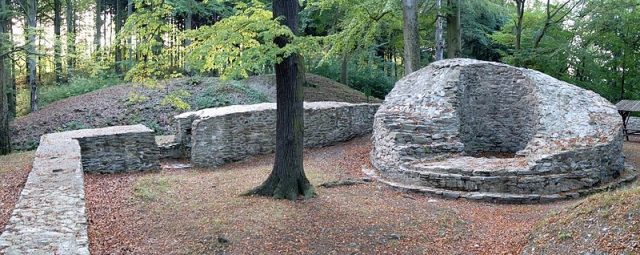
The remains of the Castle can be visited
Isenburg Castle

The Isenburg is a castle ruin in the Western Ore Mountains between Hartenstein and the Bad Schlema district of Wildbach, high above the Zwickauer Mulde valley in Saxony.
In the course of the settlement of the Ore Mountains, a defensive structure was built on the rocky spur that rises at the confluence of the Wildbach into the Zwickauer Mulde. Archaeological finds indicate that the complex already existed in the 12th century. The name Isenburg goes back to the name Eisenburg (Iron Castle) and either refers to the iron mining that took place nearby (see also: Bad Schlema Visitor Mine), or it had the meaning of "iron" in the sense of impregnable.
Little is known about the history of the spur castle and its violent destruction. No confirmed documentary mentions are known. The traditions - the first description was made in 1738 - refer to the Isenburg as "Robber Castle", "Old Castle" or "Eisenburg", from which the current name is also derived. However, there is no medieval source for this. The castle was destroyed as early as the 1 4th century and not rebuilt. From the 15th to the 17th century, the ruins presumably served as a refuge for the local population during warlike conflicts. Around 1750, the remains of the castle were blown up to build the Wildbach church with the stones.
In 1934, the remains of the rampart system were uncovered by the Reich Labor Service. The foundations of the ring wall and the remains of the round keep were restored in 1993.
Layout+
One can distinguish between an outer bailey, a lower and an upper castle, and there was also a cistern. The complex encloses an area of 51 x 33 meters, the tower has a diameter of about 9 meters at the base with a wall thickness of 3 meters. The west side of the castle, which is the only easily accessible side, was additionally protected by a moat. The inner and outer shells consist of horizontally layered rubble stone, while the core is bricked with herringbone-patterned stone layers (Opus spicatum).
Miscellaneous+
For a visit to the ruins, a walk of about 30 minutes from Hartenstein train station is recommended. Only about 200 meters from here is Burg Stein. At this point, you cross the Zwickauer Mulde and are now directly below Schloss Wolfsbrunn. Here you turn left and hike through the Poppenwald parallel to the Mulde upstream. After a short but steep climb, called "Sanfter Heinrich" (Gentle Henry), the path forks: If you keep right, you first reach the Wildbach church via a comfortable forest path. Here you follow the signpost and reach the ruins after another 700 m.
If you choose the left path, you reach your destination via a wild and romantic, narrow path on the steep bank of the Mulde. This path is known as the "Raubrittersteig" (Robber Knight's Path) and is one of the most beautiful hiking trails in the Mulde valley.
Very close to the Isenburg, but on the opposite bank of the Mulde, is the Prinzenhöhle (Prince's Cave). If you follow the path further upstream towards Bad Schlema, you will reach a radium spring after about 1 km.
Take Mobile History with you
You are reading this text for free. Premium adds what matters on the road: descriptions read aloud, sites found through your camera, whole regions taken offline.
- Every description, including the ~17,700 Premium sites
- Audio guide: have descriptions read to you on location
- AR finder: see sites through your camera, with distance and bearing
- Unlimited saved sites
14 days free, then from €2.99 a month. Cancel anytime.
Source: Wikipedia · Licence: CC BY-SA 4.0
This description draws on the facts documented in the linked Wikipedia article; Wikipedia content is licensed under CC BY-SA 4.0. Wording and editing: Mobile History.
Location: 50.6339, 12.6739