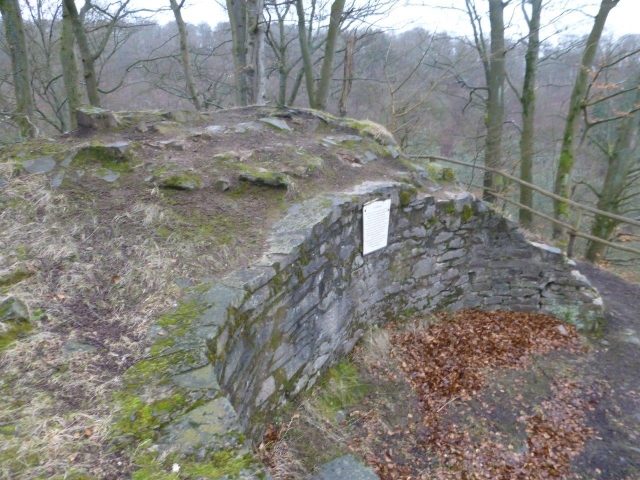
The remains of the Castle can be visited
Keseburg Castle

The Keseburg near Ederbringhausen, a present-day district of the municipality of Vöhl in the north Hessian district of Waldeck-Frankenberg (Germany), is a ruin of a former hilltop castle in the Kellerwald, of which only remnants remain.
The Keseburg ruin is located on the western edge of the Kellerwald, on the right side of the Eder valley, about 6 km south of its confluence with the Edersee. In a secluded forest location, it lies on a 385 m above sea level northern spur of the Keseberg (431.2 m), which is located in the Kellerwald-Edersee Nature Park, about 1.2 km east of the village of Ederbringhausen. About 1 km south, beyond the Keseberg, stands Hessenstein Castle.
From the Keseburg ruin, one looks west towards the mouth of the Orke into the Eder near Ederbringhausen, and west and north into a part of the Eder valley.
Current State+
The ruin today consists of the still clearly visible double ditch and wall remains of the keep.
Keseberg Castle was probably built in the 11th century by the Counts of Ziegenhain and Reichenbach. It is first mentioned in 1144 as the seat of the bailiffs of Keseberg (Caseberch). In 1186, the castle came into the possession of Friedrich, a son of Landgrave Ludwig II of Thuringia, through the marriage of Lukardis, a daughter of Count Gozmar II of Ziegenhain-Reichenbach, to Friedrich von Ziegenhain, along with Wildungen Castle. Friedrich then called himself Count of Wildungen.
Sophia, the daughter of Friedrich and Lukardis, married Burgrave Burchard VI "Kurzhand" of Magdeburg, and he sold Keseberg and Wildungen castles to Landgrave Ludwig IV (the Saint) of Thuringia before 1227. Since he lacked the consent of his wife and her family, a dispute arose between the Ziegenhains and Ludowingians. It was not until 1233 that Count Berthold I of Ziegenhain reached an agreement with Landgrave Konrad of Thuringia, who managed the Hessian possessions of the Ludowingians for his brother, Landgrave Heinrich Raspe, regarding the Ziegenhain inheritance of his uncle Friedrich von Ziegenhain, and the castle finally fell to the Landgraviate of Thuringia. The court of Geismar, however, in whose area the Keseberg lay, remained a Mainz fief of the bailiffs of Keseberg. A court decision from 1244 confirmed once again that the land on which the castle stood was landgravial, while the surrounding area belonged to Haina Monastery.
After the death of Heinrich Raspe in 1247, with whom the Ludowingian dynasty died out in the male line, Archbishop Siegfried III of Mainz tried to seize the Mainz fiefs of the landgraves. Burgrave Burchard VI of Magdeburg had since died, and his widow, Countess Sophia of Wildungen, as the actual heiress, had planned to sell both castles to Mainz. In 1247, she ceded her rights to Keseberg and Wildungen castles to the Archbishop, but the relatives of her deceased husband refused to recognize this change of ownership, and both castles remained in landgravial possession.
In the Thuringian-Hessian War of Succession (1247–1277), which broke out after Heinrich Raspe's death, the bailiffs of Keseberg allied themselves with the Counts of Ziegenhain and resisted the Hessian claims to feudal sovereignty. Thereupon, Landgrave Heinrich I of Hesse destroyed the castle in 1277 and handed over the castle hill and the remains of the castle to Haina Monastery as free allodial property. The Lords of Keseberg submitted to the Landgrave and had to move to their court in Geismar.
Landgrave Heinrich II had the nearby Hessenstein Castle built between 1342 and 1348 as a replacement, to have a fortified official seat for his local bailiffs, and the Lords of Keseburg became burgmannen there. In 1360, Widekind, bailiff of Keseberg, returned his fief, a part of the Geismar office, to the Mainz Archbishop Gerlach. The Keseburg remained a ruin.
Take Mobile History with you
You are reading this text for free. Premium adds what matters on the road: descriptions read aloud, sites found through your camera, whole regions taken offline.
- Every description, including the ~17,700 Premium sites
- Audio guide: have descriptions read to you on location
- AR finder: see sites through your camera, with distance and bearing
- Unlimited saved sites
14 days free, then from €2.99 a month. Cancel anytime.
Source: Wikipedia · Licence: CC BY-SA 4.0 · Image: Stephan Link
This description draws on the facts documented in the linked Wikipedia article; Wikipedia content is licensed under CC BY-SA 4.0. Wording and editing: Mobile History.
Location: 51.1281, 8.8834