CastleKirchschlag in der Buckligen Welt

Kirchschlag Castle
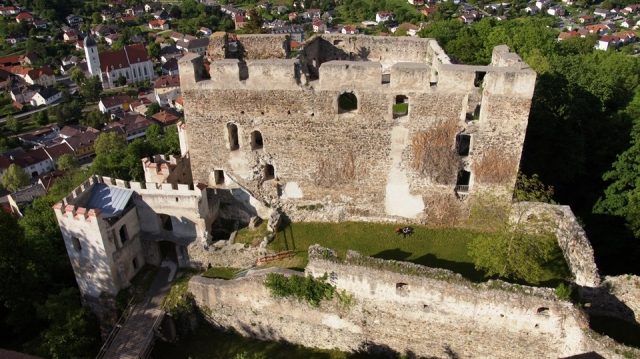
Kirchschlag Castle

The remains of the Castle can be visited

The Lordship of Kirchschlag was probably founded around 1180 by Herrand von Wildon. However, the place existed before that. Through the marriage of Gertrud von Wildon to Albero V von Kuenring, Kirchschlag came into the possession of the Kuenringers in 1240. At that time, the castle is likely to have been extensively expanded.

The castle was first mentioned in a document in 1252 during the battles with Hungarian soldiers of King Bela IV. His troops besieged and conquered the fortress in both 1246 and 1254. In the Peace of Ofen, Kirchschlag had to be ceded to Hungary. The castle went to Ivan von Güssing. Six years later, the Peace of Kroissenbrunn was concluded, whereby these territories fell back to Ottokar II.

In the meantime, the Güssingers were in Kirchschlag and made no move to give up the castle. Leutold von Kuenring had great difficulty keeping the Güssingers at bay. In 1287, Leutold exchanged Kirchschlag with his cousins Heinrich, Konrad, and Siboto von Pottendorf for the Lordship of Rosenau. The claims of the Güssingers were financially compensated. Konrad I von Pottendorf founded the Kirchschlag line of his family by paying off his brothers. In 1304, Kirchschlag belonged to him alone as a free property.

However, in 1309, he participated in the ministerial revolt, which led him back into feudal dependence. The Landmarshal Hertnid von Pottendorf succeeded in regaining Kirchschlag as a free property. From 1394, the Pottendorfers frequently appointed followers as administrators. Hans von Pottendorf had the complex extensively expanded around 1403. In 1488, Friedrich von Pottendorf, the last of his family, died. In the same year, Matthias Corvinus seized the castle and pledged it to his field captain Peter Bogan. He passed it on to Georg Baumkircher. His widow, Margarethe von Stubenberg, married Georg von Puchheim. When he died in 1514, Emperor Maximilian I confiscated Kirchschlag.

In 1528, another branch of the Puchheim family succeeded in obtaining the lordship as a princely fief. Andreas von Puchheim had the east wing in the inner castle courtyard built and the palas redesigned between 1538 and 1544. But his descendants neglected the Lordship of Kirchschlag. Although it was an important signal fire station, its poor structural condition was repeatedly lamented in the 16th century. In 1590, an earthquake destroyed the medieval St. George's castle chapel as well as parts of the building in the northeast corner of the main castle. Only in the second half of the 17th century were the defensive structures repaired under Hans Christoph III Count Puchheim.

When he died in 1657, his nephew Nikolaus IV Count Pálffy inherited it. In 1803, Karl Hieronymus Prince Pálffy had parts of the complex demolished for tax reasons. The uninhabited castle fell into ruin. Kirchschlag remained the property of the Pálffy family until 1874 and then passed into bourgeois ownership. Since the 1970s, the ruin has belonged to the municipality of Kirchschlag and is managed by a local castle association. In the years after 1979, a fundamental renovation of the existing buildings took place.

Take Mobile History with you

You are reading this text for free. Premium adds what matters on the road: descriptions read aloud, sites found through your camera, whole regions taken offline.

  • Every description, including the ~17,700 Premium sites
  • Audio guide: have descriptions read to you on location
  • AR finder: see sites through your camera, with distance and bearing
  • Unlimited saved sites

14 days free, then from €2.99 a month. Cancel anytime.

Source: Wikipedia · Licence: CC BY-SA 4.0 · Image: http://www.wehrbauten.at/noe/niederoesterreich.html

This description draws on the facts documented in the linked Wikipedia article; Wikipedia content is licensed under CC BY-SA 4.0. Wording and editing: Mobile History.

Location: 47.5004, 16.2956