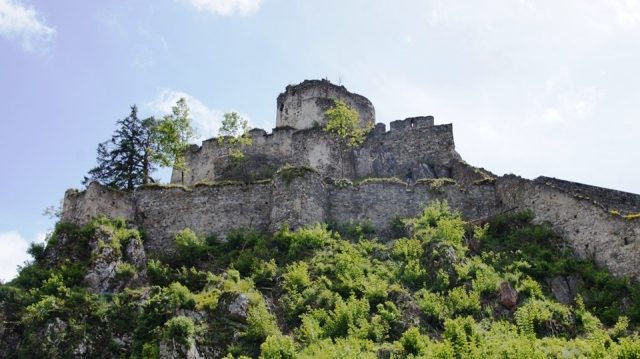
CastleBreitenstein-Klamm

Klamm Castle

Klamm Castle

The remains of the Castle can be visited

In the 11th century, there was a lordship in Klamm, administered by ministeriales of the Formbach family. However, these Lords of Chlamme are only documented between the years 1109 and 1144.

After 1158, they appear as followers of the Styrian margraves. Thus, Ortolf II of Klamm is referred to as ministerialis marchionis in the sixties of the 12th century. With his nephew Wigand II, the Lords of Klamm died out in 1211. The castle then likely passed to the Lords of Pitten, who were related to them. Hermann II of Klamm-Pitten sold his shares in the lordship to Dukes Albrecht, Friedrich, Leopold, and Otto in 1339. These then pledged Klamm to Heinrich von Rappach.

The lordship remained in the possession of his descendants as a pledge until the beginning of the 15th century and was then redeemed. Since Emperor Frederick III wanted to maintain control over the Semmering road, he only appointed administrators. When Matthias Corvinus occupied large parts of Lower Austria, Klamm, defended by administrator Hans Aichelperger, was fiercely contested. It could only be taken by the Hungarians after a prolonged siege in 1487. When Emperor Maximilian I regained possession of the castle, he initially reappointed administrators. In 1518, Siegmund Freiherr von Herberstein took over Klamm as a pledged possession. However, the castle was soon not well maintained, so that by 1571, upon its return to the sovereign, it already showed severe damage. The administrators who subsequently served took just as little care of the structural preservation as the rapidly changing pledge holders.

It was not until Matthias Wägele von Walsegg, who received the lordship from Emperor Ferdinand III as a free holding in 1642, that significant sums were invested around 1663 in improving its defensibility. However, they left the mountain fortress and made their magnificently developed Stuppach Castle the center of their extensive domain. Klamm only became a ruin at the beginning of the 19th century. In 1801, a lightning strike caused part of the buildings to collapse. In 1805, the castle was burned down by French soldiers. Countess Karoline Sternberg sold the lordship in 1830 to Prince Johann I of and to Liechtenstein, who had the most necessary preservation work carried out. In 1942, it again passed into private ownership. Three years later, it was occupied by the Russians. It currently belongs to Mr. Richard Worahnik.

Take Mobile History with you

You are reading this text for free. Premium adds what matters on the road: descriptions read aloud, sites found through your camera, whole regions taken offline.

  • Every description, including the ~17,700 Premium sites
  • Audio guide: have descriptions read to you on location
  • AR finder: see sites through your camera, with distance and bearing
  • Unlimited saved sites

14 days free, then from €2.99 a month. Cancel anytime.

Source: Wikipedia · Licence: CC BY-SA 4.0 · Image: https://commons.wikimedia.org/wiki/File:Ruine_Klamm_Breitenstein,_%C3%96sterreich.JPG

This description draws on the facts documented in the linked Wikipedia article; Wikipedia content is licensed under CC BY-SA 4.0. Wording and editing: Mobile History.

Location: 47.6600, 15.8675