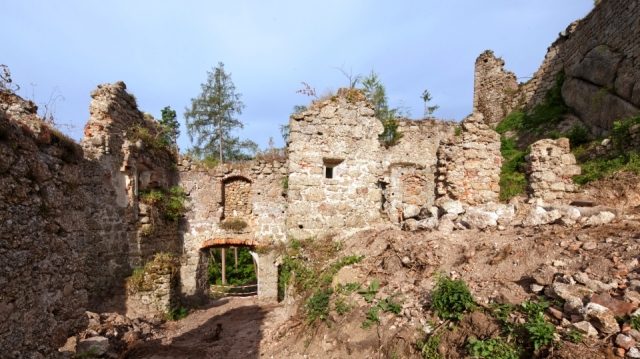
The remains of the Castle can be visited
Klingenberg Castle

The castle ruin Klingenberg is a hilltop castle presumably built in the 11th century by the Lords of Perg, approximately 2.3 kilometers northeast of St. Thomas am Blasenstein in the Perg district in the Mühlviertel region of Upper Austria.
The ruin, left to decay, is located on a wooded hilltop at 672 m above sea level, roughly equidistant from St. Thomas am Blasenstein and Pabneukirchen. From the forester's house/manor farm in Untermaselsdorf, the complex can be reached in about fifteen minutes on foot via a forest path.
Description+
The castle complex was built entirely of ashlar stones on three levels and comprised a total built-up area of 3061 m². In the northwest, at the highest point, is the keep, the southern half of which collapsed in 1855. High remnants of the northern half of the wall still protrude into the completely wooded surroundings of the ruin. A breach in the wall allows a view of the castle ruin Ruttenstein from the keep. From the keep towards the southeast, on three descending plateaus, were: The palas connected to the keep with a battlement on the outer wall, the first outer bailey from the 15th century with a cistern over 100 m deep, the second outer bailey with a large, flat courtyard and a gatehouse with a wide late Gothic arched gate. The ruin has been left to decay since the 17th century, and no preservation measures are currently being undertaken.
Klingenberg Castle was built and inhabited in the 11th century by the noble family of Perg-Machländer. By inheritance, the complex then passed first to the family of Clam-Velburg, whose last heir, Count Ulrich, did not return from the crusade in 1217, after which Klingenberg passed to Duke Leopold VI. In the princely urbarium of 1220/40, the possessions belonging to the Klingenberg lordship are listed: 13 fiefs and six farmsteads. Klingenberg initially remained in ducal possession and thus passed from the Babenbergs and Ottokar Přemysl to the Habsburgs, who pledged the lordship with other possessions to the Lords of Walsee, who owned the castle until 1358. The mortgage deed was redeemed in that year by Duke Albrecht II, but the castle was pledged to Hans von Traun shortly thereafter. In 1395, Duke Albrecht III gave Klingenberg to the brothers Wenzel and Ernst Preuhafen for life as a Leibgedinge (life annuity), in exchange for other estates and for the obligation to maintain the castle. The pledged possession later changed hands to several noble families: the Rohrbacher (from 1433), then the Neudecker, the Liechtensteiner (until 1490), the Schneckenreuter, and the Prüschenk (from 1491). In 1500, the pledged possession changed to Laßla Prager of Windhaag (County of Windhaag near Windhaag bei Perg). The long list of owners continues: in 1524 Klingenberg came to Achaz von Losenstein, in 1527 to the Steyr citizen Georg Kremser, who was followed in 1536 by Sebastian Kremser.
In 1588, Lorenz Schütter acquired the Klingenberg lordship, including the market and parish of Münzbach, with the following purchase agreement:
August 10, 1588, Crauiston on the Polish-Ruthenian border Archduke Maximilian, King of Poland, allows Lorenz Schütter, Oberdreissiger in Ungarisch-Altenburg and for 22 years servant of his sister the Queen of France and his brother Ernst, who for the Archduke paid the purchase amount for the Klingenberg lordship according to the purchase agreement with Emperor Rudolf II of March 11, 1588, in the amount of 12204 Gulden 6 lb. 20 d. on March 19 into the Vizedomamt in Vienna from his own funds, to be hereditarily transferred to him as free property by his chamberlain Hanns Jakob Löbl zu Greinburg. Signature of the Archduke. Source Regest: Repertorium Waldhausen S. 150, Nr. 474
Klingenberg is also mentioned among the refuge castles designated in 1594 in view of the Turkish threat. In 1630, Klingenberg, along with the market of Münzbach, was sold to the Waldhausen Canons' Monastery. The monastery withdrew the administration from the castle and left the complex to decay. Subsequently, Klingenberg was mostly inhabited only by gatekeepers. In 1750, a total of 47 subject houses belonging to the Klingenberg lordship were mentioned. Fire and lightning accelerated the further decay of the complex, which was occasionally still inhabited by officials. After the dissolution of Waldhausen Monastery by Emperor Joseph II, the lordship, the castle, and the manor farm at Klingenberg, as well as the associated forest, passed to the Linz Cathedral Chapter, which still owns Klingenberg today. In 1855, a part of the keep collapsed. Until the 20th century, the castle was still inhabited by poor residents; today, Klingenberg is entirely a ruin.
Take Mobile History with you
You are reading this text for free. Premium adds what matters on the road: descriptions read aloud, sites found through your camera, whole regions taken offline.
- Every description, including the ~17,700 Premium sites
- Audio guide: have descriptions read to you on location
- AR finder: see sites through your camera, with distance and bearing
- Unlimited saved sites
14 days free, then from €2.99 a month. Cancel anytime.
Source: Wikipedia · Licence: CC BY-SA 4.0 · Image: http://www.wehrbauten.at
This description draws on the facts documented in the linked Wikipedia article; Wikipedia content is licensed under CC BY-SA 4.0. Wording and editing: Mobile History.
Location: 48.3244, 14.7887