CastleKohren-Sahlis

Kohren Castle

Kohren Castle

The remains of the Castle can be visited.

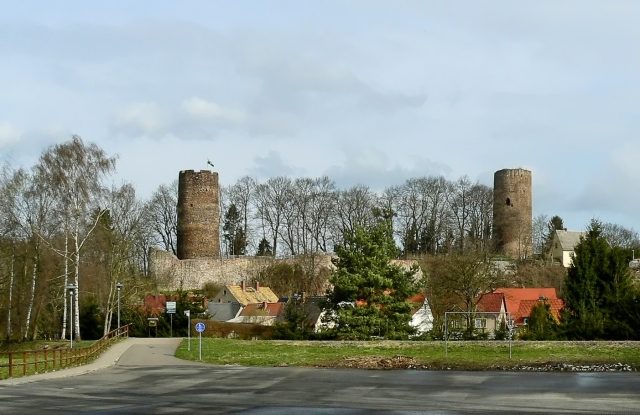
Kohren Castle, also known as Chorun or Sahlis, is an imposing ruin of a hilltop castle on the Burgberg (Castle Hill) in the town of Kohren-Sahlis in the district of Leipzig in Saxony.

The origin of the town of Kohren can be traced back to the period of Slavic settlement in the early Middle Ages. In 974, Emperor Otto II gifted the forest between the Saale and Mulde rivers to the Bishop of Merseburg. Kohren was not yet mentioned here. However, Bishop Thietmar of Merseburg reported almost 40 years later in his chronicle, written around 1010, that Chorin also belonged to the properties gifted at that time. Thietmar himself stayed in Kohren in 1018 and "confirmed all who appeared." He wrote of a ten-day stay. This presupposes the existence of a fortified estate or a burgward center.

In 1190, the noble Lords of Kohren appeared as imperial free owners of the castle. They established their rule in Kohren in the second half of the 12th century as part of the German eastward expansion.

In 1216, the Lords of Kohren sided with the city of Leipzig in its disputes over supremacy with Margrave Dietrich of Meissen. After initial successes, Leipzig and the allied Pleissenland imperial knighthood were defeated. Dietrich subsequently ordered the destruction of Kohren Castle in 1220. However, the castle must have been rebuilt by 1240. The visible building fabric today dates from this construction phase. The west tower was built first. Approximately 50 years later, the castle was expanded, and a second keep was erected. The reasons for the expansion are unknown.

The immediate imperial rule of the Lords of Kohren ended at the beginning of the 14th century. They were last mentioned in documents in 1303. Various noble families, such as the von Schönburg, Leisnig, or the Vögte von Plauen, were subsequent owners of the castle.

It is reported that Kunz von Kaufungen stayed in the castle on the night before the abduction of the Wettin princes (July 1455). After Kaufungen's execution, the castle is said to have been razed to erase all memories of the robber.

It is confirmed that in the second half of the 15th century, the Lords of Einsiedel were the owners of the castle (cf. parents of Melchior von Meckau). They moved their residence to Gnandstein, and Kohren Castle was abandoned as a residence. As was common practice, the buildings were gradually dismantled to obtain building materials. For example, the Kohren deacon Scheubner reported that in 1604 and 1605, stones were quarried from the old castle over a length of 40 meters and transported to the church wall.

During the Thirty Years' War, the castle was briefly put back into a defensible state. The extent of construction work carried out at that time is unknown. After the war, several residential houses were built on the castle grounds. However, the living situation was apparently so unfavorable that they were gradually abandoned again. The last castle house was demolished in 1900.

In 1928, excavations were carried out by the local castle association. Further excavations took place in 1965 by the State Museum of Prehistory Dresden.

Take Mobile History with you

You are reading this text for free. Premium adds what matters on the road: descriptions read aloud, sites found through your camera, whole regions taken offline.

  • Every description, including the ~17,700 Premium sites
  • Audio guide: have descriptions read to you on location
  • AR finder: see sites through your camera, with distance and bearing
  • Unlimited saved sites

14 days free, then from €2.99 a month. Cancel anytime.

Source: Wikipedia · Licence: CC BY-SA 4.0 · Image: Thomas Eichler

This description draws on the facts documented in the linked Wikipedia article; Wikipedia content is licensed under CC BY-SA 4.0. Wording and editing: Mobile History.

Location: 51.0194, 12.6011