The castle ruins can be visited.
CastleJena - Kunitz
Kunitzburg Castle (Gleißberg Castle)
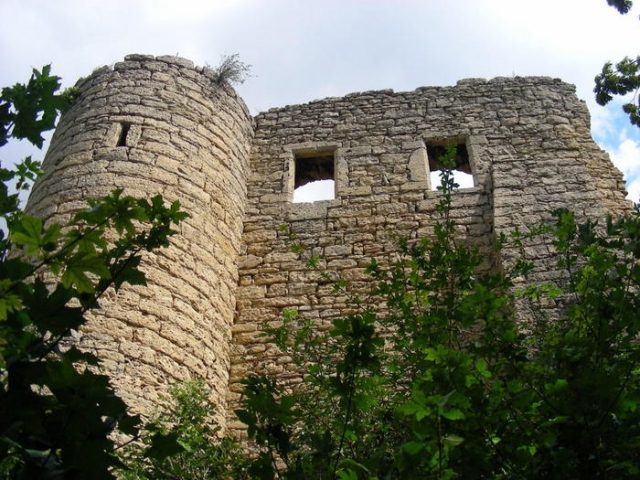
Gleißberg Castle, today mostly called Kunitzburg after the Jena district of Kunitz located below it, is the ruin of a hilltop castle at 325 m above sea level (foundations) five kilometers northeast of the city at the northern end of the so-called "Horseshoe". This is formed by the Jenzig and the steep Großer Gleisberg, which projects westwards into the Saale valley. The ruin belongs to the Kunitz area, but the border to the Golmsdorf area runs a few meters downhill.
History+
According to J.C. Zenker, the first owners of the castle were probably the Lords and Bailiffs of Glisberg. A bailiff Erwin von Glisberg built a castle on Veitsberg in 974. Another Lord of Glisberg, Walther von Glisberg, brother of the "fat" Bishop Hildeward of Naumburg, founded the Scottish monastery in Erfurt in 1036. On July 9, 1075, a Herman von Glizberg decided the battle at Homburg Monastery. The wife of Heinrich von Groitzsch, Bertha von Glizberg (also Bertha von Gelhausen), childless, founded the monastery in Thalbürgel, the place of her parents' graves, in 1132, and a little later, after the death of her brother Ekbert, she established a foundation in Thalbürgel "for seven pious sisters". The town of Bürgel, first mentioned in 1133 in the foundation charter of the monastery "zu dem Burgelin" (monastery in Thalbürgel), was the inherited property of Berta von Gleißberg. A free nobleman Liutoldus de Glizberg was mentioned in 1133 in the approval of Bishop Udo of Naumburg for the foundation of the Benedictine monastery of Bürgel. It is presumed that he died without descendants. Furthermore, especially in older literature, an alleged foundation charter from Bertha from 1133 is still under discussion. The charter reports on the death of her uncle Walther (patrui Woltheri) and her brother Ekbert von Gleißberg (Glizberk) and the consent of her relatives Otto von Kirchberg and Luthold von Gleißberg, as well as the names of her parents Damian and Ottilie. Otto Dobenecker had already recognized this document as a forgery by Hans Basilius von Gleichenstein from 1729. A frequently assumed connection with the "Counts of Glizburg (Gleisberg)" mentioned by Arnold von Quedlinburg as ancestors of the Bailiffs of Weida is also unlikely. It is more likely that Veitsberg was mistakenly read as Gleißberg, especially since no connections of the bailiffs to the area around Gleißberg can be proven for this period. Wolfgang Hartmann, in his research on the history of the Franconian noble family of the Reginbodonen, assumes the existence of an "Ekbert von Gleißberg" and sees in him the father of "Liutold von Gleißberg" and brother of Bertha (the founder of Bürgel Monastery and wife of Margrave Heinrich von Groitzsch). He also assigns the nobles of Camburg, the burgraves of Kirchberg-Kapellendorf and other families of the area to this branch of the Reginbodonen. In 1158, Frederick I, among other possessions from the inheritance of Wiprecht von Groitzsch, elevated the mountains Gleißberg (Glizberg) with the castle of the same name and Jenzig to imperial estates. A little later, the castle was occupied by imperial ministerials who named themselves after Gleißberg Castle. These vassals, who apparently originally came from the family of Pappenheim and Kalden from the Palatinate, were family members of the Lords of Weimar. The best-known representative is Walter von Weimar, first mentioned in 1154 as villicus of Allstedt among the witnesses of a royal charter. The family provided the bailiffs of the Scottish monastery of St. Jakob in Erfurt and were revered there as founders. A castrum Glizberg is only mentioned in documents in 1261. Allegedly, the Roman-German King Rudolf von Habsburg destroyed Gleißberg Castle in 1289/90 when he had 66 (60?) castles destroyed to regain imperial land in Thuringia. A document from December 17, 1293, issued by Walter IV von Gleißberg at the castle, makes this seem unlikely. This family is said to have died out with Walther von Glisberg in 1317. The Lords of Gleißberg failed to operate an effective economy in the 13th and 14th centuries. Properties belonging to the castle had to be sold several times. In addition, land was repeatedly lost through donations to the church and legal disputes. For reasons that are not precisely clear, probably due to lack of money, the Gleißbergers placed themselves under the feudal lordship of the Schenken von Dornburg around 1320, to whom they had previously been equal. They continued to reside as vassals at the castle until they sold it to Heinrich II Reuß von Plauen for 150 marks in 1327. Heinrich V von Gleißberg probably lived in Weimar thereafter, while his brother Johannes entered the clergy. The rule of the Gleißbergers thus ended. In 1327, the later Emperor Ludwig the Bavarian enfeoffed Heinrich II Reuß von Plauen with the castle. Either the feudal lordship of the Schenken von Dornburg was compensated, or Emperor Ludwig did not recognize it. Until at least 1350, Gleißberg was considered an imperial fief, as it is not listed as a Wettin property in the feudal book of Margrave Friedrich the Strict. In 1359, the fief was confirmed for the younger line Reuß von Plauen. Heinrich II von Reuß, at the time he bought the castle, was the guardian of the minor Margrave of Meißen Friedrich II and used his money to acquire the lordship for his family. Due to this fact, the Wettins laid claim to Gleißberg. From the mutual claims raised by the Wettins and the Bohemian kings, in Karl IV also German Emperor, on the lordship, the margraves emerged victorious. When Heinrich Reuß IV died in 1398, Margrave Wilhelm seized the lordship as a lapsed fief. The Reuß had managed to expand the lordship into a considerable manorial estate through effective economy and acquisitions. From the end of the 14th century, the castle was pledged to various rulers of Thuringia and ultimately incorporated into the Wettin administrative organism. Interesting is the valuation of the lordship in 1429, when it was sold for 4000 Rhenish guilders, the same value as Hildburghausen or Heldburg.
Source: Wikipedia · Licence: CC BY-SA 4.0 · Image: http://www.wehrbauten.de/thread.php?threadid=597&hilight=Lobdeburg
This description is a machine translation of an excerpt from the linked Wikipedia article. The source text was written by its authors, the translation is by Mobile History; like the original it is licensed under CC BY-SA 4.0.
Location: 50.9608, 11.6478