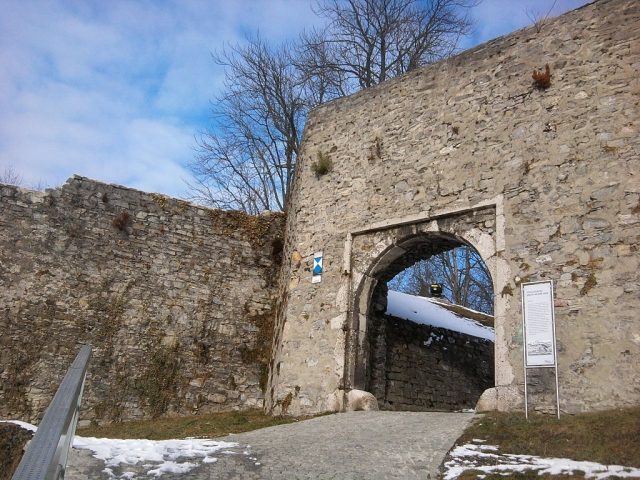
The remains of the Castle can be visited
Landskron Castle

Landskron is a former castle complex in Bruck an der Mur.
As early as 1263, during the Bohemian period under King Ottokar II, a small fortified complex existed on Bruck's Schlossberg, which was used for security and blocking tasks due to its strategically favorable location. The so-called "Castrum Prukke" was originally Eppenstein property and was probably administered by Herbord von Füllenstein (who called himself Herbord von Bruck). He was a seneschal of the royal governor Bishop Bruno of Olomouc and probably himself a city and castle captain.
In 1268, shortly after the new establishment of Bruck, another castle captain named Hermann von Krottendorf ("domino hermanno de Crottendorf castellano in Prukk") is mentioned. It is assumed that the fortress was built or expanded for the security of Bruck during its new establishment.
According to a document that can no longer be found, the fortress is said to have existed as early as 1112.
The castle was a princely fief of St. Lambrecht Abbey, mostly administered by minor nobles from the surrounding area (Krottendorfer, Timmersdorfer, Preitenfurter, Gaaler). Occasionally, the property was pledged to nobles or citizens. In 1345 to the Bruck citizen Hans Klemm d. J., in 1353 to Ulrich den Wasner, until 1478 to Lorenz Vogel, from 1505 to 1510 to Pankraz Kornmeß (builder of the famous Kornmesserhaus) and finally to the city.
During the Hungarian War (1460), an imperial caretaker was appointed, who kept six mounted men and 12 foot soldiers under arms.
Since 1461, the castle has borne the name Landskron.
On November 20, 1626, the city of Bruck acquired the Schlossberg from Emperor Ferdinand II. Due to financial difficulties, however, it had to sell its property on April 30, 1771, to the ironmaster Franz Xaver Fraydt von Fraydenegg-Monzello auf Nechelheim.
In 1792, during the devastating city fire (164 of the 166 houses were incinerated), the entire Landskron castle complex also fell victim to the flames. The stones were used by the population to rebuild the city.
In 1809, the Schlossberg was fortified under Imperial and Royal Field Marshal Count Gyulay against the French (coming from Leoben): ramparts were laid out, trenches were dug, and an underground powder magazine was built.
In 1815, Emperor Franz, at the request of the city administration, allowed six captured French cannons to be set up in the so-called "Stuckhütte," two of which are still present.
Today, not much remains of the formerly extensive complex. The walls (reinforced in 1642) were largely demolished. The remains of the main building located to the south housed a restaurant from 1907 and then a residential building, until it also burned down in 1979. In 1934, the main gate and the fortification tower (today the clock tower) were also demolished, but later rebuilt. Towards the end of the Second World War, several protective tunnels had to be driven into the mountain to protect the population. For some time now, the ruin has been illuminated at night by spotlights that change color depending on the temperature.
Take Mobile History with you
You are reading this text for free. Premium adds what matters on the road: descriptions read aloud, sites found through your camera, whole regions taken offline.
- Every description, including the ~17,700 Premium sites
- Audio guide: have descriptions read to you on location
- AR finder: see sites through your camera, with distance and bearing
- Unlimited saved sites
14 days free, then from €2.99 a month. Cancel anytime.
Source: Wikipedia · Licence: CC BY-SA 4.0 · Image: http://commons.wikimedia.org/wiki/File:Ruine_Landskron,_Bruck_an_der_Mur,_Austria,_2.jpg
This description draws on the facts documented in the linked Wikipedia article; Wikipedia content is licensed under CC BY-SA 4.0. Wording and editing: Mobile History.
Location: 47.4123, 15.2720