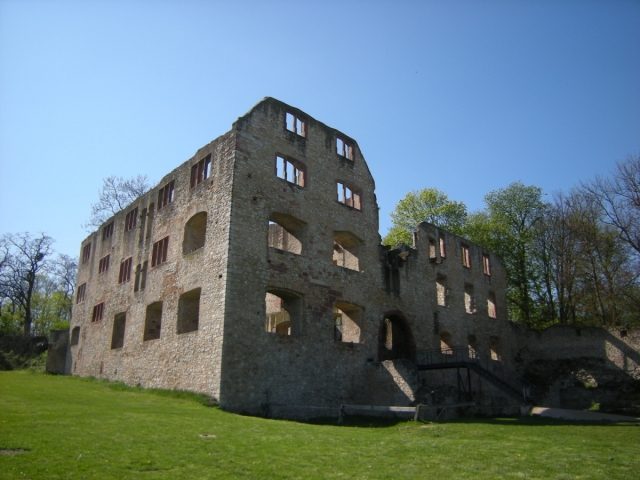
The remains of the Castle can be visited
Landskron Castle
Landskron Castle, formerly the Imperial Castle of Oppenheim, is the ruin of a hilltop castle near Oppenheim in the district of Mainz-Bingen in Rhineland-Palatinate. The castle is built on a strategically favorable point on the hill of Oppenheim.
Before Landskron Castle was built, a Salian or Staufer fortification probably stood in the same place, which was mentioned in 1118 as "praesidium" in the possession of King Henry V and destroyed by troops of Archbishop Adalbert of Mainz.
The castle itself was probably built at the beginning of the 13th century. The "Imperial Castle of Oppenheim" was first mentioned in a document in 1244. This castle was destroyed in 1257 and 1275 by the citizens of Oppenheim due to disputes with the burgmannen who claimed privileges.
After the last destruction, Rudolf von Habsburg "broke" the citizens and had them rebuild the castle by 1281. In 1375, the castle was pledged to Ruprecht of the Palatinate. It was intended to demonstrate imperial power near Electoral Mainz, so Ruprecht had the castle expanded. He was followed by his grandson Ruprecht III as owner of the castle, who also died there.
Elector Friedrich V initiated a palace-like conversion of the castle in 1615.
The castle burned down in 1621 during the city fire of Oppenheim. Only after the Thirty Years' War did the castle receive its current name "Burg Landskron" in 1668. In the Palatinate War of Succession, French troops blew up the keep in 1689. In the following years, the citizens used the ruin as a quarry.
In the 19th century, the ruin became the property of the city of Oppenheim, which erected an observation platform on the stump of the keep in 1875. In 1978, the castle was transferred to the state of Rhineland-Palatinate, which had the ruin extensively renovated and archaeologically investigated between 1990 and 1994.
Current Use+
The Landskron castle ruin is today an open-air backdrop for the theater festivals of the city of Oppenheim and for summer concerts, as well as the starting and ending point of a wine educational trail. Every year in the first half of May, a medieval market and spectaculum of the city of Oppenheim also takes place there. It is a special event for young and old every year. From the castle ruin, one has a view over the entire Bergstraße with the 517m high Melibokus in the Odenwald, Worms with the Worms Cathedral, Ludwigshafen with the BASF industrial area and Mannheim with the telecommunications tower, and if one also uses binoculars, one can even spot the 140 km distant Hornisgrinde in the Black Forest.
Layout+
Significant remains of the walls of the entire castle complex, including the three-story palas built in the 16th century, are still preserved. The architecture of the reconstruction shows traces of the respective prevailing building styles everywhere. The castle well from the 13th century is also extraordinary: it has a depth of almost 40 meters, containing a water column of approx. 2.50 meters. The water is now conveyed upwards with an electric submersible pump.
Take Mobile History with you
You are reading this text for free. Premium adds what matters on the road: descriptions read aloud, sites found through your camera, whole regions taken offline.
- Every description, including the ~17,700 Premium sites
- Audio guide: have descriptions read to you on location
- AR finder: see sites through your camera, with distance and bearing
- Unlimited saved sites
14 days free, then from €2.99 a month. Cancel anytime.
Source: Wikipedia · Licence: CC BY-SA 4.0 · Image: http://schloesserrundschau.de/pfalz/schloesser/bingen19.html
This description draws on the facts documented in the linked Wikipedia article; Wikipedia content is licensed under CC BY-SA 4.0. Wording and editing: Mobile History.
Location: 49.8552, 8.3527