CastleKönigslutter - Langeleben

Langeleben Castle
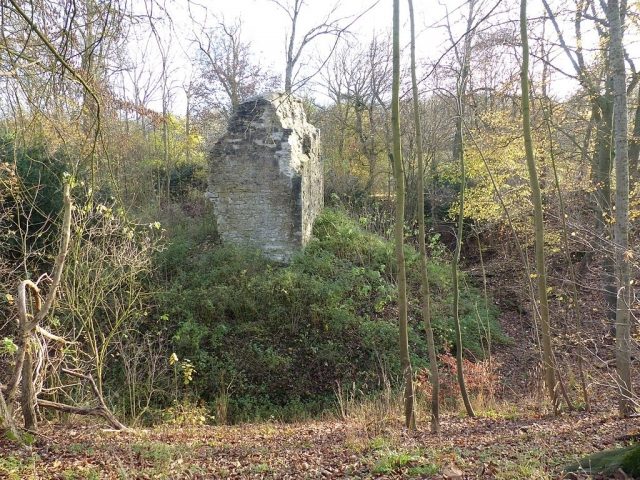
Langeleben Castle

The remains of the castle can be visited

Langeleben is a historic place at 260 m above sea level in the northern part of the Elm ridge in Lower Saxony and today belongs to the city of Königslutter am Elm. Three roads leading through the Elm intersect here. Formerly, there was a medieval moated castle, a hunting lodge, and a hamlet of the same name. The once most significant settlement on the forested Elm, with an average of 80 inhabitants, is now an approximately 50-hectare forest clearing, where the former forester's house, residential facilities, and a forest cemetery for burials under trees exist. The former castle still exists as a ruin, while the former settlement and the former hunting lodge of the Brunswick dukes from the 18th century no longer exist. Although the Schierpkebach stream originates in the spring house belonging to the garden of the hunting lodge, the drinking water reservoir located in Langeleben draws its water from Lelm and supplies Langeleben and Tetzelstein.

Middle Ages

The place Langeleben was first mentioned in a document in 1160 as Langelage, which was a forest estate. The ending -la(g)h indicates its location in a forest. A castle located there was mentioned in 1258. Langeleghe as a settlement (villa) was first attested in 1328, and by 1400 even had a priest. The ending -leben is formed analogously to neighboring places, such as Sambleben and Ampleben. Langeleben was the largest settlement on the Elm, which was due to the good water supply from the source of the Schierpkebach. During the 13th to 15th centuries, documents mention a knightly family of Langeleben. The Brunswick dukes, as feudal lords, also granted the castle to the Counts of der Asseburg during this time.

Reconstruction

In 1555, Heinrich von der Asseburg ceded the castle and settlement of Langeleben to Heinrich von Veltheim auf Destedt. The dwelling place was in a state of severe decay at the time. It is reported that the castle was "roofless and dilapidated" and the surrounding barns and cattle sheds had "fallen down." The new owner rebuilt the castle and the farm buildings. By 1609, the complex was restored, now having more economic than military significance. The new buildings (barns, bakehouse and brewery, gatehouse, summer house) stood north of the castle in a square courtyard. By 1605, there was already a substantial livestock population of 14 horses, 54 cattle, 83 pigs, and around 200 sheep. Several ponds were used for fish farming. In 1575, the inhabitants around the settlement had 14 Hufen, each with 30 Morgen of arable land on the Elm, which is now covered with forest.

Destruction and Hunting Lodge

During the Thirty Years' War, in 1626, the castle and settlement were destroyed by fire in connection with the siege of Wolfenbüttel. In 1661, Duke Anton Ulrich of Brunswick took over the ruins of Langeleben. He considered the place ancient ducal property and wanted it so that no other landowner could disturb him during hunting in the Elm. Only remnants of walls and a cattle shed remained. The Duke did not use the area but had it planted with trees. After his death, his son, Hereditary Prince August Wilhelm, inherited Langeleben. As a passionate hunter, he had a hunting and pleasure lodge built here starting in 1689. The construction is attributed to Hermann Korb. This was a two-story half-timbered building with a projecting central section. The building had a footprint of 38 x 18 m. Other buildings were erected around the lodge, including a dairy (1699), a barn (1700), a cavalier's house (1702), and a forge (1707). Behind the lodge, a 75 x 40 m pleasure garden was laid out in 1731. The source of the Schierpkebach, which sprang up next to the lodge, was enclosed with a spring house made of Elm limestone in 1705. A stud farm, which had up to 140 horses, was of great importance. The Langeleben field was initially surrounded by a fence and from 1731 by a six-kilometer-long hedge.

Ducal Castle Life

In the 18th century, Brunswick dukes spent not only a few hunting days but weeks and months at Langeleben. Due to the close ties between the Brunswick and Prussian ruling houses, Prussian kings Frederick William I and Frederick the Great were also guests. The constantly present ducal court at Langeleben was quite small for the time, comprising only about 15 people. The castle served as the starting point for large, aristocratic hunts in the Elm.

Renewed Decline

In the mid-18th century, a renewed decline set in. The stud farm was moved to Brunswick in 1754, and forest worker families were housed in the empty horse stables. In 1799, the castle was the forester's residence and later a oilcloth factory. In 1830, the neglected castle and some outbuildings were sold to a brick burner for about 3,000 Thalers, who demolished the buildings. In 1846, the forest administration began reforesting the former arable land of the settlement. The number of inhabitants in the remaining residential houses at that time was about 115 people.

Castle Ruin

Remains of the medieval moated castle, destroyed in 1626, still exist in the form of the gable end of a 12 m high building with 1.5 m thick masonry. The reduction in building mass is related to the construction of the nearby hunting lodge from 1689 onwards. During this time, 700 Fuder (approximately 600 cubic meters) of stones were removed from the castle ruin. Around 1600, a church is said to have been established in the stone building, whose ruin still exists today. Two bells are said to have hung in the tower. Today, the overall layout of the former castle is still quite clearly recognizable due to the preserved moat with pond and outer rampart. The settlement that belonged to it at the time can no longer be located.

Take Mobile History with you

You are reading this text for free. Premium adds what matters on the road: descriptions read aloud, sites found through your camera, whole regions taken offline.

  • Every description, including the ~17,700 Premium sites
  • Audio guide: have descriptions read to you on location
  • AR finder: see sites through your camera, with distance and bearing
  • Unlimited saved sites

14 days free, then from €2.99 a month. Cancel anytime.

Location: 52.2093, 10.8179