RuinStein im Allgäu

Laubenbergerstein Castle
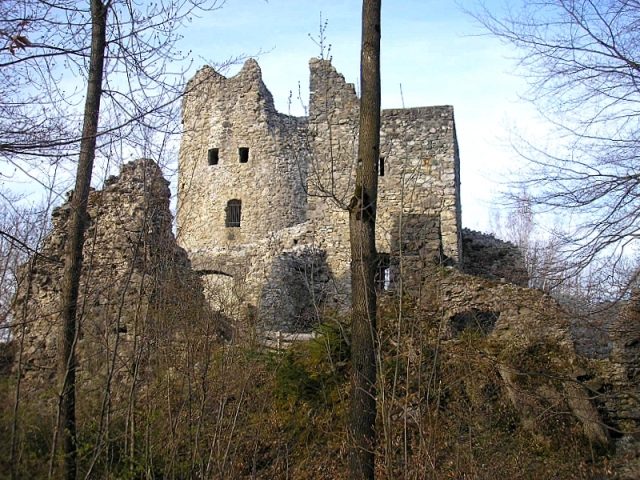
Laubenbergerstein Castle

The remains of the Castle can be visited


The ruin of the high to late medieval castle Laubenbergerstein (Laubenberg) is located about one kilometer north of Immenstadt in Allgäu (Oberallgäu district, Swabia) on a wooded hill above the Iller southwest of the district of Stein. The complex was renovated and partially rebuilt by the Immenstadt local history association from 1977 onwards.

The hilltop castle was probably founded as early as the 12th century by the bishops of Augsburg and occupied by a ministerialis. The fortification was probably intended to protect the important Iller crossing and the associated customs station.

In 1241, a Heinrich von Laubenberg zu Laubenbergerstein appears in a written source. The noble family of the Lords of Laubenberg also served the monasteries of St. Gallen and Reichenau in the 14th century. The family's ancestral castle was Alt-Laubenberg Castle near Grünenbach in Westallgäu.

As servants of the Prince-Bishopric of Augsburg, the Lords of Laubenberg originally exercised only low jurisdiction in their dominion. In 1446, Emperor Frederick III, however, granted Kaspar von Laubenberg high jurisdiction. The fortress was therefore attacked and plundered several times in 1449 by the henchmen of the angry Count Hugo von Montfort. Count Hugo resided at the nearby twin castle Rothenfels-Hugofels and apparently regarded the elevation in status of the Laubenbergs as a provocation. In addition, Isald von Syrgenstein, the widow of Hans von Laubenberg, is said to have acquired the civil rights of the nearby imperial city of Kempten at that time. The Montforter was at feud with the city at this time. Originally, the Laubenbergs lived in good neighborly relations with the counts. Walter von Laubenberg auf Stein was even appointed bailiff at Rothenfels between 1400 and 1404.

Kaspar von Laubenberg, Isald's very wealthy son, began the major expansion of Laubenbergerstein from 1450 after the attacks. The castle's appearance has since been dominated by the mighty artillery keep, which was renovated and partially rebuilt from 1977 onwards.

During the German Peasants' War, the rebels occupied the castle in 1525 and stole several cannons and firearms, including some arquebuses.

In 1559, the Laubenbergs left the hilltop castle and moved into their newly built castle in Rauhenzell. In 1588, the family was elevated to the status of Imperial Barons. In a source from 1629, the castle complex is already described as a partial ruin. At that time, the Prince-Bishopric complained about the condition of the castle and commissioned the Fluhenstein bailiff Straub to inspect it. The turmoil of the Thirty Years' War probably prevented the subsequent required repair of the episcopal fief.

From 1641, Margaretha von Laubenberg sold the roof tiles, thus initiating its complete decay. In 1647, the Prince-Bishopric seized the fief after the extinction of the Alt-Laubenberg line. The family branch on Laubenbergerstein had already died out in 1629. Between 1667 and 1806, the ruin was owned by the Barons Pappus von Tratzberg. The year 1806 brought the transition to Bavaria. However, the state soon returned the complex to the barons. When this family died out in 1934, the castle came to the Barons von Lerchenfeld.

In 1977, the Immenstadt local history association acquired the ruins and began restoration with the participation of the city of Immenstadt. At that time, on the heavily overgrown castle grounds, mostly only relatively low wall sections and foundations could be identified. The high western part of the gun tower and the main gate in the east were also severely endangered.

Description+

The castle complex was built on a freestanding, low rock outcrop on the Iller. The current castle path runs from the south around the castle complex and leads into the mighty main gate ("Bollwerk") in the east. Originally, the access road seems to have been in the north. The path then led relatively steeply through the largely filled-in neck ditch to the outer bailey plateau. Through two further gatehouses, one reached a square gate tower, behind which a wooden bridge spanned the neck ditch in front of the main castle. The gate tower was probably originally the keep of the high medieval castle.

On the western edge of the castle stands the mighty late medieval gun tower, which has been largely reconstructed today. In the 17th century, a wooden passage connected the large tower with the smaller gate tower. Behind a small courtyard, where carts could turn, was the palas, whose upper floors were built in half-timbered construction.

To the east, the castle was fronted by a zwinger system with a northern outer gate. The wall sections of this zwinger have almost completely disappeared. A short, unrestored remnant with a semicircular shell tower has been preserved in the southeast.

The small castle chapel was located southeast of the gate tower above the main gate and later largely collapsed into the neck ditch. A late Gothic altar wing from the chapel is kept in Rauhenzell Castle.

The appearance of the castle ruin today is largely shaped by the renovation and reconstruction measures of the Immenstadt local history association. Around 1975, the entire east side of the gun tower and the upper part of the gate tower were still missing. The other wall sections and gate systems were also renovated and partially rebuilt. The measures were initially somewhat arbitrary and did not always adhere to the historical original condition. Together with Treuchtlingen Castle in Middle Franconia, the ruin was therefore long considered by some castle experts to be a prime example of a failed castle renovation. Since 1998, the work has been scientifically supervised and carried out much more carefully.

The entire castle complex was built from the existing Nagelfluh rock, sandstone quarry stones, and river pebbles with half-timbered superstructures. Despite the small no-entry sign at the castle entrance, the grounds are freely accessible and safe to visit.

The Gun Tower+

The mighty artillery tower on the west side was built from 1450 onwards, after allegedly 200 horsemen of Count Hugo XIII von Montfort had attacked and plundered the castle in 1449. The count inhabited the twin castle Rothenfels-Hugofels, located about two kilometers to the west, whose few remains urgently need securing today. The east side of the keep is almost completely reconstructed. Some artillery embrasures with sandstone frames break through the wall shell. The tower can be climbed on special occasions and upon request.

Take Mobile History with you

You are reading this text for free. Premium adds what matters on the road: descriptions read aloud, sites found through your camera, whole regions taken offline.

  • Every description, including the ~17,700 Premium sites
  • Audio guide: have descriptions read to you on location
  • AR finder: see sites through your camera, with distance and bearing
  • Unlimited saved sites

14 days free, then from €2.99 a month. Cancel anytime.

Source: Wikipedia · Licence: CC BY-SA 4.0

This description draws on the facts documented in the linked Wikipedia article; Wikipedia content is licensed under CC BY-SA 4.0. Wording and editing: Mobile History.

Location: 47.5711, 10.2368