CastleZwettl-Friedersbach

Lichtenfels Castle
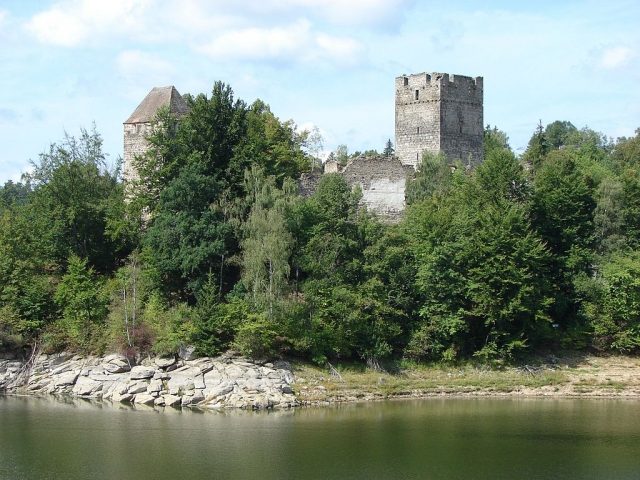
Lichtenfels Castle

The remains of the Castle can be visited

Lichtenfels Castle is the ruin of a hilltop castle near Peygarten-Ottenstein in the Waldviertel, Lower Austria, belonging to the city of Zwettl-Niederösterreich. Originally built on a wooded rocky outcrop of a mountainside, it now lies on a peninsula of the Ottenstein reservoir in the Waldviertel. It belongs to the village of Friedersbach.

Lichtenfels Castle was one of the smaller properties that bordered the possessions of the Kuenringer and originated from the possessions of the German kings. In the 12th century, these kings had granted the area to small noble houses to cultivate the Kamp region. Originally, these did not yet belong to the Duchy of Austria, but only joined in 1156.

Hartung von Rauheneck and his sons Albero, Otto, and Ortlof are documented in this area in 1136. He received this area as a fief from Duke Heinrich Jasomirgott and built the castle in the mid-12th century. The Rauhenecks, nicknamed the Tursen (= giants) and widely branched in Lower Austria, held the fief until 1335, before it fell back to the Duke.

The most famous of the Rauhenecks was Hugo der Turs von Rauheneck. He appeared in the first Austrian document, written in German, from 1248.

Later feudal lords included the Lords of Kapell, Georg von Dachsberg, and Jörg von Rappach until 1437. During this time, the castle served as a hiding place for the treasures and library of Zwettl Abbey from the plundering Hussites during the battles of 1427/28.

In the next two centuries, the feudal lords changed frequently. It was not until 1623 that Hans Unterholzer von Kranichberg bought the castle and lordship of Lichtenfels from the Emperor as a free property. In 1628, he united it with his lordship of Rastenberg. In 1774, everything was taken over by the family of Baron von Bartenstein. From then on, the castle fell into disrepair. As a result of the roof tax, Zwettl Abbey bought part of the roof in 1790. After the last inhabitant moved out in 1804, the castle visibly deteriorated.

Since 1872, the former lordship of Lichtenfels has been owned by the comital family Thurn-Valsassina.

Layout+

Only the castle chapel, dedicated to Saint Paul, is preserved and was a popular pilgrimage destination until the last century.

Take Mobile History with you

You are reading this text for free. Premium adds what matters on the road: descriptions read aloud, sites found through your camera, whole regions taken offline.

  • Every description, including the ~17,700 Premium sites
  • Audio guide: have descriptions read to you on location
  • AR finder: see sites through your camera, with distance and bearing
  • Unlimited saved sites

14 days free, then from €2.99 a month. Cancel anytime.

Source: Wikipedia · Licence: CC BY-SA 4.0 · Image: http://commons.wikimedia.org/wiki/File:Burgruine_Lichtenfels.jpg

This description draws on the facts documented in the linked Wikipedia article; Wikipedia content is licensed under CC BY-SA 4.0. Wording and editing: Mobile History.

Location: 48.5903, 15.3234