CastlePommelsbrunn

Lichtenstein Castle

Lichtenstein Castle

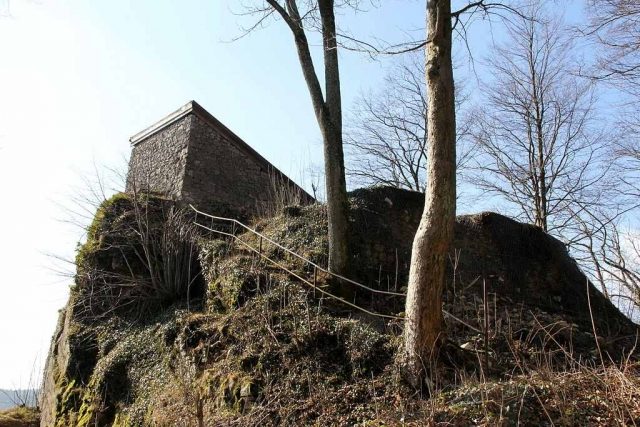
The remains of the Castle can be visited

The castle ruin Lichtenstein was a high medieval noble castle above the town of Pommelsbrunn in the municipality of the same name in the Middle Franconian district of Nürnberger Land in Bavaria. The ruin of the hilltop castle is freely accessible and serves as a viewpoint.

The ruin of the hilltop castle is located in the southern part of the Hersbrucker Alb, about 1080 meters northwest of the Protestant parish church of Sankt Lorenz above the village of Pommelsbrunn at an altitude of 507 m above sea level on a slope spur of the Schleußberg. The slope spur projects to the southwest and is bordered on its south side by the valley of the Högenbach, and on its west side by the valley of the Pegnitz.

Also on the opposite side of the Högenbach valley, on the so-called Mühlkoppe, stood a medieval castle, of which the castle site Altes Haus is the remnant. Nearby is also the castle ruin Lichtenegg and to the south the ruin of Reicheneck Castle above Lake Happurg. Also near Happurg is the castle site Hacburg and to the east the castle site Breitenthal near the village of Oed, and to the northeast the castle ruin Hauseck.

No archaeologically confirmed findings regarding the construction of Lichtenstein Castle are yet available, but due to its name, it could have been connected with the Staufer imperial castle Lichtenegg, which existed at the latest since the early 13th century. There was also a direct line of sight between the two castles. Ceramic finds also date back to the early 13th century.

Lichtenstein Castle first appeared in 1270 in the name of the ministerialis Heinrich von Lichtenstein; an "Agnes Lichtensteinerin" was mentioned in 1297. The ministerialis family of Lichtenstein was probably originally in imperial service and had connections to the powerful Schenken von Reicheneck. A 16th-century note states that the Lichtensteiners were once feuded, and the castle is said to have been destroyed during this time. Gustav Voit suspects this destruction in 1325, when during a feud between the Schenken von Reicheneck and the imperial city of Nuremberg over highway robbery, the Reicheneck castle "Turm im Weidental" was destroyed, and Hartenstein Castle was besieged by the Nurembergers. Lichtenstein Castle could also have been affected, as the Lichtensteiners were close to the Reicheneckers. However, there is no evidence for this.

In 1349, Lichtenstein Castle became a territorial possession when it came into the possession of the Palatine Counts; Ludwig Schenk von Reicheneck was the administrator of the Palatine Count's castle, in which the Lichtensteiners no longer had any rights. Lichtenstein was pledged by the Palatine Counts in 1353 to the German and Bohemian King Charles IV, who established a New Bohemian administrative office at the castle. The castle garrison consisted of the administrator, two mounted warriors, four guards, six foot soldiers, a tower keeper, and a gatekeeper.

The Bohemian rule did not last too long, because with the Treaty of Fürstenwalde of August 18, 1373, with which Emperor Charles IV wanted to acquire the Margraviate of Brandenburg, Charles had to sell a part of his New Bohemian empire and thus the office and castle of Lichtenstein to the Bavarian dukes in order to raise the purchase sum.

In 1391, the castle was pledged by the Wittelsbach dukes to Linhard von Henfenfeld, after which further pledge holders and administrators appeared. In 1419, it was ceded to the brothers Hans, Eberhart, and Wilhelm von Mistelbeck, who had claims against Duke Ludwig of Bavaria-Ingolstadt. The handover did not take place due to the Bavarian War.

In the Bavarian War between Duke Ludwig of Bavaria-Ingolstadt and his cousins, the Bavarian dukes of Landshut and Munich, Lichtenstein Castle was conquered and destroyed in June 1421 by Palatine Count Johann von Neumarkt-Neunburg, who was allied with Ludwig's opponents. In the reconnaissance of the imperial city of Nuremberg from 1503 to 1504, which listed all castles and fortifications in view of the soon-to-follow Landshut War of Succession, Lichtenstein is referred to as "an old broken castle". An entry in the Salbuch of 1516 also states that Lichtenstein was only a castle site. The district court of Sulzbach awarded the Mistelbeck brothers compensation in 1421 and again in 1422.

The castle ruin fell into increasing disrepair; in 1851, the Bavarian state sold it to Paul Wilhelm Freiherr Ebner von Eschenbach. Around 1855, in the spirit of awakening castle romanticism, he had the pseudo-ruin erected on the upper castle using existing masonry and an English landscape garden laid out in the area of the lower castle, which, however, has also fallen into disrepair again.

Today, the castle ruin is surrounded by forest and is partly overgrown with bushes. Several hiking trails from Pommelsbrunn and the surrounding area lead to the ruin. The medieval remains of Lichtenstein Castle, especially those of the lower castle, are severely threatened by decay.

Take Mobile History with you

You are reading this text for free. Premium adds what matters on the road: descriptions read aloud, sites found through your camera, whole regions taken offline.

  • Every description, including the ~17,700 Premium sites
  • Audio guide: have descriptions read to you on location
  • AR finder: see sites through your camera, with distance and bearing
  • Unlimited saved sites

14 days free, then from €2.99 a month. Cancel anytime.

Source: Wikipedia · Licence: CC BY-SA 4.0 · Image: http://de.wikipedia.org/wiki/Datei:Lichtenstein_02.jpg

This description draws on the facts documented in the linked Wikipedia article; Wikipedia content is licensed under CC BY-SA 4.0. Wording and editing: Mobile History.

Location: 49.5080, 11.4996