The remains of the Castle can be visited
CastleOberneukirchen-Lobenstein
Lobenstein Castle
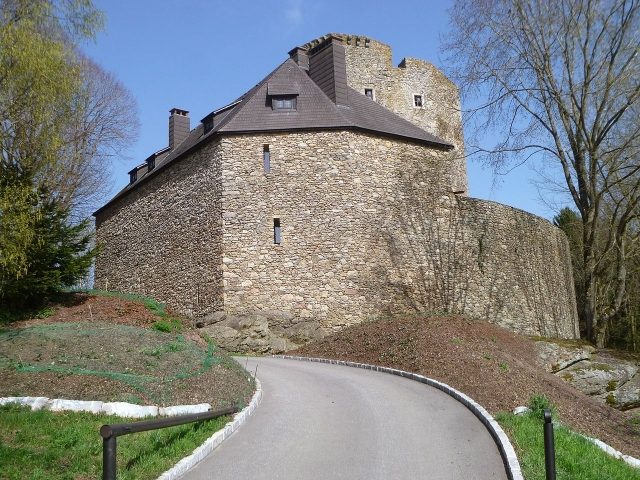
The castle ruin Lobenstein is located near Oberneukirchen in the Mühlviertel, district Urfahr-Umgebung in Upper Austria. The former hilltop castle is situated approximately 2½ km south of Oberneukirchen on a forested, flat hilltop rising from a low-lying area, at an elevation of 700 m above sea level, near the towns of Oberneukirchen and Zwettl an der Rodl.
The Lobensteiners were vassals of the Lords of Waxenberg and members of the Piber family. They first appeared in documents in 1242 with Ulrich der Piber zu Lobenstein. As vassals of Waxenberg, they had built this castle for border and road protection. The Lobensteiners were loyal followers of the Habsburgs in the fight against the Přemyslids. In 1264, Ulrich von Lobenstein built the church of Zwettl an der Rodl. After his death, inheritance disputes arose between his sons Peter and Ulrich over Lobenstein and Freudenstein, which were only resolved in 1297. In 1357, Hans Lobenstein († 1361) followed, who had the castle administered by his burgrave Friedl Kaplan. His successors in 1365 were Wernhard der Kaplan and Wernhard Nimmervoll. Inheritance disputes in the 14th century led to the family's economic ruin, and so Jans von Lobenstein had to divest himself of his property in 1365. The castle complex passed to the Starhembergers in that year. Lobenstein was granted as a princely fief. The Starhembergers united Lobenstein with the lordship of Wildberg, and the now useless complex was left to decay. In 1499, the lordship of Lobenstein included 127 subjects; by the mid-16th century, the number of subjects rose to 287. Already in 1562, the complex was described as dilapidated.
At the beginning of the 20th century, a reclusive and distrustful eccentric named Michael Kitzmüller, known as Schlossmichel, inhabited the ruin. He earned his living by repairing and manufacturing compasses, watches, and magnifiers. In 1923, he was murdered, as it was suspected he possessed gold treasures. Since 1981, conservation measures have been implemented.
Source: Wikipedia · Licence: CC BY-SA 4.0 · Image: http://commons.wikimedia.org/wiki/File:Oberneukirchen_%28Burgruine_Lobenstein-1%29.jpg
This description draws on the facts documented in the linked Wikipedia article; Wikipedia content is licensed under CC BY-SA 4.0. Wording and editing: Mobile History.
Location: 48.4447, 14.2375