CastleMöckern-Loburg

Loburg Castle

Loburg Castle

The remains of the Castle can be visited

p3w1

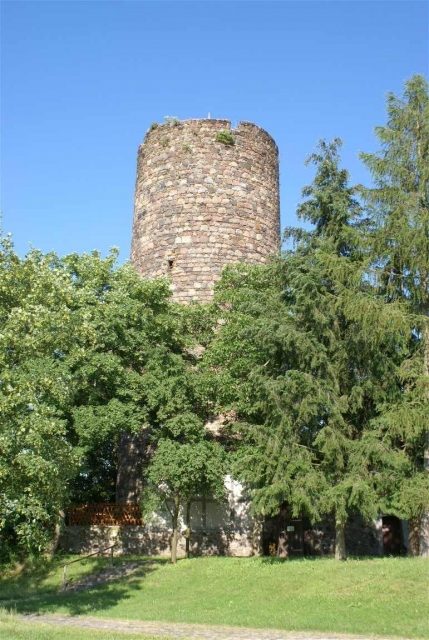
Loburg in Loburg is the ruin of a small castle in the Jerichower Land district in Saxony-Anhalt. Only the imposing keep and a barrel-vaulted cellar remain of the medieval Loburg Castle. The other buildings date from the 18th/19th century. In addition to the small castle, Loburg also has a monastery ruin from the 12th century. This is a waypoint on the Romanesque Road that runs through Saxony-Anhalt.

From the 8th to the 10th century, a Slavic rampart castle existed on an artificially raised hill. The burgward was located in the Slavic Gau Moroszani, which had been occupied by Henry I in 928/29. It was the center of a burgward district, which was first mentioned in 965 in a document by Otto I, when the burgward was handed over to the Moritzkloster. During the great Slavic uprising in 983, it fell into the hands of the rebels. In 1114, Wiprecht von Groitzsch, who had to submit to the Archbishop of Magdeburg, was brought to Loburg. Its Vogt was a non-Christian Slav named Pribor(n). Loburg was first explicitly mentioned as a castle in 1292.

The property, located on the edge of the archiepiscopal dominion, was frequently granted and pledged in the following periods. The late medieval stone buildings still existing today were probably erected by the Santersleben family in the 14th century. They called themselves Burgraves of Loburg and served the Archbishopric of Magdeburg. The frequent pledges continued until 1609, when the cathedral chapter bought back the castle from the bankrupt von Mandelsloh family and administered it as an office itself from that point on. Already in 1611, the castle was described as uninhabitable. In 1680, the Loburg office passed into the possession of Kurbrandenburg. The newer, partly still existing office buildings were erected after the Thirty Years' War on the area of the outer bailey, while the ruins of the main castle were gradually dismantled, as was often customary at the time, to obtain building material.

Around 1720, an official residence began to be built over an old cellar, the gatehouse was repaired, and farm buildings were constructed. The old bridge was replaced by a stone structure in 1756. In 1831, the castle came into the possession of Friedrich August von Wulffen. He had the old official residence rebuilt over the medieval cellar. The gatehouse was also extensively renovated. In 1870, the buildings were representatively converted to be rented to the district administrator, Baron von Plathow.

Take Mobile History with you

You are reading this text for free. Premium adds what matters on the road: descriptions read aloud, sites found through your camera, whole regions taken offline.

  • Every description, including the ~17,700 Premium sites
  • Audio guide: have descriptions read to you on location
  • AR finder: see sites through your camera, with distance and bearing
  • Unlimited saved sites

14 days free, then from €2.99 a month. Cancel anytime.

Source: Wikipedia · Licence: CC BY-SA 4.0 · Image: Roland Neubert, Halle (Saale)

This description draws on the facts documented in the linked Wikipedia article; Wikipedia content is licensed under CC BY-SA 4.0. Wording and editing: Mobile History.

Location: 52.1173, 12.0687