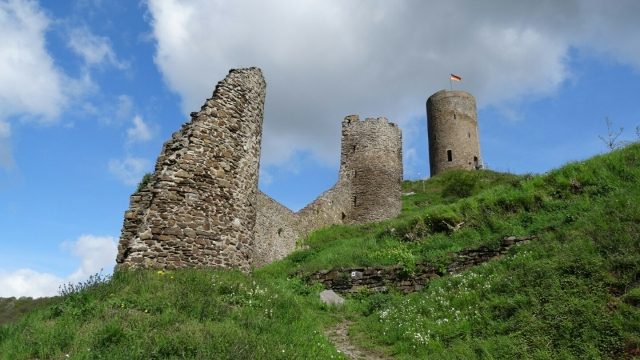
The remains of the Castle can be visited
Löwensburg Castle
Above the Eifel community of Monreal, in the Elzbach valley, on a 350 m above sea level mountain spur, rise the neighboring ruins of Löwenburg, also known as Monreal Castle, and Philippsburg. The latter is popularly known as "das Rech" (the Roe Deer).
The spur castle was first mentioned in a document in 1229. Its builder is considered to be Count Hermann III of Virneburg, who, piquantly, built the complex on the land of his brother Philipp after a partition agreement. The resulting fraternal dispute was later settled in a compromise, and Philipp ceded his rights to the region to his brother.
The Philippsburg was also built in the 13th century. It owes its nickname "Rech" to its smaller size in relation to the "Löwe" (Lion). Regarding its existence, there are two different theories: The first assumes that the Philippsburg was merely built as an outwork or outer defense of the Löwenburg, but according to local tradition, the castle is said to have been Philipp's "answer" to his brother's unauthorized construction of the Löwenburg.
Although Monreal was located in the territory of Trier, the Counts of Virneburg always maintained good relations with the Electorate of Cologne. Their main goal was the acquisition of ecclesiastical benefices for the numerous offspring of the Virneburg counts. Thus, Heinrich II of Virneburg, born in 1244 or 1246, first became provost of the cathedral in Cologne. In 1306, at around 60 years of age, he was elected Archbishop of Cologne and remained so for 26 years. He was tasked with consolidating the Archdiocese of Cologne in the decades after the Battle of Worringen in 1288 and the associated loss of power.
From the good relations of the Virneburgers with Cologne and the fact that Heinrich II of Virneburg carried out constant raids on the nearby Trierian city of Mayen, a feud ignited between the Archbishop of Trier and the Virneburgers. Through the mediation of the Archbishop of Cologne, the two parties agreed that Heinrich II should enfeoff Monreal Castle to Trier after the death of his father Robert III of Virneburg, which also happened. In Trier, the Virneburgers later also acquired ecclesiastical offices; in the 14th century alone, they provided six members of the cathedral chapter.
Under Robert IV of Virneburg, who was Lord of Monreal between 1384 and 1445, the complex was further expanded and served several times as a widow's residence for the count's family in the 14th and 15th centuries. At the beginning of the 16th century, Monreal had already replaced the count's family's ancestral castle in Virneburg as their main residence.
When the Virneburg lineage died out in the male line with the last Count Cuno in 1545, Heinrich von Leiningen followed as a vassal. But after 1555, the Elector of Trier did not re-grant the fief, but appointed his own bailiff.
The stately fortifications suffered heavy damage in 1632 during the futile attempt to defend the city against Swedish troops and were finally destroyed by French troops in 1689 during the War of the Palatine Succession. In 1815, the ruins came into Prussian state ownership as a result of secularization and remained there until the state castle administration (today: Directorate Castles, Palaces, Antiquities of the General Directorate for Cultural Heritage Rhineland-Palatinate) became the owner of the main castle. From 1970 onwards, various structural safeguards were carried out there, so that the castle ruin is now freely accessible.
Current State+
Large parts of the ruins of Löwenburg are preserved, from which the former appearance of the castle can still be clearly deduced. The remains of the 25-meter-high keep with its three-meter-thick walls are particularly visible from afar. Its high entrance faces the valley, i.e., the side facing away from the enemy. In the 15th century, the tower was protected by a sharply projecting shield wall against the firearms emerging at that time.
The main castle is secured by two neck ditches: an arched one protects it towards the higher mountain slope in the northwest, another separates it from the eastern outer bailey, of which only a few remains are preserved.
The outer walls of the early Gothic castle chapel were once reinforced by an encasement. And since its former vaults also collapsed, the remains of this sacred building are now difficult to recognize as such.
Some significant remains of the Philippsburg have also been preserved. These include primarily the northwest tower and the south wall, which has been restored since 2007/2008.
Take Mobile History with you
You are reading this text for free. Premium adds what matters on the road: descriptions read aloud, sites found through your camera, whole regions taken offline.
- Every description, including the ~17,700 Premium sites
- Audio guide: have descriptions read to you on location
- AR finder: see sites through your camera, with distance and bearing
- Unlimited saved sites
14 days free, then from €2.99 a month. Cancel anytime.
Source: Wikipedia · Licence: CC BY-SA 4.0 · Image: Jörg Heldt
This description draws on the facts documented in the linked Wikipedia article; Wikipedia content is licensed under CC BY-SA 4.0. Wording and editing: Mobile History.
Location: 50.3004, 7.1604