CastleLosenstein

Losenstein Castle

Losenstein Castle

The remains of the Castle can be visited

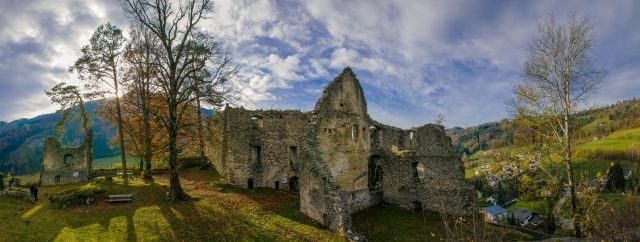
Losenstein Castle is a castle ruin in Losenstein (Upper Austria) and rises above the town on an approximately 60 m high dolomite rock (castle rock). It is one of the largest and oldest castle ruins in Upper Austria. Built in the 12th century by the Styrian Ottokars, the castle consists of a main castle and a slightly lower-lying outer bailey. From 1252, the Lords of Losenstein (Losensteiner) were the owners of the castle.

The castle ruin offers a magnificent view of Losenstein, the Enns Valley, the Enns river, and the foothills of the Alps towards Styria. The Losenstein ruin is freely accessible.

The castle largely still consists of its outer walls, but Gothic window openings, loopholes, and large gate arches are still clearly recognizable. The individual rooms such as the church, living area, inner courtyard, and utility rooms are also precisely definable.

Historical Classification+

The Styrian Otakars erected this castle around 1150 to protect against invading troops into Styria. In 1170, the castle was first mentioned in a document and in 1252 passed to Dietmar von Steyr, who received it from King Ottokar II Přemysl in exchange for the city of Steyr. From this point on, Dietmar and his descendants called themselves von Losenstein. The Lords of Losenstein continuously owned the castle until their extinction in 1692. Some of the gravestones for the Losenstein family can be found in Garsten Abbey (Losenstein Chapel). Afterwards, the complex passed by inheritance to the House of Auersperg, who finally sold the castle to the state of Upper Austria in 1905.

Construction of the Castle+

The castle complex was built around 1150. According to a document from 1252, the primary goal of the castle, together with Klaus Castle in the Steyr Valley, was to protect access to the interior of Styria. Its elevated position above the center of Losenstein allows a view of large parts of the Enns.

Structure of the Castle+

Two structures form the castle complex: the main castle (2,200 m²) and, to its west, at a distance of about 45m, an outer bailey measuring 400 m². The original path led from the Meierhof (today Gasthof Zur Burgruine) to the left, diagonally up the slope, and in a bend to the main gate on the southeast side. The slopes were not forested then as they are today but bare, to offer no shelter to enemies.

The palas is probably the oldest part of the castle. The ground floor is built on rock and accessible from the castle courtyard through a gate. Noteworthy is the masonry of limestone rubble, which has been exposed to decay for about 300 years without a roof, but is relatively well preserved. The various loose variations of late Romanesque (in terms of the design of the window arches) already hint at the new, Gothic style. The recognizable transition between the two medieval architectural styles makes Losenstein Castle particularly interesting from an art-historical perspective.

The outer bailey in Losenstein probably dates from the first half of the 14th century and was intended, among other things, to prevent besiegers from establishing themselves on this flatter section. Also, there was almost certainly no connection between the outer and main castles. A gorge is said to have separated the two parts, which in turn would be a rarity in castle building history.

The keep was a prominent feature, visible from afar. One had to climb five to six meters from the west side to the entrance using a ladder. The current door opening was added later. The lower part also served as a castle dungeon, hence the colloquial name "Hungerturm" (Hunger Tower).

Current Use+

The Losenstein castle ruin has been the venue for theater plays on various occasions (e.g., by the Losenstein Castle Theater Group). It is a popular place for guided tours for school classes and history enthusiasts and recently houses the Burgfelsen climbing area. The preservation of the historic buildings and the maintenance of the possibility for various leisure activities at this unique cultural monument have the highest priority. Child-friendly signage allows interested visitors from near and far to learn about the historical and cultural significance of the Losenstein castle ruin.

Take Mobile History with you

You are reading this text for free. Premium adds what matters on the road: descriptions read aloud, sites found through your camera, whole regions taken offline.

  • Every description, including the ~17,700 Premium sites
  • Audio guide: have descriptions read to you on location
  • AR finder: see sites through your camera, with distance and bearing
  • Unlimited saved sites

14 days free, then from €2.99 a month. Cancel anytime.

Source: Wikipedia · Licence: CC BY-SA 4.0 · Image: http://commons.wikimedia.org/wiki/File:Burgruine_Losenstein_Innenansicht.JPG

This description draws on the facts documented in the linked Wikipedia article; Wikipedia content is licensed under CC BY-SA 4.0. Wording and editing: Mobile History.

Location: 47.9240, 14.4377