CastleEssen - Kettwig

Luttelnau Castle

Luttelnau Castle

The remains of the Castle can be visited

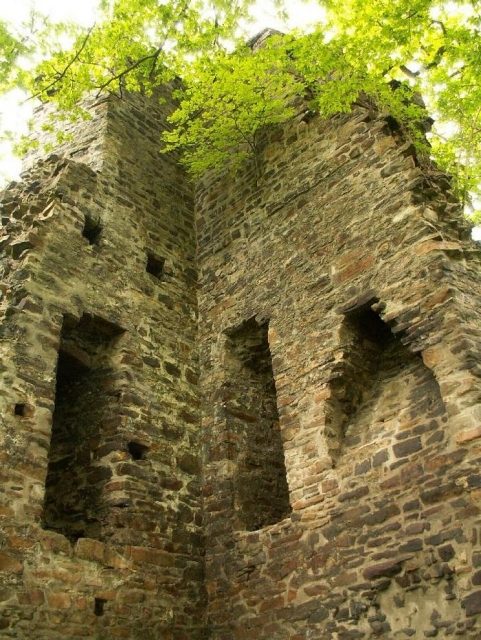
Luttelnau Castle was a knight's seat in the Ruhr valley near Essen. It is the only motte (mound castle) on this river that is at least partially preserved. The Kattenturm is the ruin of the residential tower.

The castle grounds are located on the northern bank of the Ruhr in Essen-Kettwig, at Am Kattenturm 1. The grounds are in the immediate vicinity of Oefte Castle. The owner of the ruin is the city of Essen as the legal successor of the city of Kettwig, which received the ruin as a gift from the Counts von der Schulenburg.

Lüttelnau, also written as Luthenau and Luttenau, meant as much as "small meadow". The current name Kattenturm only emerged during the 19th century and was later attributed in legendary tales to, among other things, cats and the Chatti, who are said to have guarded a treasure there.

The square tower ruin of unplastered Ruhr sandstone rises 13 meters high on a two-meter-high mound with a 25-meter diameter and has a base measuring 7.80 by 7.80 meters. Its northeastern half has collapsed, but the former three tower floors − once 16 meters high − are still clearly visible.

The preserved plinth floor has outer walls 1.70 to 1.80 meters thick and is occupied by an interior space 4.25 meters wide, 5.50 meters high, and topped by a barrel vault. The ground floor of the tower features a fireplace, a latrine, and slit windows. Above it rises the first floor with a height of about 5.20 meters and a wall thickness of about 1.35 meters.

Adjoining the tower ruin at its western corner are the remains of the former curtain wall made of rubble stone, which enclose the tower in an arc from west to east and secured it on the land side in the 14th century. On the western corner of the residential tower, a round structure, only partially preserved, with a diameter of 3.10 meters and a wall thickness of 60 centimeters, is built onto the wall remains. The remains of another annex are located at the eastern tower corner. In front of the curtain wall, the former moat is still visible as a three-meter-wide depression on the north side of the castle.

Also attested is an outer bailey belonging to the complex, which stood in a northerly direction upstream on a flat, flood-free elevation. To this day, only its location is known; no structural traces have yet been discovered.

Excavations have shown that the residential tower was built in the 13th century on an elongated Ruhr island and was only later motted. During the 14th century, the tower castle was a fief of Werden Abbey, owned by the Lords of Luttelnau, verifiable since 1296. Some publications incorrectly state that the Archbishop of Cologne, Konrad von Hochstaden, granted the complex as a fief to the knight Konrad von Elberfeld in 1260, and after the defeat of the archdiocese in the Battle of Worringen in 1288, the knight's seat, like the New Isenburg, was razed by Count Eberhard I of the Mark and subsequently not rebuilt.

However, results of the excavation in 1968 attest that construction activities took place at the small complex in the 14th and 15th centuries. Traces of fire found were interpreted by the excavator as an indication of a burned wooden palisade, which was replaced in the 14th century by a curtain wall located to the north. However, it could also have been the remains of a bridge to the no longer preserved outer bailey, which might have been destroyed during an arson attack on the Luttelnau property mentioned in 1317. In that century, the Lords of Luttelnau also had an eastern tower annex built, whose former dimensions can no longer be determined today. Possibly still in the 14th century, but at the latest in the 15th century, the eastern annex was redesigned and a round annex was added to the tower at its western corner.

After the extinction of the Lords of Luttelnau in 1417, the complex came as a fief to Heinrich von Oefte in 1424 and henceforth belonged to the property of Oefte Castle. Subsequently, it gradually fell into disrepair. Already in 1454 it is described as "desolate", and in the Werden fief register of 1573 it states that the castle was abandoned at that time ("once a castle located under the Bylstein mountain near Oefte, abandoned"). However, at the end of the 16th century, it still served the Lords of Oefte as a prison.

After the excavation, the city of Essen had stabilization work carried out on the ruin from 1969 onwards, to then open it for viewing. In February 1985, it was included in the list of municipal architectural monuments, before the area was also placed under protection as an archaeological monument in September 1992.

Take Mobile History with you

You are reading this text for free. Premium adds what matters on the road: descriptions read aloud, sites found through your camera, whole regions taken offline.

  • Every description, including the ~17,700 Premium sites
  • Audio guide: have descriptions read to you on location
  • AR finder: see sites through your camera, with distance and bearing
  • Unlimited saved sites

14 days free, then from €2.99 a month. Cancel anytime.

Location: 51.3687, 6.9612