CastleRamburg

Meistersel Castle

Meistersel Castle

The remains of the Castle can be visited

Meistersel Castle (also known as Modeneck Castle or Modenbach Castle) is the ruin of a rock castle near Ramberg in the Palatinate. It is situated on a 492-meter-high hilltop overlooking the Modenbach Valley, near the "Drei Buchen" pass on the road from Ramberg to Edenkoben.

It is one of the oldest castle complexes in the Palatinate, its name deriving from the words "Meister" (master) and "Saal" (hall) or from the term "Master of the Hall." It is therefore presumed that the ministeriales of Trifels Imperial Castle were based at Meistersel. The other name "Modeneck," however, comes from the nearby Modenbach Valley.

The castle can look back on an almost 1000-year history, as it is first mentioned in a deed of gift dated Epiphany of the year 1100 by Bishop Johann I von Kraichgau of Speyer, who handed over the castle to the diocese in that year. Its exact founding date is not yet known, but it is presumed to be in the 11th century.

At the end of the 12th century, the complex gained the status of an imperial castle and presumably served to protect Trifels Castle. During this Staufer period, the knightly family of Meistersel named themselves after it. Some of its members were mentioned several times as castle governors: in 1198, the imperial ministerialis Heinrich von Meistersele, then Siegfried von Meistersel, and Ulrich and Jakob von Meistersel. When the family died out in the male line in 1277, the castle reverted to King Rudolf of Habsburg, who around 1300 enfeoffed the Lords of Ochsenstein, an Alsatian noble family, with it.

In the middle of the 14th century, the property was divided, making the complex a Ganerbenburg (a castle owned jointly by several families). Up to eight noble families had a share in it. Among the owners in 1391 were Elector Ruprecht II of the Palatinate and from 1404, Bishop Raban von Helmstatt of Speyer.

During the German Peasants' War in 1525, Meistersel Castle was partially burned down but soon rebuilt. Only the destructions during the Thirty Years' War sealed the end of the complex. No reconstruction was undertaken, and it fell into ruin.

In 1935, the castle came into the private ownership of the Ludwigshafen manufacturer Friedrich Raschig. Until about 1995, it was managed by his community of heirs. The next owner made headlines when he tried to sell the castle in early 2006 via an internet auction house. After reports emerged that the highest bidder had close ties to the NPD, the state government of Rhineland-Palatinate declared in April 2006 that it would exercise its right of pre-emption, as a private person would be overwhelmed with the maintenance of the monument. Regardless of the subsequent legal dispute, the state began stabilization measures worth 50,000 Euros in 2009. In March 2010, the then private owner and the state of Rhineland-Palatinate reached a settlement before the Marburg District Court: the castle came into the possession of the state, which in return paid the previous owner 7500 Euros. Further costs for the renovation were determined by landscape, geotechnical, and monument preservation investigations. In August 2011, the State Real Estate and Construction Management, the State Office for Monument Preservation Rhineland-Palatinate, and the Ministry of Finance agreed on the most necessary stabilization works. In the following October, restoration work began. With these measures, the state is investing 800,000 Euros in the castle to secure it and protect it from further decay. The work is scheduled for two years, during which time the castle ruin is a construction site and access for visitors is prohibited.

Description+

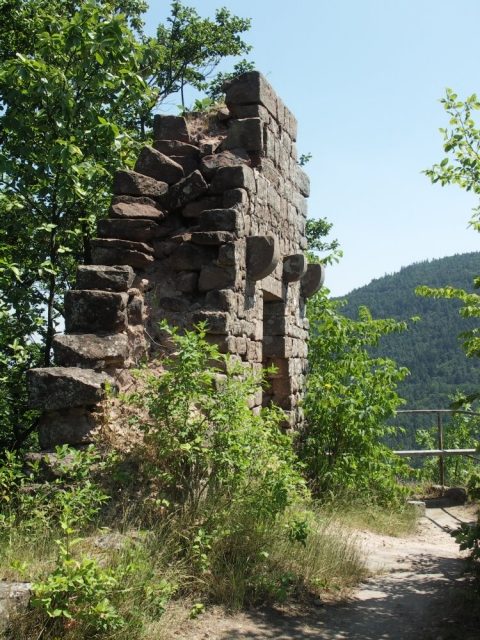
The entire complex is in a very poor condition and is at high risk of collapse. However, its preserved, impressive wall and ditch remains still reveal the former three-part division of the castle complex.

The northern outwork, surrounded by a curtain wall, is separated from the core castle by a wide neck ditch carved out of the rock. Its origins date back to the 15th century.

The core castle is divided into an upper and a lower castle. The latter formerly had an elaborate, double gate system as a connection to the outwork, of which only the inner pointed arch gate remains.

The majority of the buildings in the lower castle have now completely or almost disappeared. Only the vaulted cellar and wall remains of the so-called "stone house" still exist.

The upper castle is located on a 15-meter-high, narrow rock. It was accessible from the lower castle by a staircase hewn into the rock. A section deliberately left out during its construction was spanned by a wooden structure in earlier times, which could be destroyed in case of defense to secure access to the upper castle.

As in the case of the lower castle, the buildings of the upper castle are also only preserved in remnants. Of art-historical significance is a window niche of the Gothic palas, which features a four-part window with pointed arches of equal height, which can otherwise only be found in Alsace.

Also interesting is the construction of the castle well, whose well chamber is accessible from the upper castle by a rock staircase. Its shaft is driven through the rock from there and is also accessible from the lower castle. As an additional water supply, the upper castle had a cistern, of which some wall remains are still preserved.

From the upper castle, one has a magnificent view as far as the Rhine plain, but also of Trifels, Ramburg, and large parts of the Palatinate Forest.

Take Mobile History with you

You are reading this text for free. Premium adds what matters on the road: descriptions read aloud, sites found through your camera, whole regions taken offline.

  • Every description, including the ~17,700 Premium sites
  • Audio guide: have descriptions read to you on location
  • AR finder: see sites through your camera, with distance and bearing
  • Unlimited saved sites

14 days free, then from €2.99 a month. Cancel anytime.

Source: Wikipedia · Licence: CC BY-SA 4.0 · Image: http://de.wikipedia.org/wiki/Datei:Meistersel_Pallasrest.jpg

This description draws on the facts documented in the linked Wikipedia article; Wikipedia content is licensed under CC BY-SA 4.0. Wording and editing: Mobile History.

Location: 49.2742, 8.0241