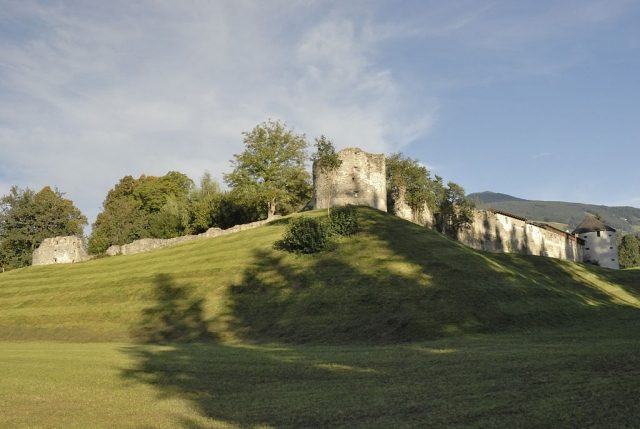
The remains of the Castle can be visited
Neu-Rettenberg Castle
Rettenberg Castle is first mentioned in 1298, but it was probably still under construction at that time, as the castle chapel, dedicated to the Blessed Virgin Mary, was consecrated only in 1302 or 1303. It was built by the Lords of Rottenburg and administered by bailiffs.
When the Tyrolean sovereign, Duke Frederick IV of Austria, around 1407, revoked the Tyrolean hereditary offices from his court master Heinrich von Rottenburg due to breach of loyalty, the latter had to hand over his two main castles, Rottenburg and Rettenberg, to him. Initially, ducal bailiffs were appointed to Rettenberg. However, Count Eberhard von Kirchberg laid claim to the castle, as he had married the widow of the Rottenburger. After two arbitrations by King Sigismund, Duke Frederick complied and gave Rettenberg to Count Eberhard as a pledge in 1419.
In 1492, Count Eberhard the Younger renounced the pledge in favor of the knight Florian Waldauf von Waldenstein. He undertook to build a new castle, as Rettenberg was already ruinous and no longer met military requirements. Waldauf had the fortress demolished and built Neu-Rettenberg Castle a little north of it. Florian Waldauf's son Hans led a lavish life and did not care about the completion of the castle. Therefore, in 1528, the pledge was revoked and transferred to Baron Oswald von Wolkenstein. He immediately had the construction work continued and, above all, the long curtain wall around the main building erected.
In 1559, Wilhelm Gienger took over the pledge. After him, the pledge holders changed quite frequently. These included Anton Baron von Landau (1582), Johann Kolowrat (1594), and the Counts Fieger (1649). In 1791, the Countesses Juliane and Justiane Fieger were able to acquire the lordship as free property. They sold the already largely dilapidated castle in 1798 to the pastor Georg Ruf from Kolsass. The residential building of the castle was completely demolished by 1914, but the curtain wall remained. In 1960, stabilization work began. The castle grounds have been used for agriculture by the Schweiger family since the end of the 18th century.
Take Mobile History with you
You are reading this text for free. Premium adds what matters on the road: descriptions read aloud, sites found through your camera, whole regions taken offline.
- Every description, including the ~17,700 Premium sites
- Audio guide: have descriptions read to you on location
- AR finder: see sites through your camera, with distance and bearing
- Unlimited saved sites
14 days free, then from €2.99 a month. Cancel anytime.
Source: Wikipedia · Licence: CC BY-SA 4.0 · Image: http://commons.wikimedia.org/wiki/File:Burg_Rettenberg,_Kolsassberg.JPG
This description draws on the facts documented in the linked Wikipedia article; Wikipedia content is licensed under CC BY-SA 4.0. Wording and editing: Mobile History.
Location: 47.2939, 11.6447