The Ruin can't be visited
Neuerburg Castle

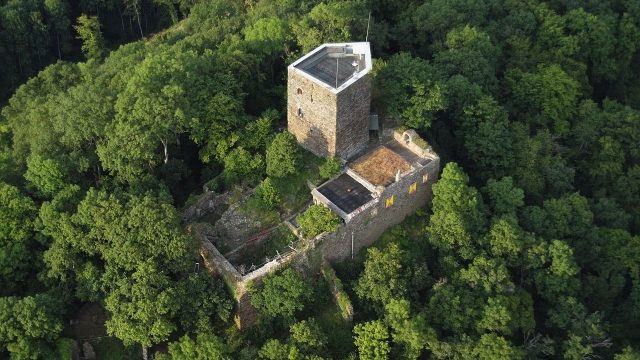
The Neuerburg is the ruin of a hilltop castle near the municipality of Niederbreitbach in the district of Neuwied in the north of Rhineland-Palatinate.
The castle ruin is located about 2.5 km east of Niederbreitbach at about 250 m above sea level on a steeply rising cliff on the left bank above the Fockenbach. The castle's jurisdiction included the villages of Hegerhof, Kelterhof, Kurtenacker, Ackerhof, Wüscheid and the western part of Kurtscheid. The castle is not accessible to hikers and interested parties.
Ludwig II of Thuringia had the Neuerburg built around the year 1170 (1160 to 1180). It is a kind of prototype of a Staufer castle.
In 1218, a noble family (ministerials) of Countess Mechthild von Sayn, who occasionally visited the castle after the death of her husband Heinrich III von Sayn († 1246/1247), named themselves after it. In 1250, she handed over the castle to the Archdiocese of Cologne. The castle itself was located in the Hunschaft Breitscheid. Two residential houses were part of it, intended for a forester, castle guards, and administrative officials. Mostly, one encounters six castle guards from Kelterhof, Kurtenacker, Ackerhof, Hegerhof, and Wolfenacker.
Since 1290, a Cologne electoral office of the same name was named after the Neuerburg, which was frequently pledged (e.g., temporarily to the Isenburg-Grenzau family and von der Leyen). The administrative area of the Neuerburg office was consistently identical to that of today's Verbandsgemeinde Waldbreitbach, with the communities of Kurtscheid and Datzeroth holding a special historical position. The administrative seat (Huhns-Mühle) was the village of Niederbreitbach until modern times.
In the 17th century, the castle began to decay. Before 1850, the remaining buildings were finally demolished by the Princes of Wied, the then and still current owners of the ruin.
During the advance of American troops in 1945, they shelled the ruin, and the castle grounds received about 60 shell hits. In the core castle, the partially preserved battlement was destroyed. One third of the shells hit the keep and its battlements. The east and south walls of the castle were razed to the ground. Reconstruction began in 1946, with the plan to make the keep habitable again.
Current Use+
Only the pentagonal keep (note: at the time a prototype of castle building art) with three preserved floors, the curtain wall (late 12th century masonry technique) and the outer bailey (around 1300) remained.
Today, the castle is still owned by the Neuwied princely family, but leased by a private individual from Niederbreitbach, who now, in the second generation, considers it her life's work to renovate the castle and protect it from further decay.
The castle is not accessible to hikers and interested parties, but an external viewing is possible. A reconstruction model can be viewed in the village museum of Niederbreitbach.
Legends and Stories+
Around the Neuerburg and the Fockenbach valley, there are many tales and legends about a monastery, a glassworks, the devil, and a legendary treasure. The life, love, and death on and around the Neuerburg are also described in these. (See literature reference)
Villages within the Neuerburg Castle's Jurisdiction+
Kelterhof - pressing wine, suggests viticulture and its processing. Near the memorial chapel, at Eppsteg, there are still remnants of the walls of the terraces where the grapevines grew. Further evidence of viticulture in the Wiedtal can be found in Farmersau, between Niederbreitbach and Bürder.
Hegerhof - tending and hunting - here stood the huts of the Neuerburg hunters, who tended the forest and its animals around the Neuerburg.
Legends and stories surround the glassworks in the Fockenbach valley, near which a plane (World War II) crashed. Nothing remains of the glassworks today. Nearby tunnels bear witness to the mining of mineral resources.
A Poem by the Princess Elisabeth of Wied+
Also known by her pen name Carmen Sylva, 1843–1916:
The Neuerburg
A singing goes through the beeches,
A ringing through the murmuring Wiedbach,
That is the echo of the songs,
Of Heinrich von Ofterdingen.
Here he sat in the forest,
Forgot the world and people
And measured his immortal throat
With the forest's singers.
I would like to dig through the walls,
Rinse the deep roots,
And ask every pebble
About its unspoken feelings.
Take Mobile History with you
You are reading this text for free. Premium adds what matters on the road: descriptions read aloud, sites found through your camera, whole regions taken offline.
- Every description, including the ~17,700 Premium sites
- Audio guide: have descriptions read to you on location
- AR finder: see sites through your camera, with distance and bearing
- Unlimited saved sites
14 days free, then from €2.99 a month. Cancel anytime.
Source: Wikipedia · Licence: CC BY-SA 4.0 · Image: http://de.wikipedia.org/wiki/Datei:Neuerburg_%28Wied%29_016-.jpg
This description draws on the facts documented in the linked Wikipedia article; Wikipedia content is licensed under CC BY-SA 4.0. Wording and editing: Mobile History.
Location: 50.5380, 7.4372