The remains of the Castle can be visited
CastleFlemlingen
Neuscharfeneck Castle
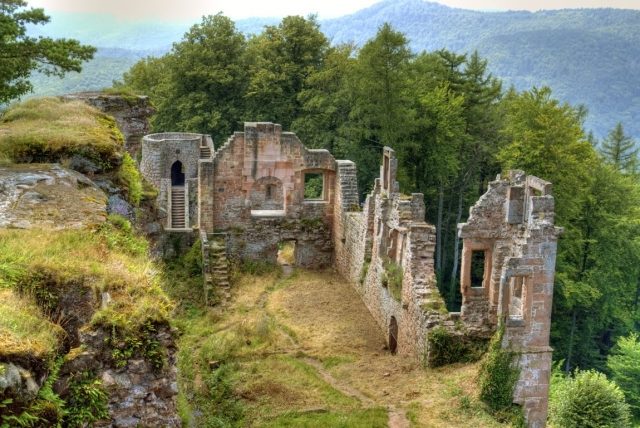
The castle ruin Neuscharfeneck, a hilltop castle in the Palatinate Forest, rises east of Ramberg and Dernbach. It is a monument of the municipality of Flemlingen.
History+
The origins of Neuscharfeneck Castle are shrouded in a 16th-century forgery claiming its construction around 1232 by Johann von Scharfeneck as an outwork for Alt-Scharfeneck Castle. In reality, the Scharfeneck-Metz family belonged to a collateral line of the older Scharfeneckers, who built Alt-Scharfeneck Castle at the beginning of the 13th century. After the main line died out around 1250, Alt-Scharfeneck passed to the Scharfeneck-Metz, but Neuscharfeneck became the main seat in the late Middle Ages, while Alt-Scharfeneck fell into disrepair. Heinrich III von Scharfeneck, who dropped the surname Metz, endowed Dernbach with a new church. The Scharfeneckers, originally imperial ministerials in the vicinity of Trifels, sought alignment with the Electoral Palatinate after the end of Hohenstaufen rule. In 1363, the Elector received the right of access to the castle, and the Scharfeneckers pledged it to him as a fief. In the 14th century, their financial situation deteriorated, leading to parts of the castle being pledged to the Knights of Kirrweiler and the Diocese of Speyer. With the death of Friedrich von Scharfeneck in 1416, the castle fell to the Wittelsbach Electors. Elector Friedrich I extensively expanded the castle, creating the outer bailey, the shield wall, and a large residential building.
Source: Wikipedia · Licence: CC BY-SA 4.0 · Image: Dr. Gebhard Gaukler
This description draws on the facts documented in the linked Wikipedia article; Wikipedia content is licensed under CC BY-SA 4.0. Wording and editing: Mobile History.
Location: 49.2527, 8.0218