CastleSchramberg

Ober-Falkenstein Castel
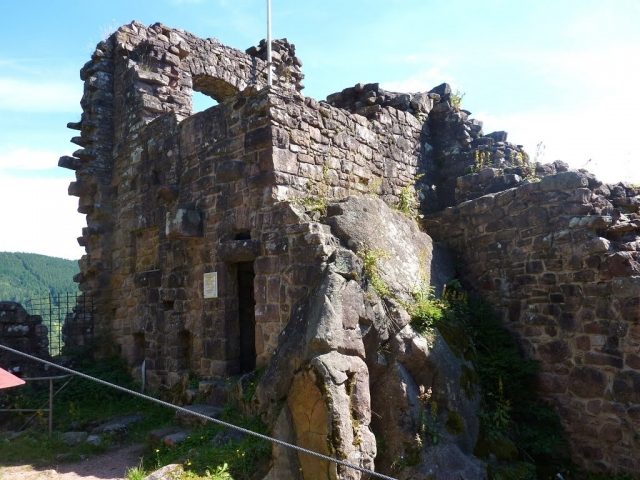
Ober-Falkenstein Castel

The remains of the Castle can be visited

Falkenstein Castle Ruin is the ruin of a hilltop castle in the Berneck Valley south of Schramberg, in the district of Rottweil, Baden-Württemberg, Black Forest.

A local noble family from the village of Kappel (Niedereschach), near Villingen-Schwenningen, built the castle here in the 11th century. Near the castle, Duke Ernst of Swabia and his companion and friend, Werner von Kyburg, fell on August 17, 1030.

In 1250, the Lords of Falkenstein bought the neighboring Ramstein Castle.

At the beginning of the 14th century, the Falkenstein family split into the lines Falkenstein zu Falkenstein and Falkenstein zu Ramstein.

In the Middle Ages, the Lords of Falkenstein had strong influence as abbots, canons, and cathedral canons in Strasbourg and in the monasteries of St. Georgen, Reichenau, St. Gallen, and Einsiedeln.

The Lords Jakob and Konrad von Falkenstein sold the castle, as well as a large part of their possessions, to Count Ludwig of Württemberg between 1444 and 1449.

In the middle of the 15th century, Hans von Rechberg acquired Falkenstein and Ramstein castles, had Hohenschramberg Castle built, and thereby founded the Lordship of Schramberg. Falkenstein Castle was destroyed in 1491. In the 19th century, the castle was bought and renovated by Kommerzienrat Arthur Junghans.

Today, the castle ruin is maintained by the Falkenstein Citizens' Association.

Layout+

The castle consists of three parts: the outer bailey, a residential tower, and the main castle.

The outer bailey, of which remnants of walls remain, protected the castle from the valley side. Between the outer bailey and the main castle lies a neck ditch, through which an old staircase leads to the outer bailey. In the main castle, the remains of the palas can be clearly traced.

The Falkenstein Chapel

The chapel stands in the valley below the castle on the other side of the valley.

In 1275, a parish of Valkenstein was first mentioned in documents of the Diocese of Constance. It was a proprietary church under the patronage of Saint Erasmus, belonging to the Lords of Falkenstein and Ramstein.

During the Thirty Years' War, the chapel was destroyed in 1634 by fighting between Swedish and Württemberg troops. Reconstruction began in 1713. In the middle of the 18th century, the chapel was consecrated by Suffragan Bishop Johann von Fugger from Constance. Until 1787, the chapel belonged to the parish of Lauterbach and was a locally important pilgrimage site.

From 1860–1863, a family crypt was established in the Falkenstein Chapel as the hereditary burial site of the Counts of Bissingen and Nippenburg.

The so-called Falkenstein Lamentation is a lamentation group from 1515 standing in the choir. It is a work of late Gothic art by the sculptor Conrad Rötlin from the former imperial city of Rottweil. It is considered one of the most beautiful lamentation groups in Southern Germany. Stained glass windows were created by Professor Otto Linnemann from Frankfurt, documents in the Linnemann Archive.

Take Mobile History with you

You are reading this text for free. Premium adds what matters on the road: descriptions read aloud, sites found through your camera, whole regions taken offline.

  • Every description, including the ~17,700 Premium sites
  • Audio guide: have descriptions read to you on location
  • AR finder: see sites through your camera, with distance and bearing
  • Unlimited saved sites

14 days free, then from €2.99 a month. Cancel anytime.

Source: Wikipedia · Licence: CC BY-SA 4.0 · Image: Joachim Schneeleopard

This description draws on the facts documented in the linked Wikipedia article; Wikipedia content is licensed under CC BY-SA 4.0. Wording and editing: Mobile History.

Location: 48.2129, 8.3808