CastleBischofsheim an der Rhön

Osterburg Castle
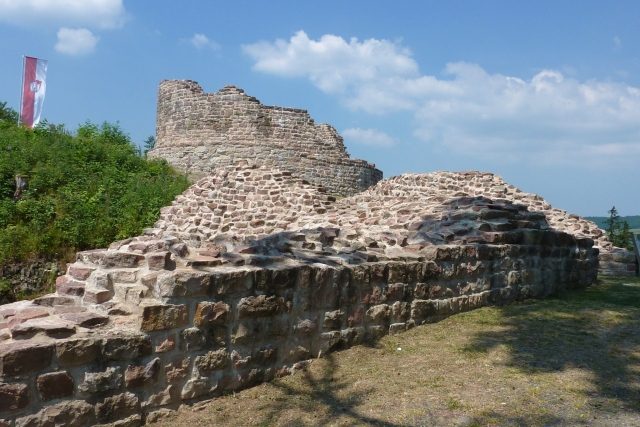
Osterburg Castle

The remains of the Castle can be visited

The Osterburg is the ruin of a hilltop castle near Bischofsheim an der Rhön in the Lower Franconian district of Rhön-Grabfeld in Bavaria. It is said to have once been a "proud castle" that "looked far into the land."

Its name, derived from the pagan spring goddess "Ostara," points back to pre-Christian antiquity. Originally, it is said to have been a Celtic refuge castle, which passed to the Germanic tribes around 1000 BC. From the Osterburg, there is visual contact with the Kleiner Gleichberg and the Kreuzberg, where Celtic refuge castles also stood. It could also have been a Merovingian or Carolingian fortress.

When the Franks were landowners in the 6th century, a hunting lodge for the Frankish king is said to have stood there. After the Salzforst became the property of the Würzburg prince-bishops, the castle is said to have secured the land against the predatory Fulda prince-abbots.

Around 1200, a Reinhold von der Osterburg was mentioned. In 1217 and 1230, an Engelhard von Osterburg appeared as a witness in documents. In 1231, a Boto von Eberstein had received a farm at the Osterburg as a fief.

When Bischofsheim with its castle was expanded into a strong bulwark in the 12th century, the Osterburg is said to have lost its importance. The castle, whose owners were constantly feuding with Abbot Bertho II, was probably destroyed around 1270 during the destruction of Bischofsheim by the Fulda abbot. Since that time, there have been no more records.

Around 1600, during border disputes over grazing, wood, and hunting rights between Bischofsheim, Haselbach, and Frankenheim, the Osterburg was mentioned as a heap of rubble.

In 1875, Anton Schumm wrote in the history of the city of Bischofsheim that hardly a trace of a former castle was visible. The Kreuzberg monastery is said to have been built from its stones.

In 1928, the Rhönwacht (the magazine of the Rhönklub) reported: "Besides the Zentturm, the ring walls of the city of Bischofsheim, which was first mentioned in documents in 1291, were also made from the stones of the Osterburg. So wall after wall disappeared, and since the construction also served as a quarry for the Haselbachers and Frankenheimers, the demise of the castle was sealed." Over time, the forest has overgrown the heap of rubble.

In 1897, during the construction of a timber transport road, the remains of the former castle walls were discovered, and the then forest master Fuchs had the purely Romanesque castle ruin, which was 114 meters long and 70 meters wide, excavated. Such a mighty castle could not be defended by a single knight; three to four knights lived simultaneously within the castle ring in separate courtyards. Artifacts from the excavations are located in Bischofsheim in the Osterburg collection.

In 1909, the keep was converted into an observation tower. Ten years later, it was blown up again because climbing it had become life-threatening.

Description+

Only with imagination can the outline of the former mighty castle complex be recognized in the remains of the dilapidated castle ruin. Its history poses many riddles; most reports are secured with "it is said."

Stairs and walls are still present. The forest has taken possession of the former castle area.

Legends about the Osterburg+

Origin of the Osterburg

In ancient times, a farmer lived on the Kreuzberg. His servant went home at night and strayed from the path. He suddenly found himself in a dark passage and groped his way forward. A dwarf stepped into his path and said: "Search diligently, and you will find an old chamber with precious treasures." The servant soon discovered a hidden room with immeasurable treasures. Then the dwarf stood there again and said: "Carry all these treasures out, they belong to you." The servant did so, and thus he was redeemed. At that spot, the lucky finder built the Osterburg and was the first knight.

Destruction of the Osterburg

One of the enemy knights rode to the nearby Arnsberg. Lost in thought about how the stubborn castle could finally be brought down, his horse suddenly startled him. It stamped so violently that the ground sank from the hoofbeat, and the underground water pipe to the Osterburg became visible. Now the enemies cut off the water supply to those besieged in the castle, forced them to surrender, and destroyed the castle down to a few ruins.

The Maiden on the Osterburg

When a long wisp of fog rises from the forest of the Osterburg, people in Bischofsheim are said to have said: "The maiden is crying again." For the beloved of a castle maiden is said to have been killed in a fight with a merchant who had been ambushed by Osterburg residents. When the girl received this news, she is said to have cried so much that the water ran down the Osterburg mountain. The maiden is said to have been seen by nocturnal visitors to the Osterburg.

The Treasure on the Osterburg

On the Osterburg, a maiden in a white gown appears here and there. As she passes, she tells the startled wanderer about a great treasure that lies in the vaults of the ruined castle. If a person succeeds in lifting this treasure, then the maiden is redeemed and will no longer appear.

A shepherd could have found the treasure. It was long ago when he herded his sheep on the Osterburg, for at that time much grass still grew there. Suddenly, the shepherd saw an open gate that had not been there before. He went through the gate and entered a long passage. Then a loud voice called out: "Shepherd, the sheep are getting through." He hurried back. The sheep grazed undisturbed. He turned around, but no gate was to be found, no matter how long he searched.

The white maiden is said to have been much more gracious to a girl. Pauline once herded her cows on the Osterburg and knitted while doing so. The ball of yarn rolled down a staircase. She hurried after the ball of yarn and came into a large cellar. Inside were many mighty tubs, all filled with knotten (knotten are flaxseeds). Pauline filled her apron with knotten, picked up her ball of yarn, and hurried back. On the way home, she sowed some of the knotten along the roadside. When the girl showed the small remainder at home, they were all gold pieces.

Friends of the Osterburg+

Since 2005, there has been the "Friends of the Osterburg" association. Together with the city of Bischofsheim and the Bavarian State Office for Monument Preservation, the ruin is being re-excavated. Subsequently, the remaining walls are to be secured to preserve the substance. When this project is completed in a few years, the true age of the castle ruin can be proven.

Take Mobile History with you

You are reading this text for free. Premium adds what matters on the road: descriptions read aloud, sites found through your camera, whole regions taken offline.

  • Every description, including the ~17,700 Premium sites
  • Audio guide: have descriptions read to you on location
  • AR finder: see sites through your camera, with distance and bearing
  • Unlimited saved sites

14 days free, then from €2.99 a month. Cancel anytime.

Source: Wikipedia · Licence: CC BY-SA 4.0 · Image: Joachim Schneeleopard

This description draws on the facts documented in the linked Wikipedia article; Wikipedia content is licensed under CC BY-SA 4.0. Wording and editing: Mobile History.

Location: 50.4001, 9.9819