CastleGroßgmain

Plainburg Castle

Plainburg Castle

The remains of the Castle can be visited

The Plainburg, also known as Salzbüchsl, in Großgmain in the federal state of Salzburg, is one of the oldest castle ruins in Austria. The castle ruin is located about 1.5 km (by road) from the center of Großgmain, overlooking the Gmainer Valley (with views of Großgmain and Bayerisch Gmain).

It is assumed that a Roman castellum was already located at the current site earlier - however, it is certain that the mountain served as a burial site for the Celts around 1200 BC.

In 1108, Comes Werigandus de Playen, who had at least built the inner courtyard and the gatehouse around 1100, is named as the builder in an imperial document. Around 1140, the Plainburg is first mentioned in a document as Plagien Castrum and served the Plainers until their demise (death of Otto II and Konrad III in 1260). It is not clear whether the current walls around the outer bailey were built by the Plainers themselves or only later, but it is certain that these walls show a different, somewhat sloppier construction method - the current state of preservation is much worse. In 1292, the castle became the property of the Archbishopric of Salzburg and then served the Prince-Archbishops of Salzburg as a country fortress and defense point for the salt trade routes between the Bad Reichenhall salt counts and Salzburg. Between 1470 and 1800, significant structural changes (primarily of a military nature) were made to the castle. In 1620, the castle complex was restored by Archbishop Paris von Lodron. In 1674, the gate between the inner and outer bailey received its current Gothic appearance; the coat of arms - which is placed above this very gate - comes from Archbishop Max Gandolf Freiherr von Kuenburg.

In 1796, the last soldier left the fortress; the subsequent decay could not be stopped by either King Ludwig I or Prince Otto von Bismarck.

The only tactically unfavorable point of the castle is the east side with the gatehouse. However, this shortcoming was compensated by a cleverly designed path that steeply approaches the gatehouse in two long curves - with the last section designed so that an attacker must always turn his right side (usually unprotected by a shield) towards the castle.

In the 1970s, during structural securing work on the gatehouse, the uppermost floor was removed, revealing the walled-in skeleton of a child. The discovery of the skeleton overlaps with an old tradition (of course, this legend does not necessarily have to be related to the actual walled-in child; building sacrifices were not uncommon in the Middle Ages and early modern period): The legend tells of an early Plain count whose child was abducted. At an invitation by Wetzel von Glanegg, he was finally presented with a dead child for the feast - the count recognized it as his own and had it walled into the Plainburg.

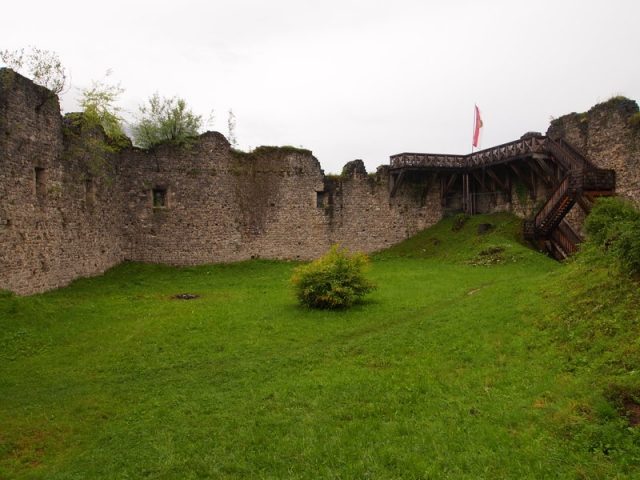
Only the outer walls, over five meters high and on average about 1.45 meters thick, the inner courtyard, and the entrance area with the gatehouse remain of the Plainburg.

Today, the castle ruin with its viewing platform and wide vista is a popular excursion destination. The ruin is accessible all year round between 9 AM and 7 PM, but the inner courtyard is closed in winter. Admission is free.

Take Mobile History with you

You are reading this text for free. Premium adds what matters on the road: descriptions read aloud, sites found through your camera, whole regions taken offline.

  • Every description, including the ~17,700 Premium sites
  • Audio guide: have descriptions read to you on location
  • AR finder: see sites through your camera, with distance and bearing
  • Unlimited saved sites

14 days free, then from €2.99 a month. Cancel anytime.

Source: Wikipedia · Licence: CC BY-SA 4.0 · Image: http://www.wehrbauten.de/thread.php?threadid=1491

This description draws on the facts documented in the linked Wikipedia article; Wikipedia content is licensed under CC BY-SA 4.0. Wording and editing: Mobile History.

Location: 47.7254, 12.9208