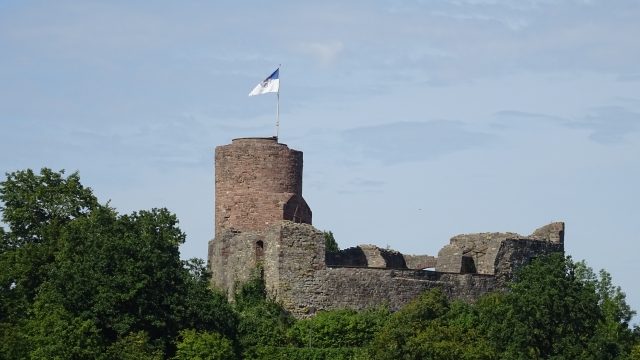
The remains of the Castle can be visited
Polle Castle
Polle Castle Ruin is the ruin of a hilltop castle on a rock outcrop about 25 m high directly on the Weser river above the municipality of Polle in the district of Holzminden in Lower Saxony.
First documented in 1285 as "Everstein Castle", the complex was the seat of the Counts of Everstein. It was also referred to as "Everstein Castle near Polle", but is not to be confused with Everstein Castle, located about 10 km south in the Burgberg mountain range.
The castle is majestically situated on a rocky elevation east of the Weser near a prominent river bend. The summit drops steeply on three sides as a cliff. The castle complex consisted of an upper castle and a lower castle, of which essentially only remnants of the curtain wall remain. From the upper castle, there are remnants of several buildings and wall remains of the gate tower, as well as the outer walls of the residential buildings. Furthermore, there is still an approximately 20 m high, climbable round tower, which served as a watchtower and keep. An underground passage leads from it to the castle well. Previously, the castle was additionally secured with walls, partly with double moats and drawbridges, as well as ramparts. The ruin can be visited.
The construction date of Polle Castle is presumed to be around the year 1200. It is considered one of the ancestral castles of the Counts of Everstein. At the time of its first documented mention in 1285, it was the seat of the Counts of Everstein, who, as supporters and relatives of the Staufer, had lost their Everstein Castle near Amelungsborn Monastery to the Welfs in 1284. In 1407, Henry I, as Duke of Brunswick-Lüneburg, captured Polle Castle in the course of the Everstein Feud with a force of 13,000 men. In 1408, Count Hermann VII of Everstein surrendered his county to the Dukes of Brunswick, so that Polle Castle also definitively fell to the Welfs.
During the Thirty Years' War, Field Marshal Tilly besieged Polle Castle and plundered it after its conquest in 1623. The town of Polle also suffered damage. In 1641, Swedish troops shelled the castle with their cannons, causing it to burn down. The castle was not captured by the Swedes. After the end of the war, the lower castle was rebuilt from 1656, while the upper castle was left as a ruin. During this time, an official residence in the Weser Renaissance style was built in the lower castle, which was destroyed during the heavy fighting around Polle at the end of the Second World War. Only the coat-of-arms-decorated Renaissance portal of the building has been preserved.
From 1984 to 1988, extensive renovation of the castle complex took place. Between 2007 and 2009, archaeological excavations were carried out on the castle grounds, the finds of which are located in the castle museum. Several times a year, cultural events take place in the castle courtyard, including performances of the fairy tale Cinderella, as Polle is the attributed "home" of Cinderella.
Take Mobile History with you
You are reading this text for free. Premium adds what matters on the road: descriptions read aloud, sites found through your camera, whole regions taken offline.
- Every description, including the ~17,700 Premium sites
- Audio guide: have descriptions read to you on location
- AR finder: see sites through your camera, with distance and bearing
- Unlimited saved sites
14 days free, then from €2.99 a month. Cancel anytime.
Location: 51.8974, 9.4071