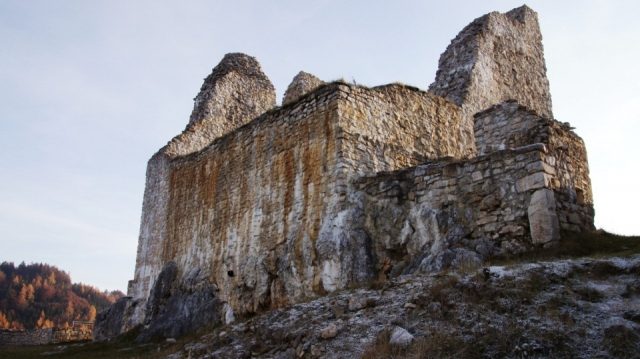
The remains of the Castle can be visited
Rabenstein Castle

The Rabenstein castle ruin is the ruin of a rock castle 300 m above the market town of St. Paul in Lavanttal, on a 691 m high rocky hill sloping on three sides. The castle was built starting in 1091. It fell into ruin after a fire in 1636. The preserved remains of the castle were secured starting in the late 20th century.
Before Rabenstein Castle was built, a fortified observation tower for the then Lavant Castle was located at this spot. When Engelbert I, Count of Spanheim, founded St. Paul's Abbey in 1091, the tower was expanded into a castle, which was intended to serve as protection for the abbey. After Engelbert's death in 1096, the castle passed to his son Siegfried II, Count of Lebenau.
The local noble family called themselves Ramenstain. The last of this lineage died out with Albertus de Ramenstain in 1200. Following the marriage of Ulrich von Peggau-Pfannberg († 1249) to the last Lebenauer, the castle came into the possession of the Counts of Pfannberg. Over time, the lords of the castle changed. However, they usually had one thing in common: they were often in dispute with St. Paul's Abbey.
Duke Henry VI of Carinthia claimed the Bohemian royal crown after the death of Wenceslaus III in 1306 and Rudolf in the following year. However, this was not in the interest of Emperor (Duke) Albrecht I. He had the castle besieged and finally destroyed by Otto von Weizzeneck in 1307, as the lords of Rabenstein did not want to hand it over to Albrecht. Albrecht ceded the property to the Bishop of Salzburg, Konrad IV von Fohnsdorf, whom he consulted as an advisor. The bishop immediately had the castle rebuilt and expanded. Finally, he enfeoffed Burkhard II von Vanstorf with the castle.
Emperor Frederick III bought the castle complex in 1461. When the Ottomans burned down the market town of St. Paul in 1476, the castle remained completely unharmed. Emperor Maximilian I inherited the property from his father. He sold it in 1514 to Franz von Dietrichstein zu Weichselstädt. His son, Seyfried von Dietrichstein zu Weichselstädt, had the castle expanded into a Renaissance palace in 1567. The fortress remained in the possession of the noble family for the next 60 years.
After Rabenstein Castle temporarily passed into princely possession, it was sold to Johann Ulrich, Prince of Eggenberg. He, in turn, sold Rabenstein back to St. Paul's Abbey in 1629, under the then Abbot Hieronymus Marchstaller. Marchstaller had the chapel, mentioned in documents in 1240, baroque-styled. The newly designed chapel was consecrated four years later. In 1636, the castle fell victim to a major fire. This was an arson, with Abbot Marchstaller suspected as the instigator. Rabenstein Castle was not rebuilt thereafter.
After the dissolution of the abbey by Joseph II in 1787, the possessions, including the castle, passed to the state's religious fund. In the 19th century, the Rabenstein estate finally came into private ownership.
Construction Description+
Parts of the 11th-century fortress, up to three stories high, and the heavily damaged castle wall from the 12th and 13th centuries are still visible today.
At the highest point of the steeply sloping rocky hill is the keep, which was built in 1307. The palas and other buildings adjoin the keep to the south. Remains of the castle chapel are still recognizable, as is the semicircular barbican to the north.
Over the years, the castle wall was almost completely removed, as the stone was used as building material for the surrounding buildings. It was a double-shell masonry, the outer shell of which has been largely destroyed by weathering.
The complex was renovated from 1997 to 2002 with the help of the market town of St. Paul, the Public Employment Service, the State of Carinthia, and the Federal Chancellery.
Take Mobile History with you
You are reading this text for free. Premium adds what matters on the road: descriptions read aloud, sites found through your camera, whole regions taken offline.
- Every description, including the ~17,700 Premium sites
- Audio guide: have descriptions read to you on location
- AR finder: see sites through your camera, with distance and bearing
- Unlimited saved sites
14 days free, then from €2.99 a month. Cancel anytime.
Source: Wikipedia · Licence: CC BY-SA 4.0 · Image: http://www.wehrbauten.at/ktn/kaernten.html
This description draws on the facts documented in the linked Wikipedia article; Wikipedia content is licensed under CC BY-SA 4.0. Wording and editing: Mobile History.
Location: 46.6888, 14.8721