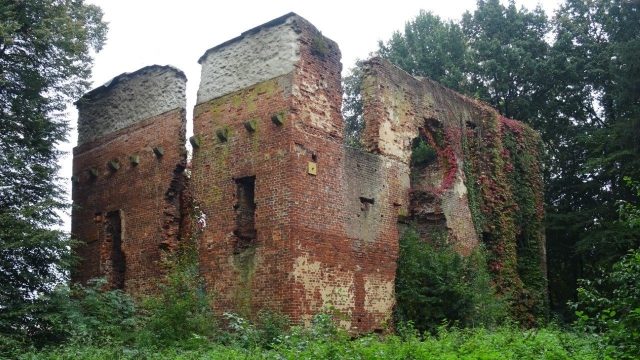
The remains of the Castle can be visited
Rahden Castle
Rahden Castle is a former moated castle in the town of Rahden in the district of Minden-Lübbecke.
The castle ruin is located in the Kleinendorf district near the Große Aue. It was originally built to protect several trade routes that crossed the Große Aue via a ford. Today, only a ruin remains of it.
The castle was first mentioned in a document in 1296. Between 1310 and 1320, Rahden Castle was rebuilt or expanded. In 1320, Hardecke von Engelingborstel is named as Drost (bailiff) of Rahden Castle. Rahden Castle was one of five regional castles built by the Bishop of Minden for protection against the Counts of Diepholz and Hoya. Other regional castles included Reineburg near Lübbecke, Schalksburg in Hausberge, Schlüsselburg Castle in Petershagen, and Petershagen Palace.
Rahden Castle was repeatedly pledged; for example, from 1391 to 1395, the von dem Bussche family held the castle as a pledge. In 1431, the Bishop of Minden's troops destroyed the castle, and in a dispute with a pledge holder, the Bishop of Minden again had the castle and the town of Rahden burned down in 1591 to force its surrender.
Rahden Castle was abandoned as an official administrative seat in 1711, with administrative duties being carried out from the "New Amtshaus" (New Administrative Building), which was located approximately in the area of today's Rahden Palace. In the winter of 1878, Rahden Castle burned down, with only the remains of the current ruin surviving the fire.
Buildings+
The extent of Rahden Castle was investigated in 1969 through trial excavations by the Rahden local historian Heinrich Bretthauer. The entire building complex measured approximately 63 x 53 meters. The castle had a moat fed by the Große Aue. Access was via a drawbridge from the south, over today's Lemförder Straße. The castle consisted of the palace (the current ruin of the main building), a horse stable, a gatehouse, and a connecting building. A mighty keep was attached to the main building. Towers were also present on the north and south sides towards the entrance. The extent of the buildings can still be recognized today; during the trial excavations, the dimensions were marked by boulders, which can now be seen in the area of the local heritage park and museum farm.
In the early 1980s, members of the Rahden local heritage society recovered an old, stone lintel with an inscription from the ruin. It was placed in front of the ruin. The inscription commemorates the 59th Bishop of the Prince-Bishopric of Minden, Duke Christian zu Braunschweig und Lüneburg, who lived from 1566 to 1633. The lintel was probably installed in the castle in 1619.
In the 1990s, measures were taken to stabilize the castle ruin. Mighty steel girders and tension rods were installed in the ruin to prevent it from breaking apart. However, even today, one can see that the north wall of the ruin, with its half-timbered supports, is dangerously leaning to the side. On the occasion of the activities for the 975th anniversary of the town of Rahden in 2008, the ruin was cleared of extensive vegetation. This also made details of the ruin more visible.
Take Mobile History with you
You are reading this text for free. Premium adds what matters on the road: descriptions read aloud, sites found through your camera, whole regions taken offline.
- Every description, including the ~17,700 Premium sites
- Audio guide: have descriptions read to you on location
- AR finder: see sites through your camera, with distance and bearing
- Unlimited saved sites
14 days free, then from €2.99 a month. Cancel anytime.
Source: Wikipedia · Licence: CC BY-SA 4.0 · Image: Jörg Heldt
This description draws on the facts documented in the linked Wikipedia article; Wikipedia content is licensed under CC BY-SA 4.0. Wording and editing: Mobile History.
Location: 52.4377, 8.5964